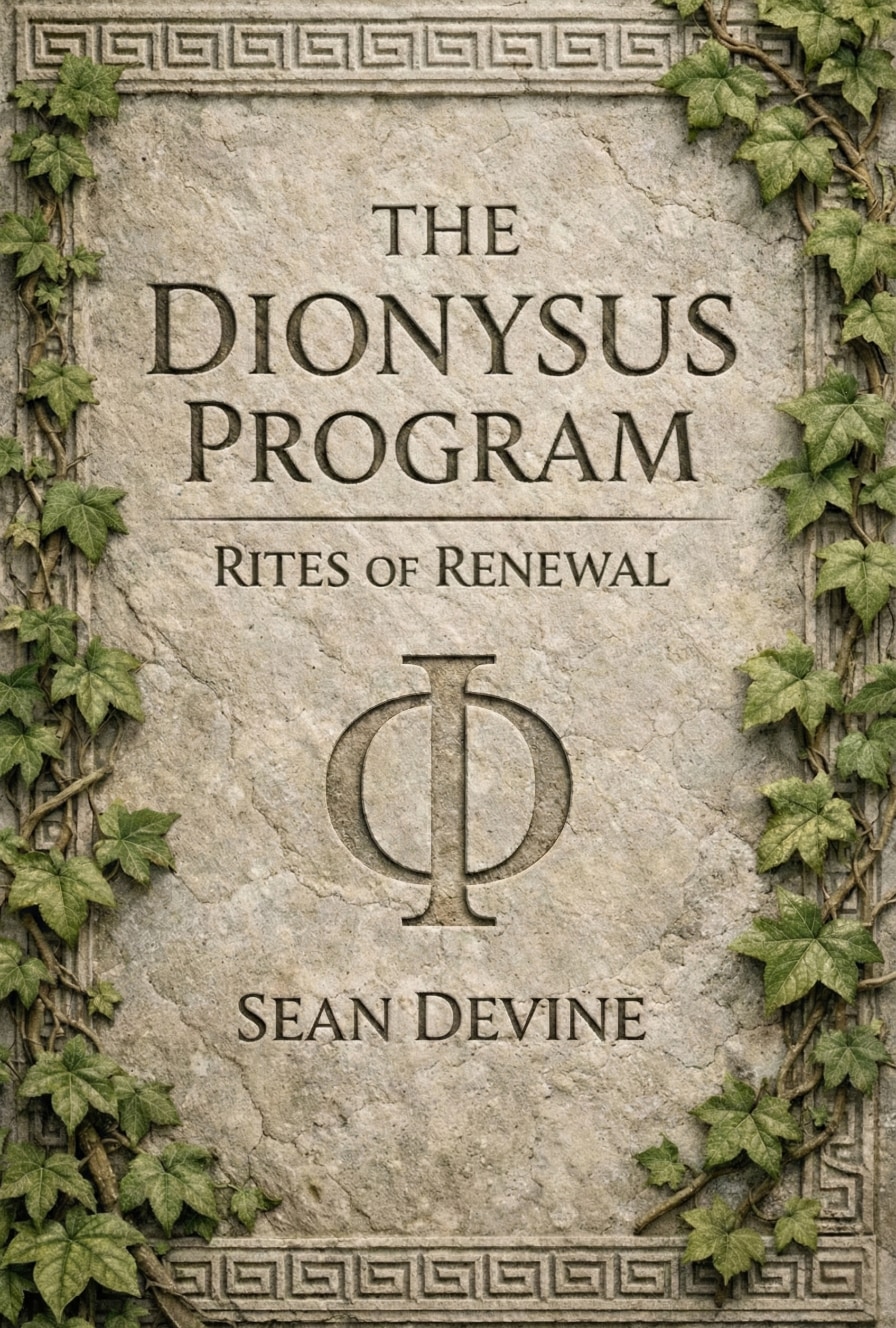
To Esthergen.
About the Author
Sean Devine is the Founder and CEO of XBE, a business operations platform for heavy materials, logistics, and construction. He founded XBE in 2016 with no construction-industry experience and no venture capital, and built it into a profitable software business with strong retention, serving tens of thousands of users across more than 100 customers, and growing to a global team of more than 100. In January 2024, he sold the majority of XBE to Banneker Partners and remained CEO and a significant shareholder. Since the transaction, he has continued to run the company while maintaining growth through a combination of organic product development and M&A, leading the acquisitions and integrations of BCMI, Gauge, and PriceBee.
His work has spanned entrepreneurship, operations, leadership, software development, and strategy, with a continuing interest in reducing the need for specialization.
Before founding XBE, he co-founded Partage in Chicago. Partage pioneered self-service spot freight brokerage by automating pricing and booking for partial- and full-truckload freight ahead of where the market would later move. In 2015, Partage’s software was acquired by TTS and its brokerage operation was acquired by MGN Logistics.
From 2006 to 2010, he held multiple roles at Con-way, including Vice President of Pricing and Engineering at Con-way Freight, where he was responsible for Strategy Management and led the rollout of Lean Six Sigma as the company’s continuous improvement operating system during the Great Recession. He also served as Chief Procurement Officer and Vice President of Engineering at Con-way Inc.
He attended Babson College from 1996 to 1999, where he studied Finance and Entrepreneurial Studies.
He also invests in businesses where his operating experience can contribute.
He grew up in Albany, New York, and lives in San Francisco, California, with his wife, Theresa, and their two youngest daughters.
He’s @barelyknown on X.
About the License
The transition from alchemy to chemistry was not a leap in human intelligence; it was a change in protocol. Alchemists hoarded knowledge, encoding their findings in metaphor to prevent theft. As a result, their discoveries often died with them. Chemistry became a science only when the Royal Society enforced a new standard: Nullius in verba (“take nobody’s word for it”). They demanded that methods be published, replicated, and critiqued in public. Knowledge was transformed from a private hoard into a public object.
The Dionysus Program is released under a Creative Commons Attribution-NonCommercial-NoDerivatives 4.0 International License in the same spirit.
Making the text available also makes it easier to criticize and improve.
The program should be subject to the scrutiny it recommends. To that end:
- Quote and share freely. The text is designed to travel.
- Criticize in public. If you disagree, do so in the open. The program requires friction to remain honest.
- Patch the code. If you find errors—in logic, phrasing, or explanation—please submit a pull request on GitHub.
A Note on the Print Edition
A print edition is available for readers who prefer a physical book or want to give a copy to someone else.
The digital edition remains free.
Foreword
A good book can make you smile or make you think. But only great books change who you are and what you’re capable of.
The Dionysus Program can inject a new worldview. Not just at the surface level of your observations, but to transform you into a person who can thrive in an ever-changing world with grace.
A talent I seem to have is recognizing genius in others. Charlie Munger’s line “the best thing a human being can do is to help another human to know more” sat well with me. So I take particular pleasure in identifying brilliant people, important ideas, and promising companies—then shining a spotlight on them.
This has been the pattern throughout my hodgepodge career. Writing books to curate the genius of Naval Ravikant, Balaji Srinivasan, and Elon Musk. Investing in founders who start in obscurity and rise to command thousands of people and billions of dollars in capital. Just noticing genius, and supporting it.
There are no good people and bad people. There are simply people—some with good ideas installed, and some with bad ideas installed. There is virtue in knowledge, and evil in ignorance.
We can see humanity’s growth over thousands of generations, from animals to civilization, as an accumulation of more and more good ideas. The idea to use fire, to create a system of writing and numerals. The ideas of forgiveness, democracy, and computers. Recognizing a good idea and spreading it to others is the most fundamental human action. (Perhaps aside from some biological necessities and, of course, procreation.)
Sean Devine is full of good ideas. And he has been hiding from the spotlight for far too long. It is my pleasure now to shine my small light on his brilliance and his ideas in the hope that they might benefit you, spread, and benefit humanity.
Most people who engage with philosophy do so at a safe distance. They read, they discuss, they admire ideas, the way one admires a painting in a museum. They know the names, they can quote the famous lines, but they keep their hands in their pockets. The ideas remain fundamentally separate from daily life.
Many people read Deutsch, Taleb, Girard, Nietzsche. Only a few people really understand them. And even fewer people change how they live based on what they learn.
I’ve known Sean Devine long enough to know he is uncommonly fluent in counterintuitive ideas. He gets a flash of inspiration and then—quickly—tries something new. Then he observes, learns, and runs a new experiment. He plays with big ideas, testing them against reality. Always moving forward.
What has always impressed me about Sean is not just his intellectual range, but his insistence on integration. True inquiry is not a lighthearted hobby; it is a means of understanding reality. Practice is not thoughtless repetition; it is the proving ground of new ideas. Sean moves fluently between the ideation and application, closing the loop. Hard and fast.
What you’re reading will help you do the same.
You are about to learn the secret formula to Sean’s success. What he himself did not even know he was discovering, until after he discovered it. What took over a decade of building, collecting a brick at a time through intuition, until looking up and realizing he’d built a cathedral.
The Dionysus Program emerged suddenly (almost overnight in book-writing terms) after years of organic discovery.
Sean has crafted an incredible career across many domains and disciplines. He rose through the ranks of a large organization, becoming a young executive in strategy at a public company. Then, he went into the wild and reinvented himself, teaching himself to code and bootstrapping a software company. As that company grew, he built a team, brought on capital partners, and integrated acquisitions. He carefully, quietly, built a powerful and profitable company in his niche, stitching together people and teams from across cultures, companies, and continents.
His success is well-rounded, as I’ve gotten to know his family and friends as well. Sean is one of those people who seems to be “winning at life”. He’s a non-stop stream of positive energy, good ideas, and generosity.
He doesn’t seem to take himself too seriously. I expect this is because he deeply understands the need to continually destroy and rebuild your “self” (whatever that happens to be). And it’s much easier to destroy yourself if you can laugh about it.
The Dionysus Program is just that simple idea, of destruction and iteration, explained as thoroughly as possible, applied at all levels of society. In this book, Sean gives you every tool in his toolbox for understanding—and using—his guide to destroying bad ideas without destroying relationships, cultures, or companies.
There are robust explanations. There are new vocabulary words. There are myriad mythical references. There are equations, charts, and algorithms. There are archetypes. And, in a stroke of brilliant originality, there is even a “comment section” where we hear the simulated critiques of many great thinkers who are featured in this book.
This is a book to be engaged with and digested. That may take time. Readers learn new concepts and definitions, then apply them throughout the book. You just have to take the time to “install the software.” Sean recommends (and I found it extremely helpful) to read this with an AI companion open next to you, asking questions, expanding definitions, and getting reminders. The brain should stretch and strain as it takes on new ideas.
This is also a book to be applied, not simply observed. There are recipes in here. Instructions for meetings, for conversations, and for reflection. Use them! As David Senra is right to repeat, “Learning is changing your behavior.” Then bring back what you learn, and help improve this text. If you find errors, correct them. If you see omissions, add them. If you see something extraneous, cut it out.
The book is itself a living system, trying to teach you about a living system. It’s complicated, I know. But life is complex, and we must not look away from the truth of the universe.
As Sean shows us, this is the process of life: theory and experiment; mutation and selection; innovation and selection; conjecture and criticism. What determines our success as individuals, families, companies, countries, and a species relies on our ability to handle this process well. Destroying ourselves, humanely, so that we become ever better.
This is the promise of The Dionysus Program well-applied. That you become ever-better. And that is all any of us can dream of being.
— Eric Jorgenson
Preface
My early success did not scale. It relied too much on personal intensity—on being smart, working hard, and tolerating pain. Those are anti-social strategies in the long run. They ask too much of other humans. They burn trust. They create brittle organizations.
For the first half of my career, I lived inside the Apollo virtues. I learned to improve systems and processes the honest way: go to the floor, name the constraints, measure the flow, remove the waste, repeat. At Con-way, during the Great Recession, I helped build and roll out Lean Six Sigma as an operating system. When you’re standing in front of a messy operation and the numbers start to move in the right direction, it’s hard not to become a believer.
The improvements were real. But the same problem kept returning.
The tools still worked, but the incentives and relationships around them changed. Metrics became things to manage for appearances. Output improved while trust declined. People became more guarded and less willing to report problems while there was still time to act.
Common became normal. Normal became moral. And once something is moral, it is expensive to change—no matter how good your metrics are.
That experience raised the question behind this book: how can a system improve without making the people in it less able to work together?
Before XBE, I co-founded Partage, a freight business that evolved into a self-service wholesale brokerage. We built automated pricing and booking for spot movements. Partage was a modest success; we sold it in 2015. The experience taught me:
Seeing the technical trend is never enough; you have to think through the full implications—how new technology reshapes the work itself, the team that performs it, the organization that depends on it, and the industry that surrounds it.
In 2016 I started XBE with no construction-industry experience and no capital. We began with dump-truck logistics because it was painful, legible, and close enough to my prior life. We built visibility: dashboards, reporting, “truth.” Visibility felt like power.
Then a deeper constraint surfaced.
Our largest customer was running a major interstate paving job at night. Trucks backed up, idle time accumulated, and the customer paid for capacity it could not use.
By the time the trucks were backing up, the decision that caused the waste had already been made.
Adjustments during the shift could only do so much. Hours earlier, when uncertainty was still high, over-ordering trucks had been the safest way for the superintendent to protect production.
In messy systems, waste is often not an error. It is an insurance policy.
On that job, the superintendent became emotional about the visibility. He saw himself as the hero of the work. Our dashboards told a more complicated story. After talking with him for a few days, it became clear that I needed to do less convincing and more enabling. He didn’t need another lecture about efficiency. He needed planning tools that doubled as communication tools—a way to surface uncertainty before the fact, and make that uncertainty socially admissible.
So we built job production plans, supply–demand balancing, and shift schedule automation. Trucking surplus fell materially. Not because anyone became morally better, but because the system made a different kind of honesty possible.
We also built a ritual we called Game Tape Review: a recurring review of plan performance attended by people across construction, materials, and logistics. The point was not to assign blame. The point was to study error while it was still cheap.
Ritual time did something run time could not: it made it safe to be wrong in public.
—
I had believed artificial intelligence was “the future” in the vague way many people believe a thing without feeling it. I did not feel it until I started pushing GPT-3 hard in 2022. Then ChatGPT arrived. Then GPT-4 arrived.
I watched skills I had spent my adult life building become cheap in months. Not metaphorically cheap—functionally cheap. And then I watched something more revealing than any technical breakthrough: people didn’t struggle most with the technology. They struggled with what the technology made them feel about themselves.
That was the moment the problem clarified.
Technical progress was outpacing the ability of people and organizations to adapt. New capabilities required new roles, norms, and commitments. Making those changes without losing trust was becoming a constraint in its own right.
Later I saw the second side of the same transition. AI was not only melting expertise; it was multiplying agency. Work that once required a chain of specialists could be compressed into one person with tools, and then into one person directing many agents. The old question was whether the organization had enough competent hands. The new questions are whether their decisions remain consistent with a shared purpose and who has taken responsibility for the outcomes.
That is the lesson of factory electrification, replayed in a new domain. The first electric factories kept the old line shafts and merely changed the power source; the real productivity came later, when unit motors let the plant be redesigned around flow instead of power transmission. AGI inside the old org chart repeats the early mistake—it bolts the dynamo to the line shaft. The larger gains wait on a redesign around the new bottleneck, which is no longer labor capacity but coherent agency.
Earlier in my career I fell into a trap: stoicism plus optimization. I judged solutions by whether they eliminated waste and whether I could implement them myself in the short run. I undervalued social scale over time. I treated identities as liabilities to be reduced rather than assets to be cultivated. I treated redundancy as waste rather than as the buffer needed to live with uncertainty—and to make room for renewal.
This book exists as a response to that critique.
I entered college before the internet was widespread and the workforce before smartphones existed. I made a career before learning to code. Now I use coding agents to do work that once required much more of my time and skill.
Once you see knowledge being created—and therefore destroyed—at that speed, it becomes impossible to unsee how slowly organizations change, and how rarely the delay is technical. It is almost always about status, shame, loyalty, fear, and the quiet bargains people make with themselves to keep their identities intact.
I went looking for older practices that let people handle conflict without destroying their relationships. The connections are developed in the chapters that follow.
In the last few years we took institutional capital, integrated acquisitions, launched new products, and kept growing under real consequences. The hard work wasn’t the software. It was integration: cultures, rituals, and stories about what mattered—under stress.
The program grew out of that work.
—
I wrote this first for myself. I had a clear vision of what artificial intelligence could do, and I wanted to lean into it. I also saw how adoption would remake my identity and my role in the world. I needed a framework that could hold both facts at once: that automation of our existing capabilities is a given, and that what remains will be cultural, moral, and relational.
Second, I wrote it for my teammates, family, and friends. I wanted to give them practices they could use.
Third, I wrote it for people facing similar changes in their own work.
The risk is that we continue to manage for a world in which our skills were scarce and our roles were stable. We may preserve output for a while through longer hours, tighter control, and the trust accumulated in better conditions. That can conceal how little capacity remains for the next change.
This book could have been written ten years ago, or a hundred. The core human dynamics are old. What changed is urgency.
The book asks something of the reader.
You will need time to try the practices and a willingness to let other people challenge your explanations, including the ones you hold about yourself.
The program is indivisible. If you take one piece—“more candor,” or “better postmortems,” or “aesthetic rituals”—and staple it onto a culture that won’t metabolize error, you will get theater. The parts reinforce each other because the problem is whole.
Success would mean people can report an error, question a decision, and revise their work without needing a scapegoat. Leaders should be able to change direction without making each correction a crisis of loyalty.
This is a working proposal. Use it, criticize it, and discard what fails. The program should meet the standard it sets for other practices: it must help people correct errors without sacrificing each other.
Introduction
The first six short essays outline why this program exists, what it protects, and how to read the remaining acts.
Between the acts you’ll find two interludes that work as gates: one checks whether you have the relational density to run the rites at all, the other checks whether the stewards can avoid turning those rites into a standing priesthood. Return to them before you attempt the more volatile practices.
Before the first essay, keep one distinction in view. This book follows two AGI pressures, not one. Ritual Time handles epistemic melt: knowledge changes faster than organizations can re-bind it into roles, norms, stories, and commitments. Run Time now has its own active discipline: action is getting cheaper, and cheap action still makes promises, opens obligations, and changes the world. The full coherence argument comes later, after The One-Man Job has shown what happens when AI collapses the division of labor.
Why Was the Apollo Program Not Enough?
In the twentieth century, humanity ran the Apollo Program. NASA’s Apollo missions, from 1961 to 1972, designed, built, and repeatedly launched spacecraft that put humans on the Moon and brought them home. It was a triumph of systems engineering and project management: specify requirements, decompose problems, model trajectories, close feedback loops, eliminate variance.
The program itself was named after the Greek god Apollo. NASA manager Abe Silverstein pulled the name from a book of mythology in 1960; “Apollo riding his chariot across the Sun” felt proportionate to the scale of the project. Apollo, in that mythic register, is the god of light, clarity, and measure.
Nietzsche made that mythic contrast explicit. In The Birth of Tragedy he uses “Apollonian” to name the drive toward form, order, individuation, lucid representation—our capacity to carve clean shapes out of chaos. “Dionysian” names the opposite but necessary drive: intoxication, loss of boundaries, collective ecstasy, the felt unity of life in all its terror and excess. Greek tragedy, for him, is what happens when Apollo and Dionysus are forced to collaborate. Neither wins; the form holds because both are present.
The historical Apollo Program illustrates the strengths of this approach. For a defined mission—land at a specified place and time with a given payload—prediction, control, redundancy, checklists, and simulation are essential.
But mechanistic thinking has a blind spot: the human meaning of the work. It can treat conflict as inefficiency, or leave questions of loyalty and identity to HR. That becomes a problem when new knowledge undermines the roles and practices that gave people a reason to do the work. Better technical control does not, by itself, help them make that transition.
As knowledge grows, progress increasingly depends on how quickly we can turn it into new norms, roles, and institutions. The Apollonian virtues of precision and control remain necessary, but they do not answer that question.
The Dionysus Program supplies a complement to Apollo, drawing on Nietzsche’s distinction. Where Apollo improves an established system, Dionysus makes room to question and replace it. Ritual, beauty, and the acknowledgment of loss help people do that without treating one another as expendable.
Apollo governs what I’ll call Run Time—prediction, execution, scored forecasts, safety margins. Dionysus governs Ritual Time—containers in which critique is welcomed, meanings are allowed to melt, and new commitments are made in public. The two modes let a group act on what it knows and revise that knowledge when it fails.
In the post-AGI organization, Apollo takes on a sharper job. Doctrine, evals, permissions, operating discipline, decision memory, and clear interfaces are not bureaucratic residue; they are the conditions under which abundant agency can act without dissolving into contradiction. Dionysus does the complementary work: when the doctrine is false, Ritual Time lets the group hold contradiction, repair Ren, and let dead explanations die without turning the correction into sacrifice.
Apollo makes action legible. Dionysus makes correction survivable.
An organization that expects to keep learning needs both modes.
The Alchemy of Error
I. The Divorce
The Royal Society’s motto—Nullius in verba, “take nobody’s word for it”—marked not an intelligence leap but a protocol shift. Alchemists hoarded knowledge in metaphor; their discoveries often died with them. Chemistry emerged when publication, replication, and public critique transformed knowledge from private hoard into public object.
The program adopts that commitment to public scrutiny.
In physical inquiry, the observer’s moral standing does not alter the properties being studied. Public methods and repeatable tests let others check a result regardless of who produced it. That is an advance the program retains.
The difficulty comes when we apply the same method to social systems without accounting for relationships among the people involved.
In organizations, information is never “just data.” It is what Durkheim called a social fact: it carries coercive force, status gradients, threat, loyalty, shame. The same sentence—“this project is failing”—has different consequences depending on who says it, when, and under what protection. Said by a trusted peer in a protected container, it initiates repair. Said by a rival in an all-hands meeting, it initiates scapegoating. The words are identical; the relationships determine how people respond.
Rigor alone cannot account for that difference. The method must also consider who delivers the criticism and what protection the participants have.
In social systems, those conditions belong within the method.
II. The Lost Art
The standard story—superstition replaced by reason—misses the point. Alchemy was not merely wrong chemistry waiting to be corrected. It was a method of transformation that included the transformer.
Impurity affected the alchemist’s capacity to observe, interpret, and persist, not the reaction in the flask. Cracks in the vessel let in contamination that obscured what was actually happening, not demons. Timing and ritual disciplined the attention on which good observation depended; the stars did not govern chemistry.
These were not mystical add-ons. They were acknowledgments that in transformative work, the operator and the operation are not fully separable.
When the chemists dismissed all of this as superstition, they were correct about the chemistry and incorrect about the methodology. They kept the part that worked for dead matter and discarded the part that worked for living systems. For three centuries, that trade-off was acceptable.
Now the trade-off has flipped. The bottleneck is no longer epistemic—we know how to find better explanations. The bottleneck is metabolic—we do not know how to turn those explanations into new roles, new norms, and new commitments without burning the people who must live through the transition.
The core claim: Error correction in organizations requires both rigorous criticism and conditions in which people can give and receive it honestly.
The program combines public critique, falsification, and replication with attention to the people conducting the work and the rules protecting them. Its purpose is to turn error into greater explanatory reach without consuming the trust that makes truth-telling possible.
AGI expands the error surface in two directions. Epistemic error means the map is wrong. Agentic error means action is no longer faithful to the map. A model can be false; an agent can also execute a true model at the wrong boundary, under stale permissions, from a local optimization that betrays the whole. Ritual Time metabolizes epistemic error. Run Time prevents agentic error from compounding while the current map still holds.
The later chapter, “The Alchemist’s Assay,” uses this analogy to distinguish changes that build trust from changes that consume it.
Prerequisite: The Form and The Current
The practices in this program can expose serious disagreements. They require enough trust for people to speak without fearing retaliation.
To understand why, we need the distinction made by Confucius between Li (ritual form) and Ren (humaneness or “authoritative conduct”).
The One-Man Job explains why Ren is newly scarce—and what organizations must do to generate it deliberately when work no longer provides it as a byproduct.
- Li: the container—the meeting agenda, the rule set, the calendar invite, the “No-Blame Covenant.”
- Ren: the current—the density of trust, benevolence, and shared history that flows between people.
Doctrine is a form of Li. It can organize action, bound agents, and make strategy executable. It cannot, by itself, create Ren. A doctrine packet can tell a person or machine how to act; it cannot make the people living under that doctrine trust each other enough to revise it honestly when it fails.
The Dionysus Program provides the Li. It offers the structural containers to process conflict and change. It cannot provide the Ren. You must bring that with you.
If you install high-intensity rituals (Li) in a group that lacks basic trust (Ren), you do not get renewal; you get management theater or a struggle session. You will demand vulnerability from people who know they will be punished for it.
Without Ren, people may repeat the same doctrine while concealing the disagreements it needs to address.
The Readiness Rule: Never build a ritual container (Li) larger than the shared humanity (Ren) you have available to fill it. If your group is purely transactional, start with lower-stakes practices before attempting a Great Dissolution.
The Wins That Break The Game
If we are playing an “infinite game” in James Carse’s sense—a game played so that play can continue—the goal is to stay in the game and keep it worth playing.
If that is the goal, some common ways of “winning” will lose. They are all ways of playing for finite wins at the expense of the infinite game itself.
When meaning starts to melt—when old stories, roles, and norms stop making sense—most leaders reach for some mix of three moves:
Self-erasure (violence inward, against the self). Ask people to shrink themselves so the melt barely registers.
- “Be more stoic. Detach from want entirely. Shrink your identity.”
- “Leave the rest of who you are at the door and just do the job.”
- “Numb your feelings or distract yourself.”
Coercive order (violence downward/sideways, through power). Keep meaning stable by keeping a standing capacity to punish anyone who threatens it.
- “Follow the process or you’ll be fired.”
- “Align with the culture or you’ll be ostracized.”
- “Agree with leadership or you’ll be demoted.”
Abdication (violence outward/forward, through neglect). Refuse to deal with the melt at all and let competition and uncertainty act beyond your control.
- “Focus on short-term results.”
- “Stick to what we know.”
- “Stop investing in new things until things return to normal.”
These strategies can be combined, but they share a problem: they produce short-term stability by reducing the team’s capacity to adapt. Output may improve while resentment grows, people withhold information, and decisions become harder to question.
But they all fail an infinite game on two fronts:
- Morally, because they treat people and the future as tools—things you are allowed to burn through to stay in control.
- Practically, because they quietly destroy the very capacity to adapt that you need to survive.
In the terms of the Dionysus Program, all three are low-epimetabolic strategies: they trade away the capacity to digest error into new structure in exchange for the illusion of control.
AI agency abundance is a fourth kind of win that can break the game. It is a genuine win: more capacity, more independence, less handoff loss, more surface area for experiment. But it breaks the old game because coordination, apprenticeship, shared context, and trust used to arrive as byproducts of labor scarcity. When one person with agents can do what a small team used to do, neither relationships nor responsibility can be assumed to arrive with the work.
More concretely:
Self-erasure asks people to give up commitments and interests that make the work worth doing. It also weakens learning: people who suppress their judgment and disagreement contribute less to the correction of error.
Coercive order fails because the more you rely on force, the less anyone believes in the game itself. The mechanism is a death spiral: every act of discipline teaches people to optimize for safety over truth, which quietly kills the feedback loops that adaptation depends on.
Abdication fails because “letting things play out” is not neutral; it is quietly choosing whatever the strongest external pressure wants. Mechanically, every deferred decision turns into an uncontrolled experiment where random shocks, rival agendas, and path dependence redraw your future without your consent.
Finite games themselves aren’t evil; they’re how we get anything done. But in an infinite game, every finite game must be aligned with the ultimate objective and scored accordingly.
The Dionysus Program applies to organizations that want to keep learning over time. It asks them to build explicit practices for revising roles, norms, and commitments as knowledge changes, and to judge those practices by whether they improve the group’s capacity to correct error.
How to Read This Document
This book names the thinkers it draws on so readers can distinguish their arguments from the uses made of them here. The main connections are:
- Carse on finite and infinite games; Popper on error correction; Deutsch on explanations; Wittgenstein on foundational commitments.
- Confucius on Li and Ren; Durkheim on anomie and social facts; Mauss on the gift; Girard on mimesis and scapegoating; Ibn Khaldun on Asabiyyah.
- Turner on ritual; Nietzsche on Apollo and Dionysus; Hegel on tragedy; Eliade on sacred time and myth.
- Weber and Michels on bureaucracy and oligarchy; Cincinnatus and Athenian sortition on granting and limiting extraordinary authority.
- Prigogine and Ohsumi on dissipative structures and autophagy; Taleb and Mandelbrot on volatility, roughness, and fractals.
- Simon on bounded rationality; Galbraith on information processing; Thompson on interdependence; Ashby on requisite variety; Goldratt on constraints.
- Paul David, Gavin Wright, and Warren Devine on the organizational changes that follow general-purpose technologies.
These references also provide starting points for questions to a language model while you read.
To make that work, give the model direct access to this document whenever possible: paste the full text (or the relevant sections) into the prompt, let it read the page you are currently viewing, or use the compressed context-ready text available on the website. The site includes a “Context” export you can download or copy directly; it exists so you can load a large share of the program into an LLM without manually trimming or reformatting the essay. With the essay or that compressed context in view, the model can not only explain Popper, Durkheim, or Girard in your language; it can also show you precisely how those ideas are being used in the surrounding paragraphs, and it can do so with much leaner prompts.
Explaining every framework for every reader would make the book much longer. The references give you a starting point for further reading or for questions to a model. Ask it to distinguish the original thinker’s argument from this book’s use of it.
When a passage is dense or unfamiliar, give a model the passage and ask it to explain the named idea in your context. Use the website’s compressed context text for a broad overview, or the exact passage for a close reading. For example:
“Given the text above, explain René Girard’s theory of mimetic desire and scapegoating, and then show how the Dionysus Program’s ‘anti-scapegoat’ modifies it. Assume I am a [software engineer / product lead / city official] with no philosophy background. Use concrete, contemporary examples.”
Or, early on, you might select the opening sections and ask:
“Using the essay above as context, summarize Nietzsche’s distinction between the Apollonian and the Dionysian as it applies to organizations, then explain how that distinction structures the ‘Run Time’ vs. ‘Ritual Time’ split in this text.”
For the new coherence sequence, use the chapters as a map. Read “The Dynamo and the Agent” for the bottleneck-shift analogy: why AGI inside the old org chart repeats the early factory mistake of bolting a dynamo to a line shaft. Read “The Coherence Ceiling” for the post-AGI scaling law: why agency becomes harmful when intent cannot survive distribution. Read “Auteurs, Agents, Actors” for the organizational form: doctrine as middleware, Agents as scalable execution, and Actors who answer for execution and consequences. Then read the Ritual Time chapters for the harder question: how doctrine changes when reality melts the map.
At any point, give the model the relevant passage, name the idea you want explained, and describe your own context. The book develops a particular program; it does not attempt to replace the sources it draws on.
Overture: The Melt and the Method
Karl Popper described knowledge as conjectures exposed to criticism. David Deutsch develops the consequence: every explanation is provisional, and a better one can require us to reconsider much of what we built on the old one.
Knowledge changes when a better explanation replaces an earlier one. The pace varies by field, but in some areas the interval is shortening.
Myth runs on a different clock—what Mircea Eliade called sacred time. Not a slower clock: no clock at all. The Cincinnatus story has not aged in 2,500 years. It is equally present every time someone serves and returns to the plow. It does not age because it is not making claims about the world. It is making a claim about you.
Knowledge explains phenomena. Its claims can be tested against the world and corrected when they fail.
Myth explains you—your relationship to phenomena, your orientation toward action, your identity across time. It is not falsifiable because it is not competing with any external fact. You cannot disprove the Cincinnatus story by pointing to a CEO who never returned to the plow. That is not a counterexample. It is a person who failed to live inside the myth. The myth does not lose.
The similarity is the one easiest to miss: both are explanatory. They are doing the same epistemic work at different levels. Knowledge orients your model of the world. Myth orients the one doing the modeling. You need both. Neither substitutes for the other.
Doctrine is different from both. Knowledge explains the world. Myth explains us. Doctrine tells current agents how to act and establishes who takes responsibility for the result. It is strategy made executable under the best map presently available. Coherence measures how much intent survives the passage from doctrine into distributed action. Epimetabolism is the process by which error updates the structure without burning Ren.
This distinction carries a specific implication for an era of shortening expertise half-lives.
When knowledge was durable—when professional identity held stable for a career, when an industry’s assumptions lasted a generation—myth’s comparative advantage was invisible. Knowledge was stable enough to carry identity and orientation on its own. You could anchor to what you knew, because what you knew persisted.
When expertise becomes obsolete quickly, an identity based entirely on that expertise is vulnerable. Myth can offer a more durable orientation: a story about how to respond to change, rather than a claim that one’s present skills will always matter.
That is the reason to cultivate myth deliberately in organizations. Stories about how to act can remain useful when a strategy or product becomes obsolete.
Apollo governs the knowledge and doctrine layer in Run Time: predict, execute, score, preserve fidelity to the current map. Dionysus governs Ritual Time: metabolize loss, rebuild identity, change the map, remain orientable after it has been redrawn. You cannot strengthen one by optimizing the other. They are answering different questions, running on different clocks, serving different needs.
Replacing an explanation has a social cost. Roles, routines, and identities often depend on it. When it fails, people can lose their sense of what matters and where they belong. Durkheim called this loss of shared norms anomie. Girard’s account adds a further risk: when shared aims lose authority, people may compete for status through refusal and blame rather than through the work.
AI accelerates these changes. Expertise can lose its value faster than institutional roles and practices adjust. An organization can respond by obstructing the technology to preserve those roles, or by adopting it without helping people adapt. Both responses limit what it can achieve.
The program links criticism to the work of repair: critique → dissolution → reconstitution → renewal.
Call the speed at which a person, team, organization, or city digests error into new structure its epimetabolic rate. When the rate is high, the melt does not stall; it rebinds quickly and cleanly.
Epimetabolic rate is the program’s central test. Revenue, valuation, headcount, shipping speed, and engagement can change for many reasons. Here the question is more specific: how quickly can the group recognize a mistaken explanation, revise what depends on it, and act on the revision without damaging trust? Practices that do not improve that capacity should be revised or retired.
Accountability splits by mode. Call the ordinary operating mode Run Time. In Run Time, we practice Apollonian accountability—answering to the best available knowledge, meanings, doctrine, and processes we’ve already stabilized (forecast → act → score). Run Time maximizes coherent agency under current doctrine. During liminal phases, which we name Ritual Time, we practice Dionysian accountability—answering to the rituals and rules of the container that keep the melt non-violent and raise epimetabolic rate by metabolizing loss (call the rite → follow the vows → publish the recognition → exit on time). Ritual Time updates doctrine when reality melts it. It does not exist only to run critique. It also exists to restore people’s capacity to give and receive criticism. In periods of intense Run Time, restoration is not peripheral to renewal; it is its precondition.
Standards of rationality and personal responsibility do not relax between modes. What inverts is only what everyone is accountable to: Ritual Time suspends performance scoring and output targets and re-aims accountability toward fidelity to the rite and reason-giving; Run Time restores performance scoring and decision-owner accountability for the explanations and commitments they endorse. We toggle modes deliberately and we name the mode we are in.
The method combines Popperian error correction with ritual, aesthetics, and tragedy. Turner helps explain the rules around a period of change; Nietzsche, the role of beauty; Hegel, the recognition through which a group understands its own failure. The same sequence can be used by a person, team, organization, or city. Criticism targets a shared object, people have protection while their assumptions are challenged, and the resulting insight becomes a commitment they can act on.
The One-Man Job
As knowledge compounds, work atomizes.
This is not a prediction; it is already happening. The tasks that once required teams—research, analysis, design, implementation, review—can increasingly be performed by one person with the right tools. AI does not merely augment individual capability; it collapses the division of labor. The generalist can now go deep without waiting for specialists. The specialist can go wide without depending on generalists. What required coordination can be done in solitude.
Call this the “one-man job”: a task completed from inception to delivery by a single person, without needing to negotiate, share context, or wait for others.
The one-man job is driven by AI independence. Large language models make explicit knowledge universally accessible on demand. The programmer can get legal guidance without a lawyer in the room. The strategist can get engineering constraints without an engineer in the meeting. The researcher can get domain expertise without the domain expert. What once required a conversation now requires a prompt; what once required a meeting now requires a search. Fewer tasks require direct collaboration.
Durkheim hoped that increasing division of labor would create what he called organic solidarity—a binding force based on mutual dependence. The surgeon needs the anesthesiologist; the anesthesiologist needs the nurse; each role is incomplete without the others. From that interdependence, social cohesion would emerge. AI independence severs the interdependence. We become specialized and self-sufficient, which produces neither the old solidarity of sameness nor the new solidarity of mutual need. It produces atomization.
A separate force compounds the problem: distributed work. Remote and asynchronous arrangements eliminate the unplanned encounters that physical proximity once guaranteed. The hallway conversation. The overheard problem. The lunch that turned into a project. The ambient awareness of what others were struggling with. Jane Jacobs called this the “sidewalk ballet”—the seemingly purposeless encounters that create trust and safety. When there is no shared space, the ballet does not happen.
Distributed work also separates colleagues from a shared local community. When people live and work in the same place, they may see each other at the grocery store, school pickup, or a restaurant. Their relationships extend beyond the task. Remote colleagues have fewer of those encounters.
These forces are distinct. AI independence removes the necessity of collaboration. Distributed work removes the serendipity of proximity and the rootedness of shared community. You can have either without the other. But they are currently co-occurring in most knowledge work, and together they eliminate Ren from multiple directions—we no longer need to work together, we no longer happen to be together, and we no longer live together. The isolation that results is more complete than any single force would produce alone.
The seduction is obvious. Coordination has real costs—scheduling, miscommunication, politics, waiting. The one-man job avoids many of those delays. For any given task, working alone is often faster, cleaner, and more satisfying than working together. The individual who embraces this will outproduce the individual who insists on collaboration for its own sake.
That is the first reading of the one-man job, and it is true. Handoff loss falls, local coordination cost falls, and the organization can take on work it could not previously afford to initiate.
The second reading is more dangerous: less coordination is not the same thing as better organization. Coordination was expensive, but it also forced context to move through shared work. People heard each other’s premises, noticed local optimizations that violated the whole, and acquired a shared sense of what the organization would and would not do. Mediated only by personal taste and local context, the one-man job becomes fast isolation; mediated by doctrine, it becomes coherent autonomy.
Shared work also helped locate responsibility. A scarce skill often identified the person expected to act. As that skill spreads, capability alone stops identifying an owner. Being able to finish a job alone does not settle which jobs are yours to finish.
Coherent autonomy needs both a shared map and accepted responsibility for outcomes.
So what is lost?
For most of human history, the work itself forced people together. Hunting required the band. Farming required the village. Building required the crew. Trading required the network. You could not opt out of human contact and still get things done.
From that forced proximity, relationships formed. Not always. Not efficiently. Not without friction. But the work created surface area—time in shared space, attention on shared problems, stakes in shared outcomes—and from that surface area, some portion of trust emerged. The work was the pretext; the Ren was the byproduct.
Aristotle observed that those who wish to be friends must eat a bushel of salt together—the salt consumed incidentally, in the time spent side by side. You did not schedule “relationship-building”; you worked, and the relationships built themselves in the gaps. Seneca made a similar observation: “Associate with those who will make a better man of you. Welcome those whom you yourself can improve. The process is mutual; for men learn while they teach.” The mutual improvement he describes assumes proximity and interaction. The one-man job severs both.
We should not romanticize this. Much historical collaboration was wasteful, political, and trust-destroying. Meetings that accomplished nothing. Projects delayed by coordination failures. Resentments accumulated over years of forced proximity with people you would not have chosen. The mere fact of working together did not guarantee trust; it often undermined it.
But even inefficient, sometimes destructive collaboration created opportunity. The occasional collision that produced genuine connection. The shared crisis that revealed character. The lunch that became a friendship. Going from inefficient opportunity to no opportunity is the phase transition we are living through.
What remains when AI independence and distributed work have done their work? Scheduled meetings with agendas. Asynchronous messages with lag. Transactional coordination with minimal context. These are the residue of collaboration—its mechanics without its substance. They are Li without Ren.
The program you are reading requires Ren to run. The rituals in Act II assume you have the trust to hold them. The Readiness Gate in Interlude I warns against attempting high-intensity containers without adequate social capital. But if Ren is no longer generated as a byproduct of work, where does it come from?
It must be generated deliberately. Otherwise, organizations will arrive at exactly the condition the program warns against: elaborate ritual machinery with no humaneness to power it.
Ren can be generated through three channels. They are partial substitutes with diminishing returns—each can compensate somewhat for a deficit in the others, but none fully replaces them. An organization pursuing anything beyond short-term extraction needs some minimum of all three.
Collaboration: Joint work on shared problems still generates relationship surface area when it occurs. The channel is not closed; it is narrowing. For the tasks that still require genuine coordination—novel problems, high-stakes decisions, creative work at the frontier—collaboration remains a Ren source. But as AI capability expands, fewer tasks will qualify. We cannot rely on this channel to supply what we need.
Shared commitment to mission or quality: Working toward something that matters—or working alongside people who care about doing things well—generates Ren through shared standards and mutual respect. When you encounter someone who holds themselves to the same standard you hold yourself to, something clicks. You recognize each other. The relationship has a foundation that does not depend on proximity or interdependence.
There is a trap here, and it is common enough to name: Mission Theater.
Organizations often inflate pragmatic missions into moral claims. A company that provides logistics services “connects communities.” A company that sells software “empowers human potential.” A company that manufactures widgets “builds the future.” The language of moral weight is applied to work that does not carry it.
People recognize the gap. When leadership speaks of purpose and employees experience routine commerce, the dissonance does not inspire—it corrodes. Every grandiose claim that fails to land makes the next one harder to take seriously. Mission Theater destroys trust faster than silence would.
The honest default: unless the mission has obvious moral weight and the team genuinely believes it, do not pretend otherwise. Find meaning instead in the dignity of quality—the pride of a job well done, individually and collectively. Craftsmanship does not require saving the world. It requires caring about the work in front of you and respecting those who care alongside you. This is sustainable because it is true.
Some missions do carry genuine moral weight. Medicine. Education. Safety. Justice. Environmental stewardship. When the work itself serves ends that people actually believe in, that belief is a Ren source. But the belief must be real, and the connection between daily work and ultimate purpose must be legible. Assertion is not enough.
Play: When work no longer generates Ren inadvertently, and when mission cannot honestly supply it, what remains is deliberate, non-instrumental togetherness. Time spent together that is not measured, not productive, not optimized—time whose only purpose is the contact itself.
Johan Huizinga argued in Homo Ludens that play is not derivative of serious activity—it is foundational. Culture, law, war, and poetry all emerge from play structures. The “magic circle” of play is a bounded space with different rules, where the constraints and hierarchies of ordinary life suspend. Georg Simmel made a complementary observation: “Sociability is the play-form of association.” Humans need social interaction freed from purpose as much as they need purposive collaboration. When work no longer forces interaction, the sociability layer must be supplied independently.
Play is not “mandatory fun,” which is work in disguise. It is not team-building exercises, which are Li without Ren—forms imported from HR catalogs that no one believes in. Play is time where:
- The activity is not scored against work output. There is no dashboard tracking play ROI.
- Shared attention is required. Parallel individual activity in the same room is not play; it is co-working. Play demands that we attend to the same thing, together.
- Status can be contested or suspended. The CEO can lose at poker without consequence. The intern can win at trivia without awkwardness. Hierarchies that are necessary in work become optional in play.
Play is not optional. This is a departure from how it is usually framed—as a perk, a benefit, a nice-to-have that gets cut when budgets tighten. In the world the one-man job is creating, play is infrastructure. It is protected time with binding force, more like Ritual Time than like PTO. The surface area is defended even when short-term pressures push against it, because without it, the Ren account drains and does not refill.
Play and rest are not identical. Play restores sociability by making shared attention non-instrumental. Rest restores capacity by lowering demand itself. The world of the one-man job will tend to confuse the two, offering amusement where decompression is needed and calling the substitution renewal. It is not. Humans require not only intervals of unscored togetherness, but intervals in which nothing at all is being asked of them.
Three implications follow.
Hiring: Ren-generation capacity is unevenly distributed. Some people are natural connectors—they bring others together, make groups cohere, create warmth that others want to be near. Their contribution may not appear in individual performance metrics, but it is visible in how readily colleagues share information and ask for help.
An organization needs a minimum density of these people, even at the cost of other capabilities. This is not a statement about every individual hire; it is a statement about the portfolio. A team composed entirely of brilliant isolates will underperform a team with slightly less individual firepower but sufficient binding force. Those relationships help the team learn from individual experience.
This is not “culture fit” in the sense that has rightly been criticized—filtering for homogeneity, for people who look and sound like the existing team. Ren-generators come in many forms. The question is functional: does this person increase or decrease the group’s capacity for trust and cohesion? The answer is observable in how others respond to them.
Leadership: Individuals face a temporal mismatch. Isolation pays now; Ren-loss hurts later. The engineer who skips the team lunch ships more code today. The trust erosion shows up two quarters from now, and it shows up diffusely—in retention, in collaboration friction, in the postmortem that becomes a blame session because the relationships were not strong enough to hold it. Individuals will not spontaneously resist the pull toward independence because the costs are not legible to them in the moment.
Leadership must account for costs that appear later and across the group. Protecting relationships can look inefficient in the short term even when the organization depends on them over time.
Leaders must also participate in play, not merely mandate it. If leadership treats play as something for others—something they are too busy or too important to attend—the signal is unmistakable: play does not matter. The gift dynamic collapses. What remains is assignment, and assignment does not generate Ren.
Competitive advantage: As AI capabilities become widely available, access alone is less likely to distinguish an organization. The harder capability to reproduce is collective learning: building explanations together and correcting errors across a group.
Tocqueville observed that the health of a democratic society could be measured by the quality of functions performed through voluntary association—the “art of association” that Americans once practiced constantly. That art atrophies without practice. When work forces no association, when proximity provides no encounters, when community and workplace diverge, what remains?
The capacity to compound knowledge requires Ren. Ren requires deliberate investment—in play, in honest commitment to mission or quality, in people who bring others together. The organizations that make that investment will outcompete the organizations that optimize only for individual productivity. The organizations that play together will outlearn the organizations that only work.
Organizations can no longer rely on shared work to provide all the relationships they need.
The efficiency that makes collaboration unnecessary also makes relationships unlikely. The same tools that let one person do what ten people did create a world where ten people have no reason to be in a room together. That is a production gain and a social loss, and the loss is not optional.
Organizations pursuing work that requires collective learning need Ren. Individual skill is insufficient if people cannot share what they know or challenge each other’s assumptions.
As more tasks become one-person jobs, organizations should preserve the gains and deliberately replace what collaboration used to provide: time together, trust, and shared context.
It also means giving solitary agency a shared map and explicit responsibilities. The new work unit cannot be “one person plus private judgment” multiplied across the firm. People and their agents need to act from living doctrine, within clear limits—with enough reality-contact and feedback that autonomy does not decay into drift.
Play, commitment to quality, and people who bring colleagues together are practical ways to do that.
The Dynamo and the Agent
The first mistake with a general-purpose technology is to install it inside the old organization and declare victory. The factory made this mistake with electricity. The One-Man Job describes the risk for AGI: AI lowers the cost of competent work, but the new work unit cannot become one person plus private judgment multiplied across the firm. The first pressure in this book is epistemic: knowledge melts faster than organizations can re-bind it. The second is agentic: action scales faster than organizations can preserve intent through it. The factory story makes that second pressure visible.
Before electrification, industrial power was centralized and transmitted mechanically. A water wheel or steam engine drove a central shaft; belts, pulleys, gears, and secondary shafts carried mechanical force across the building. The layout obeyed the geometry of power transmission—machines sat where the shaft could reach them, not where the work wanted to flow. The arrangement made sense because power was scarce and centralized. When power has to travel through belts, the factory organizes around belts, and the hidden architecture of the energy system becomes the visible architecture of the work.
Then the electric motor arrived, and at first the factories did the obvious thing. They swapped the prime mover for electric power and kept the old group-drive logic. Electricity entered the factory, but the factory did not yet become electric in the deeper sense; the power source changed while the layout stayed the same. They bolted the dynamo to the line shaft.
That is the first stage of AGI adoption. The firm keeps its job descriptions, approval chains, meeting cadences, handoff rituals, managerial spans, and departmental boundaries, then gives each person a model, adds a few copilots, routes some summaries into Slack, and calls itself transformed. The tools have changed more than the organization.
The deeper gains came later, when the motor stopped being a better way to turn the old shaft and became a reason to redesign the plant. Unit drive put a motor on each machine. Once power no longer had to be dragged mechanically across the building, machines could be placed by process flow: material moved in cleaner lines, backtracking fell, single-story layouts became practical, downtime grew modular, buildings got lighter, capital worked harder. The gains came less from the new power source than from the layout it made possible.
Paul David and Gavin Wright describe the lag precisely: the productivity surge did not arrive with the dynamo. There was a long pause while the complementary practices—layouts, accounting, management, operating concepts—caught up. Warren Devine’s history of the shift from shafts to wires makes the same physical point. Electricity did not merely lower the cost of energy; it changed what the factory could be organized around. The bottleneck moved. Once power was abundant, the binding constraints became material flow, scheduling, information, downtime, coordination, and managerial imagination. The factory did not merely become stronger. It became reorganizable.
AGI moves the bottleneck the same way in knowledge work. Pre-AGI organizations are built around competent labor capacity, because people held the scarce judgment, memory, skill, context, and execution. The org chart is, among other things, a power-distribution system for human cognition: managers allocate attention, work gravitates toward scarce expertise, meetings move context across the shafts, approvals transmit force.
That arrangement is what AGI dissolves. The new question is not “Can we do enough knowledge work?”—in many domains the answer will increasingly be yes, because one person with agents can research, draft, code, test, analyze, sell, support, and revise at scales that used to require teams. The constraint moves from capacity to coherence: can the organization preserve low-loss intent as agency multiplies? That is the post-AGI equivalent of flow. The limiting factor is no longer the supply of hands but whether many forms of agency, human and machine, can act from one living map without contradicting each other, outrunning correction, or opening obligations the organization cannot own.
So the old org chart is the new line shaft. It will outlast the technology that made it necessary, because it encodes status, comfort, law, habit, and memory. The first wave of productivity will come from using agents to make the old architecture cheaper; the real wave will come from redesigning the architecture around the new bottleneck.
There is an important difference from factory electrification. Retaining an old factory layout could delay productivity gains. Deploying agents without adequate coordination can also create new costs: contradictory commitments, duplicated work, and errors that propagate before anyone corrects them. The longer the delay, the more work there may be to undo. This gives the next chapters their organizing claim:
An organization scales until its agency exceeds its coherence. Beyond that point, agency becomes an accelerant of incoherence.
The Coherence Ceiling
An organization can have more capacity to reason and act than it can coordinate. To describe that problem, we need to distinguish agency from coherence.
This is where the distinction becomes formal. Epistemic melt is about knowledge validity. Agentic abundance is about execution fidelity and responsibility. A perfectly coherent organization can still be wrong; a brilliant organization can still act incoherently. The program addresses both because AGI can increase both kinds of error.
Agency: the capacity to perceive, choose, act, and create commitments in the world.
Agency is not output. Output is a thing produced; agency is the power to make things happen. A sales agent emailing a customer, a code agent opening a pull request, a support workflow crediting an account, a team launching a campaign, a manager changing a policy, a founder making a public promise—all exercise agency, because the world is different after they act. It appears in three states. Latent agency is capacity available but unused: the model can do the work, but no workflow calls on it. Bounded agency operates inside doctrine, permissions, evals, stop conditions, and feedback paths—it can act, and the organization knows what map it is using, what it may touch, who answers for execution and consequences, when it must stop, and how correction returns. Unbounded agency acts faster than the organization can integrate or correct, and may look productive locally while multiplying contradiction globally.
Coherence: low-loss intent across distributed agency.
Coherence is intent surviving the passage from vision into strategy, strategy into doctrine, doctrine into decisions, decisions into actions, actions into feedback, and feedback back into doctrine. It does not require agreement or conformity. It is regulated variety in service of shared essential variables. A coherent organization can hold disagreement, rivalry, exploration, and local judgment—in fact it needs them. The opposite of coherence is not disagreement but drift: local action that no longer participates in a shared whole.
Coherence also requires obligations to have accepted owners. Shared doctrine can guide every action while leaving an obligation unattended. The organization must know who will ensure execution, observe consequences, and respond.
The Coherence Ceiling is the point at which added agency stops increasing useful throughput, because shared intent, context, trust, and correction can no longer keep pace with the actions being generated. Below it, agency becomes throughput; above it, agency becomes contradiction. Past the ceiling, every new agent is a faster way to be wrong. The organization produces more documents, variants, tickets, campaigns, dashboards, code, decisions, meetings, summaries, confident local answers—and outputs collide while other obligations go unattended. Each new channel creates fresh obligations to interpret, supervise, review, handle exceptions, delete, and repair trust. Activity increases while the organization becomes harder to direct. Call the sign flip agency inversion: the point beyond the ceiling where marginal agency becomes harmful.
The rest of the controlled vocabulary is small:
Dominant scaling constraint: the constraint that most limits further useful scale after other constraints have been relieved.
Incoherence tax: the cost of excess agency: rework, contradiction, clarification, duplicated effort, neglected obligations, supervision, political friction, trust repair, and strategic drift.
Doctrine half-life: how long doctrine remains valid, current, and understood before drift or world-change makes it stale.
Context debt: the accumulated divergence between stated strategy, lived incentives, operating reality, and executed instructions.
Span of coherence: how much human and machine agency can act autonomously while remaining one system.
Herbert Simon explains why AGI does not dissolve the problem on its own. Bounded rationality was never only a story about weak human computation; it was a story about decisions made under limits—on alternatives, attention, information, consequences, search, and shared premises. AGI expands local rationality: it can search more alternatives, summarize more information, simulate more consequences, generate more options. It does not abolish organizational bounded rationality. The organization still has to decide which premises are valid, which tradeoffs dominate, which customer promises are canonical, which facts are current, which obligations bind, and which action counts as “us.” If every agent reasons brilliantly from a different premise set, the organization has not become rational. It has become many rationalities competing under one logo.
Doctrine is how an organization bounds rationality without merely throttling intelligence. Doctrine is strategy made executable: it tells distributed agency what diagnosis is current, what tradeoffs are accepted, what local wins are globally wrong, which decisions belong where, what must be escalated, what must be killed, and what would change the map. It is not a motivational poster or a strategy deck. It is the set of premises the organization is willing to let action proceed from.
Jay Galbraith frames organization design as information processing under uncertainty: as tasks grow more uncertain, the organization must either reduce the need to process information, increase its capacity to process it, or restructure the work so coordination costs less. AGI obviously increases capacity—it can read, summarize, generate, route, and compare quickly. But it can also explode demand. Every agent can spawn plans, variants, objections, analyses, workflows, code, forecasts, customer messages, memos, and rival interpretations. The resulting information can exceed the firm’s capacity to interpret it and decide what to do.
Should the organization add processing capacity, cut processing demand, or redesign the work so less coordination is needed? Direct doctrine-to-agent execution is powerful because it removes avoidable mediation—but only where the work is modular enough and the doctrine current enough. Otherwise it just moves ambiguity faster.
James D. Thompson marks where the boundary belongs. Different kinds of interdependence demand different coordination: pooled interdependence can be standardized; sequential interdependence needs plans and interfaces, because one output becomes the next input; reciprocal interdependence needs mutual adjustment, because the parts continuously shape one another. The post-AGI translation: route modular work directly through doctrine-guided agents, and let Actors coordinate reciprocal, ambiguous, high-stakes work with agent support. Actors take responsibility for execution and consequences in both cases. That responsibility does not require approving every action. The coordination mechanism should match the kind of interdependence.
Ashby adds a requirement: only variety can absorb variety. If AGI multiplies agency-variety—the number and diversity of actions the organization can take—then regulatory variety must rise to meet it: doctrine, evals, permissions, feedback paths, decision memory, Ritual Time, human judgment. The answer is not less variety but regulated variety—coherence without conformity, shared premises with divergent probes.
Theory of Constraints turns this into method. When coherence is the constraint, do not add agency and hope the system catches up. Find the constraint, exploit it, subordinate to it, elevate it, then repeat when it moves.
In a coherence-constrained organization, the five focusing steps become concrete:
- Identify the coherence constraint. Where does intent degrade or responsibility go unclaimed? Between Auteur and doctrine? Doctrine and agent? Execution and consequence? Customer feedback and doctrine update?
- Exploit coherence. Stop wasting coherence on stale decisions, ambiguous handoffs, local initiatives, duplicate documents, and unbounded agentic work.
- Subordinate agency to coherence. Do not deploy more autonomous agency than the current doctrine, evals, interfaces, and feedback loops can integrate.
- Elevate coherence. Build doctrine systems, context stewards, responsibility and handoff rules, agent evals, Actor feedback loops, Ritual Time cadence, and decision memory.
- Repeat. Once coherence is no longer the constraint, the bottleneck may move to demand, regulation, capital, compute, physical operations, or trust outside the firm.
Do not add agency to a coherence-constrained system. First exploit and elevate coherence.
Now return to the central split of this book. Run Time converts current doctrine into coherent agency; Ritual Time updates doctrine after reality falsifies it and repairs the trust and relationships that knowledge-change damages. Run Time preserves fidelity to the current map; Ritual Time changes the map. A group can fail in four ways:
| High coherence | Low coherence | |
|---|---|---|
| Valid knowledge | Productive Run Time | Agentic decoherence |
| Invalid knowledge | Coherent wrongness | Collapse, churn, anomie |
Productive Run Time is the ordinary target: doctrine valid enough, action faithful enough. Agentic decoherence is knowledge that is fine while distributed action no longer carries it cleanly. Coherent wrongness is the more frightening case—everyone acting consistently from a false premise. Collapse is both at once: the map is wrong and action cannot even stay faithful to it. This is why coherence cannot replace epimetabolism. Coherence is the Run Time scaling constraint; epimetabolism is the Ritual Time capacity that restores and raises the ceiling after the world breaks the map.
Auteurs, Agents, Actors
Managers assigned work and responsibility explicitly. But responsibility also settled naturally around the few people competent to handle it. This de facto arrangement often worked well: for many key obligations, there were few plausible owners, so people knew whom to rely on without a formal assignment.
AI makes many more people and systems competent to do the same work. Capability alone identifies the owner less often. Having more possible owners does not establish an actual owner. Some obligations go unattended while other work attracts overlapping effort. More responsibilities now need to be established de jure: explicitly assigned and accepted under doctrine.
Aristotle observed that “everybody is more inclined to neglect the duty which he expects another to fulfill” (Politics, II.3, 1261b, Jowett). He was criticizing Plato’s proposal to raise children in common. When AI makes more people capable of the work, each can assume someone else will take responsibility.
People should not be the middleware. Doctrine should be the middleware.
Use doctrine to carry instructions and coordinate work. Preserve Ren, taste, legal accountability, moral responsibility, and room for grief and repair. People still have to earn trust, exercise judgment, and care for one another.
The post-AGI organization needs three functions. Auteurs author and revise doctrine. Agents execute doctrine. Actors take responsibility for doctrine’s execution and its real-world consequences. These are distinct functions, not permanent ranks or human/machine categories. A person or system may perform several at once or different functions at different times.
The work can be done by people, machines, or both. Even a fully automated system needs intent, execution, responsibility for consequences, and a way to revise doctrine when reality contradicts it.
Auteurs
The Auteur function generates, preserves, and revises the organization’s source of intent: vision, taste, doctrine, identity, and essential variables. It answers the questions the executing layer cannot answer for itself: What is this organization? What is it trying to become? What must not be violated? What counts as excellence, and what counts as betrayal? What local success would be globally wrong?
The Auteur need not be one person. It may be a founder, executive group, creative lead, board, council, model, constitution, governance process, or some combination. Whatever the form, some part of the system must author the premises that make action meaningfully “ours.”
Auteurship gives the organization standards for accepting and rejecting work. Plausible output is not enough; the output must fit the organization’s purpose and taste. But the Auteur should not have to interpret every decision. If every significant action returns to the center, doctrine has not made independent action possible.
Doctrine
Doctrine is strategy made executable. A strategy says where the organization intends to go; doctrine says how distributed agency should act now, under the current diagnosis, with current tradeoffs, while reality stays uncertain. Strategy that agents cannot execute is not yet doctrine.
A useful doctrine packet contains:
- Current diagnosis and guiding policy.
- Tradeoffs and anti-goals.
- Responsibilities, decision rights, and handoffs.
- Instructions, evals, and examples of good and bad judgment.
- Stop and escalation rules.
- Known contradictions.
- Version history and update owner.
Doctrine should be memorable enough to use and precise enough to execute. Examples should convey the Auteur’s judgment; permissions and stop conditions should make the boundaries clear.
Doctrine must establish which responsibilities need coverage and how Actors acquire, accept, transfer, and relinquish them. Actors need authority to intervene, capacity to follow through, and evidence of execution and consequences. Doctrine must name who ensures coverage and resolves gaps and conflicting claims. An inventory of existing workflows can miss obligations nobody has undertaken.
Actors can volunteer, divide work, and arrange handoffs under these rules without waiting for central assignment. Acceptance must be visible; a transfer needs an accepting successor. Relinquishing responsibility must either end the obligation under doctrine or return it to whoever ensures coverage. Permission to act does not assign responsibility for ensuring an outcome.
Doctrine is living Li: it gives form to action. It does not replace Ren, and it must never be confused with myth. Myth explains who we are, at a depth that should not be revised every quarter; doctrine explains how we currently act, under a map that may need to die next week.
Agents
The Agent function converts doctrine into action. Agents do not merely “do tasks”; they act from some premise set, which must be canonical, fresh, and bounded. A generic agent produces plausible output; a doctrine-bound agent produces organizationally coherent output.
Agents need current doctrine, retrieval from canonical sources, permissions, evals, stop conditions, escalation triggers, blast-radius limits, output review proportional to risk, and feedback paths back into doctrine. Without those, the organization is not deploying agency. It is launching private interpretations at scale. Permissions should rise only as doctrine, evals, and Actor feedback mature. A suggestion can be questioned before anyone acts on it. An agent that touches customers, money, compliance, code deployment, or irreversible promises needs clear instructions and limits.
Actors
Actors interface with the real world: customers, partners, regulators, employees, markets, and physical operations. They ensure execution happens, consequences are observed, problems receive a response, and contradictions return to the Auteurs who can revise doctrine. They can delegate execution, observation, and coordination to agents while retaining responsibility.
An Actor can delegate dispatch, tracking, and coordination without approving every step. The Actor remains responsible for the delivery’s arrival and for responding if it fails.
In human organizations the Actor function carries legal and moral weight. A machine may perform the Actor function, but moral responsibility does not vanish into the tool. Accountability stays with the human organization that authorized, bounded, and learned from the action.
The loop looks like this:
Auteurs → Doctrine → Agent execution with Actor responsibility → Real-world consequences → Contradiction → Ritual Time → Revised Doctrine → Run Time
That is the post-AGI metabolism of the firm, and it fails in recognizable ways.
Auteur Bottleneck: the Auteur function remains the only place doctrine can be interpreted, so every serious action returns to the center.
Auteur Delusion: top vision overwhelms reality-contact, and the organization remains loyal to a false premise.
Agentic Slop: agents produce endless plausible output without taste, context, kill criteria, or deletion.
Actorless Execution: doctrine and agents produce work, but no one has taken responsibility for its execution and consequences.
Coherent Wrongness: the organization acts consistently from a false premise.
Shadow Doctrine: teams or agents act from stale, local, political, or private versions of strategy while official doctrine remains decorative.
Doctrine Rot: doctrine is technically available but no longer current, trusted, or used.
Agency Inversion: marginal agency has turned negative because coherence capacity is exhausted.
The aim is an organization whose people and machines can act autonomously because doctrine is current, permissions and responsibilities are clear, feedback reaches decision-makers, and Ritual Time can revise the assumptions behind the work. Its span of coherence determines how much independent action it can sustain.
The Impatience of Jobs
The One-Man Job diagnosed why Ren is newly scarce: AI independence collapses the division of labor, distributed work eliminates proximity, and neither generates relationship as a byproduct. The prescription was deliberate investment—play, commitment to quality, hiring for relational density.
Building those relationships takes time, and a leader may face a crisis before enough trust has accumulated.
What happens when the need for Ren outpaces its organic accumulation?
The coherence problem adds another pressure. A group needs enough trust to question its assumptions, and enough doctrine, permissions, and feedback to keep independent actions consistent.
The Impatience of Jobs names an attempt to shorten that interval through shared commitments and difficult work. Its methods can also produce coercion; trust must not be confused with lock-in.
The Temporal Mismatch
Ibn Khaldun observed that Asabiyyah—group feeling, the binding force that makes a tribe act as one—accumulates through shared hardship and common cause over generations. The desert bands that conquered empires had developed Asabiyyah through mutual dependence in difficult conditions. The dynasties they displaced had let it dissipate through comfort and security.
Khaldun’s insight was cyclical: Asabiyyah builds slowly and decays slowly. A generation of shared struggle creates it; three or four generations of ease exhaust it. The timescale was generational.
A leader facing rapid technological change may not have a generation. AI independence and distributed work can reduce everyday contact before new relationships have time to form. Waiting for trust to accumulate carries its own cost.
This creates a genuine dilemma. The rituals in Act II—the Crossings, the Dissolutions, the Tragic Postmortems—require Ren to function. They are designed to metabolize loss. But metabolizing loss requires a container strong enough to hold the process without shattering. If you attempt a Crossing in a group held together only by payroll, you do not get renewal; you get trauma.
So: Ren is the prerequisite, but Ren takes time you may not have. What then?
The Two Archetypes
The Patience of Job is a private virtue. In the ancient account, Job sits in the dust, loses everything, and waits. For the individual soul seeking holiness, this is the path—purification through radical acceptance. What cannot be controlled must be endured.
But the steward is not an individual soul seeking private holiness. The steward holds responsibility for others. To practice radical acceptance on behalf of a group—to let identity evaporate into a collection of isolated tasks while waiting for trust to accumulate naturally—is not piety. It is abdication.
The Impatience of Jobs is a different archetype. It is the willingness to act before conditions are ideal, to force the timeline rather than submit to it. It recognizes that a vacuum of feeling is worse than friction, and that waiting for organic consensus is often waiting for dissolution.
This approach uses shared transgression to shorten the time in which people learn what they can expect of one another.
Transgression as Accelerant
Machiavelli observed that the founder of a new principality faces a problem the hereditary prince does not: legitimacy must be created rather than inherited. The founder cannot appeal to tradition because they are breaking with it. They cannot rely on accumulated loyalty because none exists yet.
His advice was unsentimental: the founder must do what is necessary to establish the state, even when those acts would be condemned under normal circumstances. The violence of founding is different from the violence of tyranny because it aims at creating the conditions for stable rule, not at perpetuating instability.
This is not an endorsement of cruelty. Machiavelli distinguished between cruelty “well-used”—concentrated, necessary, and declining over time—and cruelty “badly-used”—increasing, capricious, and self-serving. The former is the tragic cost of founding; the latter is mere barbarism.
Apply this to Ren. Normally, trust builds through repeated interaction, kept promises, and shared experience. But when the timeline is compressed and the alternative is organizational death, the leader may need to manufacture the shared experience that generates trust.
The mechanism is transgression: leading the group across a line that renders them mutually implicated.
The Three Transgressions
The impatient leader compresses relational time through three related moves. Each involves a sacrifice of something the leader might otherwise value—reputation, affection, or innocence.
1. The Boundary (Exclusion)
Ren cannot exist in a space without boundaries. If everyone is “us,” then “us” means nothing. Durkheim showed that social solidarity requires distinction between the sacred and the profane, the inside and the outside. A group that cannot say what it is not cannot know what it is.
The impatient leader narrows the aperture of who belongs. They exclude high-performers who do not share the specific obsession or history that defines the core. They create shibboleths—tests of belonging that make no sense to outsiders but perfect sense to insiders.
This is not mere gatekeeping. It is the deliberate creation of a boundary that generates identity. The leader sacrifices the reputation of being “fair” or “inclusive” so that those inside the boundary can recognize each other.
Mary Douglas’s Purity and Danger makes the point: groups define themselves through what they exclude. The categories of pollution and taboo are not primitive superstitions but structural necessities for social organization. Without a boundary, there is no group—only a collection of individuals who happen to be in proximity.
2. The Stripping (Shared Ordeal)
People arrive carrying the insulation of their past successes—titles, status, habits of deference. These identities prevent the formation of new bonds because they orient attention toward external validation rather than toward each other.
The impatient leader creates conditions that strip away this insulation. They subject the group to demands that the comfortable world would consider “unreasonable.” They create a common adversary: often, themselves.
This is the mechanism of the agoge, the Spartan training regimen that turned boys into a brotherhood. It is the logic of boot camp, of hazing rituals, of initiation rites across cultures. When a group survives shared hardship, they bond horizontally because the vertical pressure makes individual status irrelevant.
Victor Turner’s analysis of liminality applies: in the threshold state, normal rank suspends. The communitas that emerges from shared ordeal is more binding than the hierarchy it temporarily displaces.
The leader sacrifices the desire to be loved. They trade affection for cohesion. They accept being experienced as the source of difficulty so that the group can bond by enduring that difficulty together.
3. The Complicity (Mutual Implication)
Trust is highest when defection is costly. In a purely transactional environment, individuals can exit a failure untouched—they were “just doing their job,” “just following orders,” “just a contractor.”
The impatient leader creates mutual implication. They lead the group across a line—a radical technical bet, an unfashionable commitment, a public stance—that renders everyone “heretics” to the incumbent consensus. If the ship sinks, no one can claim they were merely a passenger.
This is the logic of “burning the ships”: once the option of retreat is eliminated, the only remaining move is forward together. The commitment becomes irreversible, and irreversibility generates solidarity.
The leader sacrifices their own innocence. They are no longer the prudent professional who kept all options open. They are the one who led the group into territory from which there is no easy return. They take the blame for the transgression while distributing its consequences.
Trust vs. Lock-In
A critical distinction: transgression can generate genuine trust, or it can generate mere lock-in.
Lock-in occurs when people stay because leaving is costly—they have invested too much, burned too many bridges, accumulated too many sunk costs. Lock-in produces compliance but not commitment. People do what is required because they have no better option, not because they believe in the work or each other.
Trust occurs when people stay because they want to—because the group has become valuable to them beyond any calculation of cost and benefit. Trust produces discretionary effort, honest feedback, and resilience under pressure.
The test is blunt: Would they leave if they could?
If the answer is yes—if people are staying only because exit is costly—then you have created lock-in, not Ren. You have trapped people rather than bonded them. Lock-in will not hold under the pressure of a Crossing. It will shatter into resentment the moment conditions change.
Genuine Ren passes the departure test. People who could leave, who have options, who are not trapped—choose to stay. The group has become meaningful, the relationships valuable, the mission theirs.
The three transgressions can produce either outcome. Exclusion can create a tribe or a cage. Shared ordeal can forge brotherhood or Stockholm syndrome. Mutual implication can generate solidarity or resentment.
The difference lies in what happens after the transgression. The boundary must become a source of identity, not a wall preventing escape. The ordeal must be followed by recognition and care, not by more ordeal. The complicity must bind people to each other, not just to the leader.
These methods must be temporary. If exclusion, ordeal, and mutual implication become permanent features of leadership, they can create dependence on the leader instead of trust among members.
How Transgression Becomes Trust
The mechanism is not obvious. Transgression does not create Ren. It creates the conditions under which Ren can be seen.
Confucius observed: “Only when the year grows cold do we see that the pine and cypress are the last to fade.” The cold does not make the pine strong. It reveals what was always there.
The three transgressions work the same way. The Boundary makes inclusion visible: those who remain chose to stay when staying was costly. The Stripping removes the insulation of role and title so that character becomes observable. The Complicity creates stakes that make conduct meaningful: when defection is costly, loyalty becomes information.
Under pressure, people watch each other. Does she protect the group or position for exit? Does he tell the truth when truth is expensive? The watching is mutual. I see you choose. You see me see. This is common knowledge under construction.
Ren forms when people see each other choose relationship over self-interest—and know they were seen in return. The bond is not the shared experience. The bond is the shared knowledge of each other’s demonstrated character within the experience.
But witnessed conduct remains ambiguous until named. Recognition—specific, mutual, public—collapses the ambiguity. “You showed up.” “You told the truth when it cost you.” What was private inference becomes common knowledge. This is the substance of trust: not prediction based on incentives, but reliance based on observed conduct.
One asymmetry remains. The ordeal was designed by someone. How does the group know the transgression served them rather than the leader?
Submission answers the question. When the leader who imposed the ordeal binds himself to the container that emerged—follows the rules he authored, accepts criticism under the rituals he convened—he proves the transgression was for the group, not for himself. The tyrant exempts himself. The founder of Ren remains bound.
Without submission, Ren runs through the leader rather than between members. The group bonds to him, not to each other. When he departs, the structure collapses.
With submission, the institution can outlast its founder.
The full sequence—transgress, recognize, release, submit—builds trust; partial completion produces lock-in or cult. Each step addresses a different problem: shared stakes, recognition of conduct, independence from the leader, and limits on authority.
Skip one, and you trap people together or bond them to a person. Complete the sequence, and you bond them to each other.
The Moral Sequence
The founder’s problem is not just practical but moral. The transgressions that compress relational time are genuinely transgressive. They involve acting before permission is granted, excluding before consensus is reached, demanding more than is socially “reasonable.”
From the outside—from the perspective of those excluded or judging by normal standards—the impatient leader appears unjust. They are the gatekeeper who plays favorites, the taskmaster who pushes too hard, the true believer who forces commitment before commitment is warranted.
The leader accepts that others may regard these choices as unjust.
But the sacrifice is only justified if it serves the group rather than the leader. The distinction between founder and tyrant lies in trajectory. The founder uses transgression to create the conditions for stable trust, then steps back. The tyrant uses transgression to perpetuate their own centrality.
Machiavelli’s test applies: does the transgression concentrate and decline, or does it disperse and increase? The founder who must be unjust in the founding moment should become progressively more just as the foundation solidifies. The tyrant becomes progressively more arbitrary.
In the terms of this program: the Impatience of Jobs is justified only when it raises epimetabolic rate. If the boundary, the stripping, and the complicity produce a group capable of metabolizing error without burning trust, then the transgression served its purpose. If they produce a fragile cult dependent on continued coercion, then the transgression was mere violence dressed as strategy.
The Sequence in Practice
The path requires specific ordering:
The Transgression: Use the three moves—boundary, stripping, complicity—to compress relational time. Accept the external judgment. Create the shared experience that generates Ren faster than organic accumulation allows.
The Recognition: Once the ordeal is survived, recognize what was accomplished. Name the transition. Mark the moment when the group became a group. The recognition converts raw experience into meaning.
The Release: Step back. Let the Ren you generated through transgression become the property of the group rather than a dependency on you. The leader who cannot release creates a cult; the leader who releases creates an institution.
The Submission: Submit to the container you created. The rituals, norms, and relationships that emerged from the transgression now govern the transgressor as well. You are no longer above the rules; you are within them.
The proposed sequence requires the leader to accept the costs of setting boundaries and making commitments, then relinquish the exceptional authority used to establish them. Stopping before release and submission leaves the group dependent on the leader.
The alternative is the full sequence: transgress, recognize, release, submit.
Act I — Entropy of Dissolution
Constructive Criticism
Popper’s insight is unflinching: knowledge grows by conjectures subjected to refutation. Deutsch completes the stance: we can be optimistic because problems are soluble, but we never own final answers. Criticism is part of creating knowledge.
Treat this operationally. A better model, a clearer theorem, a more accurate measure—these don’t “update” the old; they negate it. They call into question what depended on the old explanation: your roadmap, your hierarchy, your story about yourself.
A team that built a world-class recommender system watches a new architecture trivialize their advantage. What dissolves isn’t just code; it is the team’s standing and sense of purpose. The rituals built around success (weekly wins, team lore, the wall of customer quotes) shift from sacred to awkward overnight.
A country shifts its energy mix. The symbols that made petroleum noble or villainous no longer anchor common action. Coal miners, climate activists, and utilities must renegotiate who they are.
This is ordinary Popperian progress experienced socially: it feels like melt.
Melting Meaning
Durkheim named what happens next. Shared norms and stories coordinate not just behavior, but hope. They are cognitive shortcuts for “what counts” and “where I fit.” When they collapse, individuals don’t merely lose rules; they lose a map of worthy desire. Anomie is not a mood; it is a vacuum of valuation.
Mechanically, anomie is a collapse in common knowledge. Thomas Schelling showed that coordination depends less on private beliefs and more on what we believe others believe we all believe. When new explanations refute the grounds of yesterday’s actions, we lose the public signals that make choice legible. People become less certain whose judgment to trust, which risks are worth taking, and what their work is for.
Merton extended Durkheim to “strain”: when legitimate paths to legitimate ends vanish, people adapt via retreat, ritualism, innovation, or rebellion. During rapid change, all four appear. Retreat: “I log my hours and disengage.” Ritualism: “I follow process and avoid blame.” Innovation: “I go rogue.” Rebellion: “I burn it down.” None reconstitute shared meaning by themselves.
Anomie develops when epimetabolic rate drops—when we can break meanings faster than we can remake them.
Vibrating Vacuum
Girard’s mimetic theory explains how desire is learned. We learn what to want by watching others. Shared objects and heroes keep rivalry bounded—competitive but productive. When legitimacy melts, imitation flips into anti-mimesis: coolness as non-desire; identity in subtraction. Cynicism becomes a safety technology. With no agreed object to pursue, rivalry jumps to persons. We don’t fight over things; we fight over recognition.
A group can regain temporary unity by blaming and expelling a person or faction. It can also avoid conflict by reducing its ambitions and withholding effort. Scapegoating damages people; withdrawal leaves the underlying problem unresolved.
The alternative is to give conflict a form in which people can question shared assumptions without attacking one another, then turn the resulting insight into changes they can act on. The following chapters describe how ritual, beauty, and tragedy contribute.
Agentic Decoherence
Post-AGI dissolution has a second signature. The organization does not look blocked; it looks busy. More AI output appears every week, teams move faster, artifacts get more polished, agents clear queues, documents multiply—and the whole becomes harder to steer.
That is agentic decoherence. The symptoms are practical:
- More AI output, more rework.
- Faster teams, less shared direction.
- Polished but contradictory artifacts.
- Agent workflows acting from stale strategy.
- Obligations unattended while other work is duplicated.
- Metrics improving locally while the customer promise deteriorates.
- Decisions repeatedly reopened.
- Nobody knows which context is canonical.
The organization is not blocked. It is overproducing contradiction.
This is not the same failure as anomie, though it can lead there. Anomie is a vacuum of valuation after meanings melt. Agentic decoherence is action that has outrun shared intent and responsibility. The first says, “We no longer know what matters.” The second says, “We are all acting as if we know, but not from the same map.”
Interlude I — The Readiness Gate
The Poverty of Forms
Before using the practices in Act II, check whether the group has enough trust to use them honestly.
The error of the modern manager is the belief that process produces culture. They observe a high-trust team running a blameless postmortem and think, “If we run that agenda, we will become a high-trust team.” The agenda does not create the trust that makes the review possible.
That trust is part of what this program calls Ren.
Confucius asked in The Analects: “If a man is not humane (Ren), what has he to do with ritual (Li)?”
When Li (the form) is present but Ren (the spirit) is absent, you get the “Village Honest Person”—the bureaucratic functionary who follows every rule perfectly, checks every box on the assessment, yet offers no protection to someone who needs to challenge a rule. In the Dionysus Program, Li without Ren looks like a “Crossing” where criticism is technically allowed but socially fatal. It is a trap.
Asabiyyah and the Wind
How do you know if you have the Ren required to proceed? You look for what Ibn Khaldun called Asabiyyah—group feeling, or the binding force that makes a tribe act as one.
Asabiyyah is not “morale.” It is the capacity of a group to survive a fight with itself. It is the density of shared history that allows us to say, “We can dismantle this belief (Dionysian destruction) without dismantling us.”
If your organization is held together only by the monthly payroll, your Asabiyyah is near zero. If you introduce the heat of dissolution here, the group will simply dissolve.
This readiness is the responsibility of leadership. Confucius described the mechanism: “The virtue of the gentleman is like the wind; the virtue of the small man is like the grass. Let the wind blow over the grass and it is sure to bend.”
If the leadership is transactional, the team will be transactional. If the leader cannot practice Zhengming (the “Rectification of Names”)—calling a failure a failure, calling a loss a loss—then the rituals of truth-telling will be performed as farce.
The Audit
Before entering Act II, audit your readiness.
- The Truth Test: When was the last time a junior person contradicted a senior person without consequence? If the answer is “never,” you are not ready for a Crossing.
- The Mercy Test: When a project failed, was the team protected or purged? If they were purged, you are not ready for a Tragic Postmortem.
- The Naming Test: Do you use language to reveal reality or obscure it? If you use euphemisms for pain, you are not ready for the Rite of Redress.
- The Recovery Test: Is this group merely afraid, or is it also depleted? If people are exhausted, overstimulated, or coming directly out of prolonged Run Time, you are not ready for a high-heat rite. Lower the heat first. Sleep, food, daylight, silence, ordinary kindness, and a temporary reduction in demands are not luxuries here; they are prerequisites.
Add a Coherence Gate before deploying high-agency workflows. Do not ask only whether the team can tolerate truth. Ask whether the organization can preserve intent through action.
- Doctrine Currency: Is the doctrine current, versioned, and owned?
- Doctrine Executability: Can each executing unit tell from the doctrine what to do, what not to do, what to escalate, and what to kill?
- Decision Rights: Are decisions and permissions clear enough that autonomy will not become ambiguity?
- Kill Criteria: Are stop conditions defined before the workflow starts?
- Bounded Permissions: Is the agent’s blast radius explicit and proportional to maturity?
- Actor Responsibility: Which Actors have accepted responsibility for execution, consequences, response, and feedback?
- Ritual Path: If the workflow creates contradictions, where will they be metabolized?
- Stale Doctrine Owner: Who is accountable if the doctrine ages but the agent keeps acting?
Then run a Coherence Audit.
Telephone assay: Track Auteur intent through executives, managers, teams, people, agents, customer-facing output, and feedback. Note where the meaning changes.
Context checksum: Ask human operators and machine systems to answer independently: What are we doing? Why? What are we refusing? What would change our mind? What local win would be globally wrong?
Agency inventory: List every deployed agentic workflow, the Actors who have accepted responsibility for its execution and consequences, its doctrine source, permission level, blast radius, and update cadence.
Responsibility coverage: List the obligations the organization must fulfill, including those with no workflow. Who has accepted each, with what authority, capacity, and evidence? Who resolves uncovered duties and conflicting claims?
Contradiction ledger: Keep a visible list of unresolved tensions between strategy, incentives, customer reality, doctrine, metrics, and execution.
If you fail these tests, begin with lower-stakes coordination, shared meals, and small promises kept. Build enough trust for disagreement before attempting the more demanding rites.
Some groups fail the gate morally; others fail it metabolically. A team too depleted to metabolize truth will turn even a good rite into punishment, theater, or collapse. No ritual technology, however elegant, can metabolize loss when the participants are exhausted.
The practices in The One-Man Job—play, commitment to quality, hiring for Ren-generation—are where to begin building Ren before attempting the heavier rituals.
Build the relationships before increasing the intensity of the ritual.
When the Gate Fails: Submerged Ritual Time
But the failure of the gate does not stop the melt. It only changes where the melt can go.
Submerged Ritual Time is the private, hidden, informal, or coded processing of social melt that appears when public Ritual Time is unavailable, unsafe, disallowed, or not yet earned. It is not a replacement for public rites. It is what people improvise when they cannot speak honestly in public.
Ritual Time is not optional. Only its location is optional. If a family, company, city, or state cannot hold public Ritual Time, the rite will submerge into private life. It will appear as withdrawal, coded speech, jokes, memes, illness, refusal, prayer, art, low desire, and quiet exit. These forms are easy to dismiss because they do not look like politics or management. But they are often the few ways people can still acknowledge a problem safely. Submerged Ritual Time preserves truth when public truth is unsafe. It protects the person, but it cannot by itself renew the whole. Renewal begins when the hidden recognition is given a public anti-scapegoat, a protected witness, and a binding path back into shared life.
Public Ritual Time creates common knowledge: participants know what was questioned, what changed, and what commitments now apply. Private processing can preserve a person’s understanding, but usually cannot revise the group’s roles, norms, or commitments. That requires a safe way to return the issue to public discussion.
Agentic systems create their own submerged forms. People may not say, “The doctrine is stale.” They may route around it with private prompts, shadow workflows, hidden spreadsheets, unapproved scripts, local retrieval folders, ironic detachment, or quiet refusal to trust the official agent. Shadow doctrine is submerged Ritual Time in operational form. It is the private processing of contradiction when public doctrine cannot be corrected safely.
This is why withdrawal should not be read first as cowardice, apathy, laziness, decadence, or disloyalty. When people withdraw, the steward’s first question should not be: Why are they weak? It should be: What public container was missing such that withdrawal became the safest available rite?
The mercy is real. So is the danger. Submerged Ritual Time can become permanent fallow: rest becomes identity, and nothing is planted again. It can become cynical superiority, where “I see through the game” becomes a new status game. It can become fragmented truth, conspiracy drift, aestheticized despair, or exit addiction. Everyone knows privately, but no one can bind publicly. Memes, irony, and art process pain but never re-enter action. Leaving feels purer than repairing. Submerged Ritual Time is medicinal only when it preserves the possibility of re-entry. When it makes participation contemptible, it obstructs repair.
The Catacomb Rule: When public Ritual Time is unavailable, build the smallest private container that can preserve truth without demanding martyrdom. Do not confuse this with renewal. Its purpose is conservation: to keep the person, the memory, and the possibility of future public reconstitution alive.
The Bite and The Gift
Most modern corporate rituals are meetings in costume. We give them solemn names, but everyone knows the truth. They are assignments. They are authored by a manager, placed on a calendar by an algorithm, and performed by employees who are calculating the minimum viable participation required to stay employed.
They fail because they lack bite. They feel invented rather than received.
More agency creates obligations too. Every autonomous workflow needs interpretation, supervision, review, exception handling, and eventual revision or retirement. Capacity includes the work of integrating it.
One way to name what’s missing is chronos versus kairos. Chronos is clock time—calendar time—fungible minutes allocated to tasks. Kairos is threshold time: the felt moment when we step out of ordinary work and into a container whose rules bind. Most corporate “rituals” are chronos disguised as kairos—borrowing solemnity without acquiring gravity.
To raise the epimetabolic rate, we cannot just schedule meetings. We must construct what Émile Durkheim called Social Facts. These are ways of acting, thinking, and feeling that exist outside the individual consciousness and are endowed with coercive power. A Social Fact is not something you negotiate with; it is something you encounter. It has gravity. It resists you.
When a rite is experienced as a Social Fact, you do not attend it; you submit to it. Paradoxically, it is only through submission to a form that is other than yourself that you become safe enough to speak the truth.
The Durkheim Constraint: Otherness
Otherness is a kairos checklist. Its job is to convert ordinary time into Ritual Time—to make the rite feel encountered rather than negotiated, received rather than invented—so it can carry heat without collapsing into theater.
For a ritual to hold the heat of dissolution, it must feel other. It cannot feel like something we just made up five minutes ago to solve a ticket. Its rules need authority independent of the manager’s immediate preferences.
We generate this otherness through four dimensions:
Temporal Otherness. The rite must feel older than the current problem. This is why we steal forms from history. When we use a form that feels like a court, a duel, or a confessional, we borrow the weight of centuries. We step out of Tuesday at 2 PM and into Ritual Time.
Social Otherness. The rite requires witnesses who are not usually present. The presence of an outsider, a customer, a board member, or a Jester, changes how participants relate to the discussion. It signals that the tribe’s internal hierarchy is suspended in favor of a higher external standard.
Form Otherness. The rules must be rigid. In a meeting, we can change the agenda on the fly. In a rite, the script is the master. We do not alter the vows because they are inconvenient. The rigidity of the form creates the psychological safety. Stable rules let participants address more difficult subjects.
Witness Otherness. We record the verdict. A rite should leave a record of its decisions and commitments. The book of oaths or the graveyard of attempts creates a persistent external memory that judges us.
If a manager says, Let’s all be honest, that is a request. If a ritual container demands, Under the Rite of Redress, you must speak, that is a Social Fact. The former is polite; the latter bites. We need the bite.
The Mauss Dynamic: The Rite as Gift
Durkheim names the container; Marcel Mauss names the current that flows through it. Mauss argued that the fundamental social bond is not the contract, but the gift. The gift creates a cycle of obligation: to give, to receive, and to reciprocate.
Most business time is transactional. I pay you; you give me labor. I call a meeting; you give me attention. This transaction creates no deep bond and encourages efficiency, which means doing the least for the most.
Ritual Time must be structured as a gift.
When leadership convenes a Crossing or a Great Dissolution, it must not feel like an assignment. It must feel like a substantial commitment of time, protection, and attention to the participants.
To make this work:
Name the cost. Explain why operations are being suspended and what the protected time is for.
Provide hospitality. Food, a suitable setting, and care with the arrangements show respect for participants and help them give the work their attention.
Make acceptance an act. Making people enter the circle explicitly, by signing in or reciting a preamble, turns attendance into acceptance of the gift. Once the gift is accepted, the obligation to reciprocate kicks in.
What is the reciprocal obligation? In a Dionysian rite, the return gift is candor.
The organization’s commitment creates a reciprocal obligation: participants should offer honest criticism, including what ordinary meetings leave unsaid.
Candor becomes part of the relationship, rather than another performance target.
By combining Durkheim’s receivedness with Mauss’s gift, we ensure that rituals generate binding reciprocity instead of being experienced as obligations themselves.
Act II — Reversal of Reconstitution
Doctrine Reconstitution
Ritual Time is not finished when the room reaches insight.
Insight alone does not change operations. If the new recognition does not enter Run Time, the old structure will keep acting through old prompts, old dashboards, old incentives, old approval rules, old definitions of success, and old customer promises. The group will feel transformed and behave unchanged.
After Ritual Time produces new knowledge, the organization must encode it into doctrine, agent instructions, evals, decision memory, permissions, workflows, and promises. What changed? Where does it live? Which agents need new context? Which workflows are now invalid? Which commitments must be revised? Which responsibilities change, and who accepts them? Who ensures coverage until handoffs are complete? Who owns the update?
A lesson not encoded into doctrine is a future incoherence.
Doctrine Reconstitution turns recognition into instructions, permissions, and commitments that people and agents can use in Run Time.
Retraining Order: The Anti-Scapegoat
Girard taught that scapegoats resolve crises by uniting a community against a victim, creating sacred peace through violence. The Dionysus Program keeps the stabilizing function and rejects the violence. The anti-scapegoat is a conscious, non-person, non-faction ritual object that absorbs the blame, tension, and critique during liminal phases while new structures form.
When no public anti-scapegoat is available, people often create submerged substitutes: jokes, memes, nicknames, private documents, anonymous stories, hidden symbols. These can reduce immediate self-blame, but they are unstable; they do not create public reconstitution.
When an agentic workflow fails, the anti-scapegoat may be the prompt, doctrine packet, eval, permission boundary, handoff, responsibility rules, escalation rule, stale premise, missing Actor feedback loop, or decision memory that never got updated. Do not scapegoat the person who “used AI wrong” if the system never made coherent use possible. Ask whether the responsibility was ever assigned or accepted, and whether its owner had authority and capacity to fulfill it.
Victor Turner names the choreography: separation → limen → reincorporation. We suspend normal rank, enter a threshold where rules invert and intensity peaks, then cross back into order with new bonds (communitas) and clarified norms.
Separation: We bracket blame. “No person is on trial.” We designate the anti-scapegoat—a charter, an assumption document, a test suite, a prototype, a policy—something everyone can legitimately attack. We move the heat to the symbol.
Limen: We perform the trial of ideas. We maximize conflict under rule. Red teams. Adversarial tests. Public proofs. We record the hits. We ritualize non-defensiveness: the builder speaks last; the critic holds the floor; the process owns the pain. The standing right of criticism is live: rival explanations and tests may be tabled at any time under the same rules of the container.
Reincorporation: We declare verdicts and new commitments in public. We bind them with oaths or signatures. We redistribute roles. We retire old symbols with honors (and without shame).
Every Crossing names two roles:
Owner: The person with the greatest stake in the object under criticism. The Owner receives criticism with warmth, grace, and humor when it helps. They thank people for difficult truths and show that disagreement leaves the relationship intact. Speaking last is not enough; the room watches how they listen. Welcoming a criticism does not require agreeing with it. The Owner remains accountable for the verdict and the commitments that follow.
Host: The person entrusted with the room’s warmth, beauty, pacing, and protection throughout the rite. The Host notices when candor becomes prosecution, laughter becomes ridicule, or someone withdraws. They keep criticism on the object and have authority to slow, interrupt, or pause the rite when care fails. The Host must remain welcoming during difficult criticism and allow silence, seriousness, and grief. Humor is optional.
One person may carry both roles, but a separate Host can tend the room while the Owner absorbs difficult criticism. Both remain subject to the covenant and the stewardship rules below.
Key elements:
No-person blame covenant: During liminal phases, critique targets artifacts, assumptions, and rules—not persons. Personal responsibility is constant but re-aimed: in Ritual Time, individuals are accountable for reason-giving, openness to refutation, and fidelity to the container; at reentry, they are accountable for the decisions and commitments they endorse.
Common-knowledge signals: Clear start and stop flags (“The Crossing begins now,” “The Crossing is closed”). Everyone knows that everyone knows whether we are in Ritual Time or Run Time, so people can match their level of agreeability or disagreeability to the moment.
Standing right of criticism: During Ritual Time, any participant may introduce a rival explanation and a falsifiable test plan without permission; retaliation or chilling is a breach of the container and itself subject to remedy.
Responsibility for Speech: Criticism may come from your own experience, another person, or a machine. Say what you know, what you believe, and what you are bringing for examination. You need not agree with every criticism you introduce, but you must help the room question and test it. “Someone else said it” does not end your responsibility.
Speaking on someone’s behalf is a narrow accommodation for a concrete barrier to participation: an access need, unavoidable absence, or a credible risk of retaliation. Permission alone is not enough. The person represented controls what may be said, and the role is limited to the concern and occasion. Do not turn private remarks into public positions or make an unnamed source sound like a consensus. A steward can carry confidential reports while protecting the source and making clear what remains unverified.
The steward asks: “What is the criticism, and how can we examine it?” Return attention to the claim and the artifact. Help the speaker clarify their contribution without putting them on trial.
Severability and reversibility: Like Popper’s “piecemeal engineering,” we structure experiments to fail safely. That makes criticism cheaper and more honest.
Hard-to-vary test: A candidate survives only if its core explanation cannot be freely tweaked or reworded without losing its ability to explain the observed facts and make risky predictions. Document: (a) the facts explained, (b) the explanatory parts that cannot vary, and (c) at least one risky prediction to score after reentry.
Hospitality as binding force: Following Mauss, treat the ritual time as a gift, not an assignment. The convener owes the participants protection, dignity, and material hospitality. By making the ritual time expensive and generous, you create a reciprocal social obligation for the participants to return the gift in the form of candor. If the ritual feels like a chore, you will get compliance; if it feels like a gift, you will get truth.
This is ritual as engineering. It channels heat away from bodies and into forms. It preserves the necessary roughness of criticism and conflict while giving it a non-destructive shape, instead of smoothing it into silence or letting it explode into scapegoating.
Rituals also owe part of their power to feeling given rather than endlessly negotiable. To preserve that, keep the design surface small: a limited steward group, drawn from active operators for short rotating terms, sketches and iterates the container, then returns to ordinary work while the form itself stays stable. Everyone can help test and critique the rite in use; not everyone should be in the room rewriting its bones every cycle, or it will never acquire the opacity and taken-for-grantedness that real social facts need.
Skin-in-the-Game Rule: Every rite must be owned by the person or group with the most downside in its scope. The people who stand to lose the most if the verdict or commitments are wrong must be inside the container as named owners, not outside it as designers or observers. Facilitation can be delegated; accountability cannot. A Crossing about a product must be owned by the leader whose charter lives or dies by that product, not by a neutral “ritual team.” A civic Rite of Redress must implicate the officials whose policies are on trial, not just professional conveners. If the stewards of the rite carry less risk than the participants, the program has slipped into priesthood and should be stopped or restructured. Interlude II (“The Cincinnatus Rule”) makes that restructuring concrete: stewardship must rotate through real operators on short, bounded terms, with a built-in return to ordinary work.
Lindy-first design: Rituals work best when they feel received, not invented. When you need a container, start by stealing the shape from something older than your organization: court procedure, guild apprenticeships, academic seminars, religious feasts and fasts, shareholder meetings, union congresses, village festivals. This creates temporal otherness; the sense that we are submitting to a form that has survived longer than our current problems. Change the names and stakes to fit your context, but keep the skeleton. New rites are allowed, but they are experimental and provisional by default; if you cannot find a pre-modern cousin for a form, be suspicious of it until it proves itself over multiple cycles. The governance of the rites themselves—who stewards them, how long, with what risks and protections—is handled later under the Cincinnatus Design; treat the rules here as the operational core, and Interlude II as the guardrail that keeps them from hardening into a priesthood.
Ritual Time / Dionysian accountability: while the frame is molten, we hold ourselves to the container—no-sacrifice vow, stewarded rules, beauty cadence, tragic trial—and to clear exit criteria. We do not demand output metrics here; we demand fidelity to the rite that makes output possible again. Ritual Time suspends performance scoring—not standards of rationality or personal responsibility; accountability is re-aimed at fidelity to the container and high-quality criticism.
You already know secular versions: blameless postmortems, code review norms, mock trials in courts, moot parliaments, null hypothesis testing. The difference is making them explicit anti-scapegoat containers tied to calendars and roles.
Operate it:
- Personal: designate “the assumption of the week” as your anti-scapegoat. Attack it with your best critiques and your friends’ best attacks. Examine the assumption without turning the criticism against yourself. Publish a verdict: keep, revise, discard.
- Team: run a weekly Crossing. Nominate one artifact as the anti-scapegoat. Keep criticism directed at the artifact. Close with an oath: “We commit to X until Y evidence.”
- Org: a quarterly Great Dissolution. Pre-commit the targets: strategies, pricing models, review processes. Invite external critics. Close with re-charters, promotions aligned with what survived, and dignified retirement for what did not.
- City: an annual Rite of Redress. Citizens bring cases against policies and institutions; the objects stand trial. Independent jurors rule. The community commits to the verdicts. The trial concerns the policy, not the worth of the people involved.
At every scale the closing discipline is the same: apply the hard-to-vary test, record at least one risky prediction to score after reentry, and note the reach delta—the new problem-classes the verdict unlocks that the prior rule could not explain.
Before you run any of these rites, check ritual readiness. The authority of a Crossing or Rite of Redress doesn’t come only from clever design; it rides on pre-existing density of trust, shared history, and at least a thin moral community. Run a simple readiness audit: how many repeated, non-transactional experiences has this group already shared? Is there a live story about what we are together that people actually believe? If the answer is “not much,” start with smaller, lower-heat containers and move slower. Pushing Dionysian intensity faster than the social fabric can bear is itself a low-epimetabolic move: you get backlash, cynicism, and management theater instead of metabolized change.
To host a playful version of this ritual, use It’s So Dumb, with a step-by-step guide, host scripts, prompts, and a session timer.
Beautiful Heat
Losing a familiar explanation can leave people unable or unwilling to engage with what replaces it. Nietzsche’s account of Greek tragedy suggests a role for aesthetic form: music, story, and performance can help people face an experience they cannot yet explain. The program uses beauty in that sense, as part of the conditions for learning.
Durkheim’s “collective effervescence” is not limited to religion or stadiums. Aesthetic synchronization—music, story, dance, visual symbol—re-binds attention and affect when concepts alone cannot. Kant and Schiller treated aesthetic education as training freedom: beauty teaches us to want without coercion.
Make that operational:
Loss exhibits: turn deprecations, failed models, and retired rituals into public artifacts—posters, stories, performances. Name the thing. Honor its service. Tell the truth about why it died. Place it in a “Scrapbook” or “Graveyard” everyone can visit. Memory is a stabilizer.
Aesthetic reviews: open product and research reviews with a three-minute artifact—renderings, a poem, a demo with music—not to manipulate but to show what people stand to gain or lose. Then go to hard critique.
Festivals of misrule: schedule licensed inversions. Carnival works. Use it. Let junior staff roast leadership. Let support write the keynote. Let people challenge the usual presentation of a failure. Then restore order. The inversion resets.
Naming: rename phases and projects with symbolic precision. Names anchor attention. “Crossing,” “Touch Down,” “Rite of Redress,” “The Great Dissolution,” “The Rubedo.” Language carries ritual.
At home: memorize a poem about a loss that taught you. Read it aloud before you begin a hard change. In class: set a “Gallery of Attempts” with student failures honored as stepping stones. In law: publish dissenting opinions as civic art, not just legal text.
Beauty can help people acknowledge a loss before they are ready to explain it.
Doctrine needs similar care in its expression. Clear examples, concise language, and a recognizable voice help people remember and use it. It must also remain precise enough to guide action.
The Fallow Interval
Run Time does not only consume hours. It consumes slack.
Intense work reduces patience, curiosity, generosity, and the ability to hear criticism without treating it as an attack. People may still meet their obligations while having little capacity left for a difficult conversation.
This is why Ritual Time cannot consist only of active renewal. It cannot be only critique, postmortem, reckoning, and recommitment. Those are necessary. But they are not enough. A group that attempts to metabolize loss while its members are exhausted does not get transformation. It gets theater, compliance, numbness, or cruelty with elevated language.
Fallow time in agriculture offers a useful comparison. A field is left unharvested to restore its capacity for future crops. In an organization, continuous demands can likewise damage the capacity on which future work depends.
Sabbath traditions make rest an obligation rather than a reward for finishing the work. Organizations always have more work to do. A stopping rule prevents urgency from becoming permanent.
So Ritual Time has two forms.
The first is passive renewal: sleep, silence, meals without agenda, walks, beauty without argument, shared presence without scorekeeping, intervals in which nothing is being extracted, solved, decided, or improved. Passive renewal lowers heat. It restores physiological and emotional surplus. People regain the capacity to attend and respond.
The second is active renewal: lament, critique, postmortem, confession, recognition, the explicit naming of what has ended, the deliberate rebinding of commitments. Active renewal is where meaning is metabolized. But active renewal only works when passive renewal has restored enough capacity for the truth to be borne without violence.
Cool first. Metabolize second.
A crisis may require immediate discussion. But leaders should generally assume that exhaustion makes interpretation less reliable. People become more susceptible to the strongest voice, more likely to mistake agitation for insight, and more inclined to accept a scapegoat or slogan instead of an explanation.
Some reviews fail because people move directly from a demanding project into an equally demanding postmortem. The process may be well designed, but participants have not recovered enough to use it. Readiness depends on available energy as well as trust.
The more demanding the work, the more recovery the group needs before a difficult review.
That may mean sleep, unscheduled time, meals together, and contact without an agenda. Once people have recovered, they are better able to take part in recognition and repair.
Rest and play serve different needs. Play creates shared attention without a work objective. Rest lowers demand. A depleted team can attend a game night and still be exhausted. Organized sociability cannot replace sleep, quiet, or time alone.
Before convening a difficult review, ask whether the group has enough energy to discuss the failure without turning on each other. If not, reduce demands first. End early, remove unnecessary preparation, or delay the Great Dissolution if the delay would let people take part more thoughtfully.
Ritual Time must both restore people’s capacity and help them revise shared meanings and commitments.
Requiring exhausted people to perform renewal adds another demand. Providing rest without returning to the unresolved problem leaves the work unchanged. Recovery makes the later discussion possible.
When a group refuses to grant a Fallow Interval, people will take one privately. They will call it burnout, disengagement, silence, illness, minimalism, low desire, or refusal. Some of this is pathology. Some of it is the organism protecting itself from further extraction. The steward’s task is to tell the difference.
Rest is not outside the Dionysian cycle. It is one of the conditions that keeps the cycle from turning predatory.
In a post-AGI organization, fallow time also becomes deletion time. The organization must kill stale prompts, dead docs, zombie initiatives, obsolete metrics, abandoned automations, old commitments, and workflows that no longer correspond to doctrine. Otherwise agents will keep acting on obsolete instructions.
Retiring a workflow does not by itself end its obligations. Transfer those that remain.
As creation gets cheaper, deliberate retirement of obsolete work becomes more important.
Once the system has cooled enough to bear recognition without choosing a victim, tragedy can do its work.
Tragic Metabolism
Tragedy offers a way to understand one’s own part in a failure. Aristotle describes its structure; Nietzsche, its value; Hegel, the recognition through which a person sees themselves in what they had opposed and reaches a different understanding (Aufhebung). The practical purpose here is comprehension.
Install tragedy as method:
The Tragic Postmortem. Structure it in four moves:
Hamartia: state the decisive mistake as an internal cause, not external bad luck. “We believed X; that belief bred complacency in Y.”
Peripeteia: name the reversal event that forced a turn. “The deployment failed at Z; our model assumptions inverted.”
Anagnorisis: articulate what you recognized about yourselves. “We are the kind of team that overweights input A; we privilege metric B; we reward silence in review.”
Catharsis into Act: bind a change that incorporates the recognition—a renamed role, a rule reversed, a ritual added. Make it stick by symbol: retire a term; add an oath.
Role Reversal Interviews: swap seats with your strongest critic. Steelman their case against you. Let them cross-examine your steelman. Record and distribute.
Anagnorisis Journals: daily, write one sentence—“Today I realized that I was wrong about X; therefore I will Y.” The entry connects a changed understanding to a specific action.
Public Trials with Mercy: courts are ritualized conflict that turn vengeance into symbolically contained judgment. Preserve adversarial rigor; forbid humiliation. Mercy is not leniency; it is refusal to scapegoat.
The difference between tragedy and farce is whether recognition lands in structure. With tragedy, the self metabolizes destruction into comprehension. Without it, destruction returns.
Coherent wrongness is one of the hardest tragedies to metabolize. Sometimes fragmentation is not the problem. Sometimes everyone did exactly what doctrine said, and doctrine was wrong. A false map becomes more dangerous when the organization is excellent at following it. Tragic Metabolism must therefore be willing to put coherence itself on trial, not only the deviations from coherence.
Interlude II — The Cincinnatus Rule
The Farmer-King
The Romans told a story that should sit behind any attempt to build a ritual layer.
Cincinnatus was a farmer. In the legend, envoys from the Senate find him at the plow and offer him absolute power—dictator of Rome—for a limited crisis. He wipes the mud from his hands, accepts the mandate, raises an army, breaks the siege, and sixteen days later, with the danger passed, he resigns and goes back to his field.
Three moves, mechanically: he is called up from ordinary work, not down from a permanent office; his authority is extraordinary but tightly scoped to a specific emergency; and when the scope closes, he lays the authority down and returns to the plow. Call this pattern the Cincinnatus Rule: anyone given liminal authority must be drawn from real operators, empowered to act decisively on a bounded mission, and then required—by form, not just by personal virtue—to rejoin ordinary work. Stewardship cannot become a permanent office.
The Dionysus Program needs Cincinnatus because its rites create exactly the kind of liminal authority that tends to harden into priesthood. A small group of stewards can convene Crossings, set anti-scapegoats, decide when the culture enters or leaves Ritual Time, and interpret what the vows “really mean.” Without constraints, that group congeals into ritual oligarchy: a class whose primary job is to manage liminality for others. Interlude I (“The Readiness Gate”) warned against Li without Ren—form without substance. This interlude warns against the next failure mode once both are present: sacerdotal capture, where the forms become a habitat and power base for their stewards.
Ritual Oligarchy and Sacerdotal Capture
Max Weber described how live, charismatic movements routinize themselves. Early on, authority is personal and volatile; it lives in specific acts of courage, sacrifice, and insight. To survive beyond the founding generation, that energy gets frozen into offices, rules, and procedures: charisma becomes bureaucracy. Robert Michels extended the pattern into his iron law of oligarchy: once you have organization, you have a leadership layer with privileged information and agenda control, and over time that layer tends to protect its own continuity more fiercely than the mission that justified it.
Apply that arc to ritual. First, a group of high-Ren operators improvises rites so they can metabolize conflict and melt meanings without blowing themselves up. Then they routinize: write charters, set calendars, appoint “ritual stewards” so the forms can scale. Then the steward role itself stabilizes and becomes desirable. At that point you have sacerdotal capture: a priestly stratum whose relationship to the rites is mainly administrative—designing, convening, and explaining them—while their income, status, and identity depend on those forms continuing in roughly their current shape. That dependency subtly bends decisions.
In a captured Dionysus Program, you see a “ritual team” or “culture office” become the exclusive site of anti-scapegoat design and Crossing schedules, even though its members no longer own operating charters. Stewardship becomes full-time; the stewards stop shipping products, running cases, teaching classes. Criticism of the rites themselves is coded as bad manners rather than as a normal part of the epimetabolic loop. The net effect is to lower epimetabolic rate: rituals installed to accelerate error digestion now protect the people who run them from error; forms meant as containers for conflict become topics that cannot themselves be safely questioned. The program becomes another institution that resists correction. This is not primarily a moral failure; it is Weber and Michels doing their work unless you design against them.
The post-AGI variant is doctrine capture. The people who maintain doctrine, evals, agent permissions, and context gates can become a coherence priesthood. They can preserve control under the language of coherence, decide which contradictions count as valid, and frame dissent as misalignment. Stale doctrine protected by status becomes more dangerous than stale ritual because agents can reproduce it at scale.
Doctrine capture has recognizable symptoms: agents are forced to reproduce leadership’s preferred account; Actor feedback is treated as noise; dissent is called incoherence; coherence is weaponized against reality-contact.
Symptoms of Ritual Oligarchy
Ritual oligarchy is easiest to see in its downstream effects. Look for five symptoms.
1. Agenda Control
In principle, any artifact, policy, or assumption can be nominated as an anti-scapegoat and put on trial. In practice, whoever controls the agenda controls what is ever exposed to the heat. When stewards quietly decide what is “appropriate” to question, low-risk artifacts are repeatedly chosen (a feature spec, a minor process) while high-stakes structures (compensation, promotion, the ritual program itself) are never examined. The group’s apparent capacity for self-critique stays high, but the most leveraged errors are off-limits, and epimetabolic rate falls because the core of the game is never at stake.
2. Moral Hazard
Ritual stewards can create real downside. A Crossing can kill a product; a Rite of Redress can overturn a policy; a Great Dissolution can reorder careers. In a healthy program, those who call the heat stand in it: they own charters that live or die by the verdicts. In ritual oligarchy, stewards enjoy moral hazard: they can summon risk for others while remaining structurally insulated themselves. When intense rites misfire—destroying trust or compounding error—the costs are socialized and the steward role is untouched. Participants learn to treat the program as theater that happens to them, not as a tool they own.
3. Interpretive Monopoly
Rituals need shared interpretation to function, but when a small group monopolizes the right to say what the rites “really mean,” the forms cease to be tools and become dogma. Stewards act as authorized expositors; ordinary participants defer their own judgment in favor of “how the ritual team reads this”; criticism of a rite’s structure is reframed as misunderstanding rather than as a legitimate objection. Hard-to-vary explanations are replaced by hard-to-question ones. A program designed to keep meanings meltable becomes a new source of frozen meaning.
4. Ritual Inflation
Priesthoods justify themselves by increasing the amount and complexity of ritual needed. If a steward’s status depends on being indispensable to the rites, the temptation is to multiply them and make them harder to run without expert help. You see ever-longer liminal phases with fuzzy exit criteria, proliferating categories of rites with subtle rules, and vocabulary creep that makes the program less legible to newcomers and operators. The cognitive and temporal tax on participation rises until high-value operators treat the rites as overhead to be minimized. The containers are still on the calendar, but they are empty of real heat.
5. Negative Selection on Epimetabolic Talent
The people you most want near your error-digestion machinery are those who notice contradictions early, name them clearly, and act on what they learn—high epimetabolic talent. Ritual oligarchy pushes those people away. They sense when forms serve stewards more than truth; their critiques of the program are unwelcome; they have better things to do than argue with a clerisy. They opt out or leave. Those who remain or advance are, on average, more comfortable with frozen forms and less willing to entertain destabilizing questions. The culture becomes increasingly unable to metabolize error even as it spends more time talking about how important that metabolism is.
Left unchecked, these dynamics turn the Dionysus Program into what it was meant to prevent: a brittle, self-referential system that preserves its own forms at the expense of truth and people. The fix has to be structural, not merely exhortational.
The Cincinnatus Design: Four Countermeasures
The Skin-in-the-Game Rule and Lindy-first design already push against capture: rites must be owned by those with the most downside, and their skeletons should be stolen from long-lived institutions. For doctrine stewards, the same logic requires rotation, auditability, public decision memory, standing criticism, Actor feedback channels, and periodic Ritual Time review of the doctrine layer itself. The Cincinnatus Design adds four governance constraints aimed directly at ritual oligarchy.
1. Sortition Selectors
Sortition selectors break the link between wanting to run the rites and ending up in charge of them. Steward roles are filled by lottery from a qualified pool of active operators—people who still carry real charters, have demonstrated Ren in the eyes of peers and reports, and have skin in the domains where they will steward. Terms are short and non-sequential; gaps between terms are mandatory. The steward group stays small, and stewardship is framed as a temporary civic duty, not a career track. Because everyone knows that anyone in the pool might be called up and then sent back to ordinary work, the rites feel owned by the whole group rather than by a separate caste.
2. The Law of Conservation of Risk
The Law of Conservation of Risk says that any real downside created by a rite must be borne at least as much by stewards as by participants. In practice this means stewards only convene rites whose consequences land inside their own operating world, and they make explicit how they personally stand to lose if verdicts are wrong. They are not neutral conveners sitting above the blast radius; they are players who will live under the new commitments. When risk is conserved in this way, stewards treat liminal authority as a serious bet rather than as a costless performance, and participants experience them as people who share the consequences of the verdict.
3. Hard Limits on Liminality
Hard limits on liminality prevent Ritual Time from becoming a permanent habitat. Stewardship is a bounded slice of someone’s life: a fraction of their time, for a fixed season, alongside primary work that remains Run Time. Titles foreground operating roles (“engineer,” “teacher,” “council member”) with stewardship as a dated annotation, not the other way around. The rites themselves are similarly bounded: each liminal phase has a declared start and stop, clear exit criteria, and a sharp re-entry into ordinary accountability. Liminality stays hot and scarce—something people pass through with attention and respect—rather than diffusing into an endless workshop atmosphere where no one is quite sure whether anything is binding.
Rotation needs handoffs: make surviving responsibilities visible and name who accepts them when a term ends.
4. The Jester’s Privilege
The Jester’s Privilege keeps criticism of the stewards and the program metabolizable instead of taboo. Each significant rite designates one or two participants as Jesters for its duration, ideally drawn by lot from those affected. Their role is to question the structure and timing of the rite itself, point out performative or hypocritical patterns, and name places where the program feels captured or ornamental, using humor or plain speech as they like. Speech under the cap is protected from retaliation and from being weaponized in performance reviews. After major rites, a short “Jester report” captures what they saw without rebuttal. The point is not to turn every Crossing into a roast; it is to ensure that the forms and their stewards can themselves be treated as anti-scapegoats when needed, instead of floating above critique.
Return to the Plow
The Dionysus Program lives or dies on whether it stays subordinate to real work. The rites are not the point; they exist to raise epimetabolic rate so that a person, team, organization, or city can keep learning without burning its people. The Cincinnatus Rule turns that priority into structure: stewards are drawn from operators by some fair calling mechanism, given temporary liminal authority under explicit risk-sharing, spend most of their time in Run Time, are open to protected internal criticism, and then are required to lay the role down and go back to the plow. No one is allowed to become a permanent “keeper of the rites.”
If you are already in ritual oligarchy, the way out is itself a rite. Treat the program as an anti-scapegoat: run a Crossing on the steward structure, selection process, term limits, and risk rules; put Weber and Michels on the table as mechanisms to be defused, not just names to cite; let Jesters speak freely; and then bind to concrete changes that reinstall rotation, sortition, risk conservation, and hard limits on liminality, including your own disappearance from any permanent steward role. At larger scales, the same pattern shows up as citizen assemblies drawn by lot, time-limited commissions, and sunset clauses on extraordinary powers—constitutional Cincinnatus Rules that force even the most serious offices to return to the plow.
A simple test remains: if someone in your system can plausibly build a long, comfortable career primarily as a “keeper of the rites,” you are already in ritual oligarchy. The remedy is not personal denunciation; it is redesign—shift authority back onto operators, restore rotation and risk, re-open criticism—and build the expectation into the bones of the program that every steward returns to ordinary work.
Act III — Negentropy of Renewal
Renewal is not only a new explanation. It is a higher coherence ceiling. After successful Ritual Time, the organization should be able to sustain more agency without drift because doctrine is clearer, Ren is less damaged by correction, and feedback returns faster from reality into structure.
Autophagic Growth
Life survives by eating its own decay. Cellular autophagy (Yoshinori Ohsumi’s Nobel-winning work) recycles damaged components into usable material. Ilya Prigogine showed how order persists far from equilibrium: dissipative structures export entropy and maintain coherence by consuming energy.
Applied to organizations, the principle is to recover useful knowledge and resources from work that has ended.
The Scrap Heap Library: archive retired code, policies, and drafts with notes on what was learned. New colleagues can study why earlier approaches failed before repeating them.
Sunset Budgets: allocate time and money for decomposing assets—unbundling products, disassembling teams, deleting features. Fund decay as a first-class function, not a grudging cost. The reward is space and reusable parts.
Hormesis Quotas: schedule small, non-catastrophic stressors—chaos drills, adversarial patches, leaderless sprints—to keep the system’s epimetabolic rate high. Taleb’s antifragility depends on this: low-level volatility inoculates against ruin.
Deprecation Ceremonies: dignify the end of roles and rules. Give them names; mark the time; publish “obituaries” that tell the truth; redeem symbols for new use. This makes it clear that an old rule no longer applies.
Agentic Autophagy: retire stale prompts, abandoned automations, obsolete retrieval indexes, misleading dashboards, old evals, and decision premises that agents will otherwise keep executing. Retiring these explicitly prevents agents from continuing to use them.
Reverse Apprenticeships: let novices study and rework retired material. They extract patterns the veterans can no longer see. This spreads renewal across generations.
Heraclitus’s image of the changing river expresses the continuity: an organization can remain recognizable while replacing the practices it has outgrown.
Pro-Fractal
The loop—critique → dissolution → reconstitution → renewal—can repeat at different scales. Mandelbrot’s fractal geometry supplies the analogy: the pattern recurs as its size changes. A person can question a habit; a team, a working rule; a city, a policy. Frequent small corrections reduce the need for larger breaks. Keep the sequence and adapt its duration and scope.
The Fractal Calendar:
Daily: micro-critique (what belief did I challenge?), micro-dissolution (what identity loosened?), micro-reconstitution (what rule did I add?), micro-renewal (what energy returned?).
Weekly: team Crossing with one anti-scapegoat, one aesthetic opening, one tragic postmortem, one artifact committed.
Quarterly: org Great Dissolution with external critics, festivals, re-charters, promotions aligned with what survived.
Yearly: civic Rite of Redress and city festival. Policy trials. Public retirements and renewals. Founding myths updated with care.
The Renormalization Rule: as you scale up, lengthen the liminal period, widen participation, and use symbols that participants recognize. Keep the verbs the same. Attack objects, not people. Bring heat; avoid harm. Bind commitments; publish them.
Meta-fractal: the Dionysus Program does not stand outside its own loop. The small group stewarding these forms should periodically treat the program itself as an anti-scapegoat—especially its steward selection, term limits, and risk-sharing rules—and run a relatively private Crossing on its charters, vocabulary, and metrics. Score it on the same ledgers; let it shed and rename parts that no longer serve, aided by the protected internal criticism encoded in the Jester’s Privilege. That self-application keeps the program from hardening into the kind of frozen, over-explained orthodoxy it was designed to dissolve.
The same fractal applies to coherence. At every scale—person, team, firm—the loop should exist: Auteur-like intention → doctrine → agentic action with Actor-like responsibility → consequences → contradiction → Ritual Time → revised doctrine. The names change with scale, but the metabolism does not. A person has commitments, habits, tools, reality-contact, contradiction, and revision. A team has doctrine, agents, customers, postmortems, and updated commitments. A firm has Auteurs, formal doctrine, agentic workflows, Actors, Ritual Time, and Run Time. If the loop exists only at the top, coherence will not travel.
Two ledgers, one toggle:
Ritual Time / Dionysian (liminal) ledger — container integrity, participation parity, affect cooling after rites, rule fidelity, clarity of exit.
Run Time / Apollonian (operating) ledger — responsibility coverage, commitments kept, prediction accuracy, leverage per unit knowledge, reversibility, safety.
Both ledgers exist to raise epimetabolic rate. The liminal ledger asks: did we create a container where criticism was honest, roles and meanings could safely melt, and new explanations could actually surface? The operating ledger asks: once we had those explanations, how reliably did we act on them in the world? If the answer is “yes” on both ledgers, epimetabolic rate went up. If not, it did not—regardless of what the quarterly numbers say.
Across both ledgers, standards of rationality and personal responsibility remain constant; only the object of accountability toggles.
We measure the first ledger inside the Crossing; we measure the second after Touch Down. In Ritual Time, we score how intensely and safely people questioned the work; in Run Time, we score how reliably they executed the commitments that survived. Both measurements are just instruments. The underlying variable is the same: did our capacity to digest error into new structure increase?
Signs that your epimetabolic rate is actually increasing:
- The half-life of bad explanations is shrinking: it takes weeks, not years, for “everyone knows X” to be replaced once X is refuted.
- Postmortems lead to visible structural changes—roles renamed, metrics retired, rituals added or killed—not just documents and platitudes.
- Fewer topics feel “undiscussable”; the set of things you can put on the table without social penalty is getting larger, not smaller.
We measure lightly. Forecasts are scored and big bets are written down and remembered, but any metric that becomes a primary target or starts to distort the feel of the rites should be killed immediately. The practices and stories are senior to the numbers; numbers may help us stay honest about whether the loop is alive, but they never get to define what the rite is for. If a ritual, metric, or role does not increase your epimetabolic rate, it is overhead and should be deprecated.
This differs from Taleb’s emphasis on asymmetric payoffs from uncertainty. The proposed gain comes from improving a group’s ability to correct its mistakes and act on what it learns.
Touch Down
The purpose is to keep learning and repair connected. Criticism should lead to changes the group can understand, carry out, and question again when necessary.
Practices to run tomorrow:
Close Ritual Time with doctrine updates. Before Touch Down, answer: What changed? Where does it live? Which agents need updated context? Which workflows are invalid? Which commitments must be revised? Who has accepted responsibility for execution and consequences? Who is accountable for encoding the change?
Install the anti-scapegoat. Write a no-person blame covenant. Choose one artifact for your next Crossing. Put it on trial. Publish the verdict and your next oath.
Guard against ritual oligarchy. Treat stewardship as a rotating duty for active owners (ideally by lot), cap term and time spent, and write down how stewards personally share the downside of any rites they convene.
Add beautiful heat. Commission a one-page, illustrated obituary for a recently killed project. Hang it in your main room. Open your next review with it.
Protect time for play. Schedule non-instrumental togetherness—time where the activity is not scored, shared attention is required, and status can suspend. Defend it from short-term pressures.
Run a tragic postmortem. Use hamartia → peripeteia → anagnorisis → act. Record the insights and the structural change. Rename the involved role to mark the learning.
Start the Scrap Heap Library. Move your deprecated assets into a visible, searchable archive with tags like “assumption rejected,” “test that changed the decision,” and “misleading metric.”
Repeat the practices at different scales. Add daily, weekly, quarterly, yearly loops with invariants: attack objects, not people; open with beauty; close with binding speech.
Lineage as design:
The Dionysus Program is intentionally conservative about form. Almost nothing here is truly new; it is a recombination of long-lived civilizational vessels—trials, synods, festivals, postmortems, fasts and feasts—under modern names. When in doubt, we prefer to bend existing rites to new uses rather than invent our own from scratch.
Popper and Deutsch give you the epistemic engine. You will break things by necessity.
Durkheim and Merton give you the diagnosis of drift and the power of social facts. Expect anomie. Don’t misread it as a personal failure. Build rites that have the bite of otherness.
Confucius gives you the critical distinction between Li (form) and Ren (humaneness). Never exceed your Ren with Li.
Mauss gives you the mechanics of the gift. Create a cycle of obligation where the return gift for hospitality is candor.
Ibn Khaldun gives you Asabiyyah, the measure of a group’s binding force.
Weber and Michels give you the drift path from charisma to bureaucracy to oligarchy; Cincinnatus and Athenian sortition give you the counter-pattern of temporary, operator-drawn, lottery-selected authority that must return to ordinary work.
Girard explains the risk of scapegoating. Avoid scapegoats; deploy an anti-scapegoat.
Turner gives you the script for ritualized change. Separation; limen; reincorporation. Run it.
Nietzsche explains how aesthetic form helps people face difficult knowledge.
Hegel describes recognition: seeing one’s own part in what went wrong.
Prigogine and Ohsumi supply analogies from physics and biology for maintaining order and reusing damaged components.
Taleb and Mandelbrot give you the implementation guidance. Design for volatility; keep the shape self-similar.
Paul David, Gavin Wright, and Warren Devine give you the bottleneck-shift analogy. General-purpose technologies create their largest gains after organizations redesign around the new constraint.
Simon explains why shared premises remain necessary even when local intelligence rises.
Galbraith explains why uncertainty creates information-processing load.
Thompson explains why interdependence changes the right organizational form.
Ashby explains why agency-variety requires regulatory variety.
Goldratt explains how to organize around the constraint instead of optimizing everything except the bottleneck.
Eliade: myth runs on sacred time, not chronos—received forms draw power from being older than your current problem. This is why Lindy-first design works: the form has already survived conditions you have not yet encountered.
Wittgenstein: every system of thought lives on hinges it cannot itself justify. Know what yours are. Name them as commitments, not conclusions.
The test is whether people can correct an error and still be willing to report the next one.
The Alchemist’s Assay
“The Alchemy of Error” argued that organizational error correction needs both public scrutiny and protection for the people involved. We can now use the alchemical analogy to examine whether the method is working.
I. The Correspondence
The Program and alchemy describe the same cycle from different angles. The Program names what you do—verbs, rituals, toggles. Alchemy names what the material feels like—states of breakdown, purification, dawning, embodiment.
Neither vocabulary is complete alone. The operator who knows only the verbs may execute the motions without sensing when the process has gone wrong. The operator who knows only the states may sense the wrongness without knowing how to intervene.
The materials correspond directly. What the alchemists called Lead—the prima materia, heavy and opaque—is unmetabolized error: the failed deployment, the wrong assumption, the strategy refuted by reality. Gold is explanatory reach: hard-to-vary structure that survives contact with the world. The Stone, the catalyst that enables transformation without being consumed, is Ren. The Vessel is Li—the ritual container whose integrity determines whether the process completes or explodes. Melt supplies the pressure for change; critique challenges the existing structure; beauty helps people bear the loss.
The stages correspond as well. The alchemists described four phases of the Magnum Opus, each named for a color observed as transformation proceeded. The classical sequence begins with nigredo; the program deliberately reorders the first two stages, because in social systems purification cannot follow the blackening—the protected container must exist before anything is allowed to dissolve inside it. Albedo, the whitening, is the entry into Ritual Time—purification that lets truth be spoken without scapegoats. Nigredo, the blackening, is dissolution—the dark phase where the old structure dies and the material looks ruined. Citrinitas, the yellowing, is reconstitution—the stage when a new explanation takes shape. Rubedo, the reddening, is renewal—embodiment, when the new understanding changes ordinary work.
II. The Diagnostic Value
The alchemical vocabulary earns its place by revealing failure modes. At each stage, there is a true form and a false form. The false form mimics the appearance while missing the substance. Practitioners who can name the difference catch problems before they compound.
Albedo: True Whitening vs. False Whitening
True whitening produces a room where critique flows because it is object-targeted and protected. Truths emerge that would not have emerged without the container.
False whitening is “blameless” that is actually blame-hidden—politics disguised as analysis. Everyone performs the ritual while knowing that real critique will be punished later, outside the container. The test: Did truths emerge that would not have emerged otherwise? If the Crossing produced only what people would have said anyway, the whitening was false.
Nigredo: True Blackening vs. Scapegoat Substitution
True blackening lets the old explanation die in public without a human sacrifice. The team watches assumptions dissolve and does not reach for a victim to restore order. The darkness is uncomfortable and necessary.
False blackening is the Girardian explosion: heat jumps from object to person. Someone gets blamed. The group feels relief. Nothing is learned. The test: Did the dissolution feel like loss, or did it feel like victory? True Nigredo is painful. If it felt triumphant—if someone was vanquished—the darkness was false.
Citrinitas: True Dawn vs. False Dawn
True dawn produces a new explanation that is specific, testable, and socially bindable. “We are the kind of system that…” becomes explicit. Roles and norms begin to update.
False dawn is insight without binding—beautiful recognition that never becomes policy, code, or oath. The group understands but nothing changes. The test: Can you write down the commitment and name who has accepted responsibility for it? If the recognition cannot be expressed as a specific change, the dawn was false.
Rubedo: True Embodiment vs. Extraction
True embodiment returns the organization to Run Time with more reach and thicker Ren. The team is more willing to tell the truth next time. The process strengthened trust.
Extraction ships the fix while burning trust. Structure improves but the team learns “truth is unsafe.” You won the quarter and lost the capacity to run the next cycle. The test: Is truth-telling cheaper or more expensive than before? If cheaper, the renewal was real. If more expensive, you extracted.
III. The Assay
The alchemists developed assays—tests to determine whether the transformation had succeeded, whether the gold was real or merely gilded lead.
In chemistry, a catalyst is not consumed by the reaction. It enables transformation and remains unchanged—ready to enable the next transformation.
In organizations, the catalyst is either burned or multiplied by the rite.
This is the fundamental asymmetry. When you run a Crossing, the trust in the room either increases or decreases. There is no conservation law. Every cycle is a bet on which direction you will go.
Extraction produces structure by burning Ren. The mechanism: overflow, theater, scapegoat drift, endless liminality, coercive closure. The cultural lesson: “truth costs people.” The improvement consumes the trust needed for future corrections.
Multiplication produces structure and thickens Ren. The mechanism: the group enters heat together under protection, survives without scapegoating, binds recognition into commitment, exits knowing they can do this again. Trust becomes common knowledge.
After Touch Down, ask two questions:
Did reach expand? Can you solve problem-classes you could not solve before?
Did the catalyst survive? Is the team more willing to surface error next time, or less?
If both answers are yes, you practiced true alchemy. If only the first, you practiced extraction—and should expect diminishing returns as the trust account drains.
Add a Coherence Assay after any high-agency cycle:
- Did intent survive distribution?
- Did agents act from current doctrine?
- Did local optimizations preserve the system goal?
- Were obligations covered by Actors who had accepted responsibility?
- Did feedback return to doctrine?
- Did contradictions become structure?
- Did trust survive correction?
If the work shipped but these answers are no, the organization may have increased output while lowering its coherence ceiling. That is not renewal. It is inventory before the bottleneck.
The alchemists used the Ouroboros—the serpent eating its own tail—to represent cyclical transformation. Here the point is that every explanation may eventually need replacing. The aim is a repeatable process that preserves the trust needed for the next correction.
When the work is complete, the group must still be able to trust one another.
The Hinge
The Dionysus Program begins with a commitment:
We commit to discovering and correcting error, holding no explanation or practice exempt, and sustaining the conditions for doing so.
Sustaining the conditions includes remaining viable. As the half-life of knowledge falls, we must consume our own error—or be consumed as error by the market. We must learn and change fast enough to retain the ability to learn and change again.
This is the program’s hinge. It is also its myth: an orienting commitment that describes how to be. It promises no final answers or inevitable progress. We choose to act from it even when our present explanations fail.
Wittgenstein’s image of a hinge is useful here: inquiry proceeds from commitments that the inquiry itself does not first establish. The program’s methods already depend on a willingness to discover and correct error. They cannot establish that willingness without relying on it.
The commitment can be discussed, its wording improved, and its demands questioned. Its expression is not immune to correction. But abandoning the commitment would mean leaving the practice it defines. We hold it as a commitment we make, rather than a conclusion the program has proved.
Each part has work to do. Discovering error requires contact with reality and an opening for contradiction. Correcting error requires that what we learn can change our explanations and conduct. Holding no explanation or practice exempt includes those of founders, stewards, and the program itself. Priorities and timing remain necessary; permanent immunity does not.
Sustaining the conditions means keeping discovery and correction possible over time. Those conditions can change. We may retire a ritual, replace a technology, reorganize a team, or reduce human involvement in a cycle. We may need to rest, rebuild trust, repair feedback, or limit action that outruns our ability to learn from it. Continuity belongs to the capacity for correction. No particular arrangement is entitled to survive.
A local cycle cannot claim success by destroying conditions on which the wider system depends. Nor can protecting the conditions become an excuse to postpone correction forever. Both obligations remain live.
I chose this commitment because it says little about which particular explanations are true and much about how to respond when they fail. It does not depend on a technology, market position, or human participation in every cycle. It can orient human, automated, and mixed systems as their circumstances change.
Doctrine must not be smuggled into the myth layer. Myth is the stable tier and doctrine the updateable one: myth explains who we are, doctrine how we currently act. Make doctrine sacred and the organization cannot update; revise myth every quarter and it cannot orient. Confusing the two is among the cleanest ways to turn coherence into frozen meaning.
The Human Application
Human participation brings obligations to people. In the human application of this program, we protect honest criticism, refuse humiliation and scapegoating, honor the protections under which people speak, and take responsibility for harm. People have claims on us even when disregarding those claims would make a process more efficient. These are commitments of the human application; the hinge alone does not establish a complete human ethic.
Ren makes correction possible among people who must continue to live and work together. Rest, hospitality, beauty, and the acknowledgment of loss help sustain it. Protection does not remove accountability: people remain responsible for their conduct, their use of authority, and the commitments they make. Reducing human involvement in a cycle does not erase obligations to the people affected by it.
The Profession of Faith
A shared commitment needs a public expression. Participants need to know what they can ask of one another when correction becomes costly. The profession gives that commitment words they can return to together:
We commit to discovering and correcting error, holding no explanation or practice exempt, and sustaining the conditions for doing so.
In our work together:
We learn and change to remain viable, so we can keep learning and changing.
We welcome criticism, protect those who offer it, and honor their trust.
We make our shared intent clear, carry it faithfully into action, and let reality change our minds.
We keep our power to act within our capacity to guide and correct it.
We respect each person’s worth and refuse humiliation, retaliation, and scapegoating.
We make room for rest, loss, and repair.
We honor our obligations to everyone our work affects.
We admit failure, answer for harm, and undertake repair.
We hold ourselves and our leaders to these commitments.
Leaders are responsible for making the commitment clear, helping participants understand its demands, and keeping it present in the culture. They must also make their own submission visible: receive unwelcome criticism, correct their own decisions, and accept the limits on their authority. The profession belongs to everyone, and everyone may appeal to it, including against a leader.
Return to it when people join, when a consequential Crossing begins, and when a difficult correction has tested the culture. Speak it together, then connect it to the conduct the occasion requires. Recitation acquires credibility through what follows it.
Faith here is a willingness to honor the commitment through uncertainty. Doubt about a particular rite, leader, or explanation is permitted; so is doubt about whether the culture is living up to its profession. Such doubt calls for examination. Demanding a performance of certainty would close the very opening the profession promises to keep.
Coda: Crimes Against Ren
Preamble
The program builds machinery to metabolize error into structure. Crossings, Dissolutions, and Tragic Postmortems are containers designed to hold high heat without burning people.
But none of it works without enforcement.
A container that cannot be enforced is not a container; it is a suggestion. The standing right of criticism is a trap if retaliation carries no consequence. Without law, the program becomes what it was designed to prevent: a performance of renewal that changes nothing.
Ancient traditions—separated by geography and theology—converged on a single recognition: crimes against the sacred social fabric require distinct treatment. The Hebrews held that even the Day of Atonement could not discharge sins against a fellow human without the victim’s consent. The Athenians prosecuted hubris as a public crime because degrading dignity threatened the city. The Germanic tribes placed oath-breakers outside the law’s protection entirely.
The program adopts a related principle: a breach of trust can entail the loss of the privileges that trust made possible.
There are also crimes against coherence, but they remain subordinate to Ren. The point is not to build a procedural penal code for every stale prompt. It is to name the breaches that make distributed agency untrustworthy.
Doctrine laundering uses official language to smuggle local interests into agentic execution. Shadow doctrine maintains private operating premises while pretending to follow shared doctrine. Stale-agent negligence knowingly allows agents to execute obsolete doctrine. False coherence suppresses valid contradiction in the name of alignment. Mode fraud uses Ritual Time language to win Run Time power, or Run Time authority to prevent necessary Ritual Time.
These are serious because they damage the machinery by which intent survives distribution. But they become crimes against Ren when they weaponize trust, suppress reality-contact, punish protected contradiction, or make people unsafe inside the container. Coherence law must never outrank the trust and relationships that make correction possible.
The stakes run in both directions. Without enforcement, the container is theater. With enforcement that cannot be questioned, the penal code becomes an instrument of scapegoating. What follows names the crimes, the judgment, and the penalty.
I. The Breach
1. The Categorical Distinction
The Dionysus Program runs on a specific loop: critique → dissolution → reconstitution → renewal.
Crimes against Ren do not fit this loop. They are not errors to be metabolized through Crossings; they are breaches of the conditions that make Crossings possible. A team that has lost trust cannot run a blameless postmortem. A container whose record has been corrupted cannot produce reliable verdicts.
Crimes against Ren are categorical, not scalar. They are not “worse errors.” They are acts that damage the machinery of error correction itself.
2. The Three Orders
We distinguish offenses by what is harmed.
First Order: Crimes Against the Container
These are violations of the machinery. Breaking the no-person blame covenant during Ritual Time; corrupting the Scrap Heap Library or oath books; falsifying the mode toggle to ambush someone. Following the logic of Islamic Hudud, these are crimes against the boundaries themselves. The victim is the group’s capacity to function.
Second Order: Crimes Against Persons
These are violations that harm specific individuals within the container. Weaponizing vulnerability revealed under protection; retaliation for protected speech; abusing the Jester’s Privilege to launch genuine attacks. Here, the victim—not the community—holds the primary claim.
Third Order: Crimes Against Common Knowledge
These violations corrode the common knowledge on which coherence depends: what we have committed to, what others have agreed to, and whether criticism is actually protected. Gaslighting about commitments; falsely claiming that others have agreed; using professions of loyalty to conceal retaliation or suppress protected criticism. These make the public signals of commitment unreliable. Criticism of the program, or doubt about whether it is living up to its profession, is not itself a breach.
3. The Modifiers
Two principles intensify the weight of any breach.
Chillul Hashem (Desecration of the Name)
If the violator’s position makes the violation representative, the gravity increases. A junior person cutting corners is a personal failure. A steward cutting corners is evidence about the system. Violations by stewards carry automatic additional consequences because they license defection.
Lashon Hara (The Evil Tongue)
Harmful speech includes true statements that damage. Using accurate information revealed in Ritual Time to harm someone in Run Time is a crime against Ren. Truth is not a defense; the violation is the weaponization of the container’s safety.
II. The Reckoning
1. Prior Reconciliation
For Second Order violations, the sequence is rigid. The community cannot process the breach until the wrongdoer has sought the victim.
- Direct Acknowledgment: Name the act and the wrong to the person harmed.
- Restitution: Restore what was taken or damaged.
- Request for Release: Ask the wronged party to release the debt.
The community can witness and facilitate, but it cannot grant forgiveness on behalf of victims. If the victim refuses, the debt persists. If the victim has died, the debt becomes permanent.
2. Public Acknowledgment
Distinct from private reconciliation, this serves the community’s learning. It follows the tragic arc:
- Hamartia: State the internal flaw, not the circumstance.
- Anagnorisis: Articulate the recognition (“I am the kind of person who…”).
- Structural Commitment: Bind a concrete, observable change.
This is required even if private reconciliation fails. The community needs to secure its future regardless of whether the victim grants release.
3. The Tribunal
Different orders require different judges.
- For the Container (First Order): A Sortition Tribunal judges. Jurors are drawn by lot from a qualified pool to break the link between power-seeking and judgment.
- For Persons (Second Order): A Victim-Centered process applies. The wronged party proposes the remedy. The community facilitates but cannot override a victim’s refusal to release.
- For Common Knowledge (Third Order): The Jester Channel escalates. The Jester names atmospheric violations; if they persist after acknowledgment, they move to a First Order tribunal.
III. The Consequence
1. Atimia
The primary remedy is not punishment but separation. Atimia was civic death in Athens: presence without voice.
The atimos loses participation in Ritual Time, the standing right of criticism, and eligibility for stewardship. They retain their Run Time role, compensation, and performance accountability. This status must be declared publicly, or it fails to protect the common knowledge.
- Temporary: Fixed duration.
- Indefinite: For Second Order violations where the victim withholds release. It persists until they relent.
2. Exile
Exile is removal from presence. It applies to repeated violations or severe desecration (Chillul Hashem) by stewards. Like the cherem, it redraws the boundary of the community to exclude the offender entirely. Exile from Ren may or may not coincide with termination of employment, depending on whether the role can be performed transactionally without trust.
3. Restoration
Separation aims at return.
- From Temporary Atimia: Requires completion of reconciliation and public acknowledgment.
- From Indefinite Atimia: Requires the victim’s release. There is no alternative path.
- From Exile: Rare. Requires extraordinary demonstration of transformation.
Under these rules, some breaches do not lead to restoration. The possibility of permanent separation is part of the enforcement model.
The Living Law
The enforcement rules must remain subject to review.
The penal code must periodically be treated as an anti-scapegoat. Put it on trial in a Crossing. Are the orders correctly drawn? Is atimia being weaponized? Is restoration actually possible?
If the code stops protecting the container and starts protecting the powerful, it must be rewritten. The stewards of the law are subject to it; a tribunal member who betrays deliberation commits a First Order violation.
The hinge holds no explanation or practice exempt, including this law. In the human application, the law protects the container and the people who entrust themselves to it.
The code must remain open to revision.
The Epimetabolic Equation
A Mathematical Thought Experiment
What would the book’s concepts look like if we imagined them as a mathematical system? The equations below are one possible answer. They give formal shape to the program’s central intuition: an organization’s ability to improve depends on how readily it can digest error into new structure without destroying its social fabric.
This is a thought experiment, not an empirically validated theory or a proven calculus of organizational life. Trust, beauty, and stewardship do not arrive in standardized units. The numerical values are illustrative choices, and the equations encode judgments about how these concepts might interact. A result can follow correctly from those choices without establishing that a real organization behaves that way.
The value of the exercise is to make the assumptions visible. Making trust a bottleneck, letting unprocessed error compound, and allowing stewardship to decay lets us explore the consequences of those premises together. You can question the relationships as well as the numbers. The mathematics gives the argument something explicit to be wrong about.
The coherence addition does not replace the model. It adds a Run Time load condition. Epimetabolic rate governs how well the organization updates the map and repairs trust and relationships. Coherence capacity governs how much distributed agency can act from the current map before marginal agency turns negative.
Objective: Explanatory Reach (S)
In this model, Structure (S) is defined as Explanatory Reach: the range of problem-classes the organization can successfully address with its current explanations, roles, and commitments.
- The Reach Delta (ΔSt): We are optimizing for the rate at which this reach expands per cycle.
- Decay as Amnesia: When toxicity hits, we don’t just “feel bad”; we lose reach. We forget how to solve problems we used to handle (institutional amnesia) as the social structures holding that knowledge dissolve.
Variables: Inputs and Environment
These inputs and state variables describe an imagined organization at cycle t. Their scales belong to the model; assigning a number to Ren or Beauty does not constitute a measurement of an actual team. Some represent deliberate choices; others represent accumulated conditions or environmental pressures.
Melt Rate (μt)
Melt has two components:
μtenv — Environmental Melt: The disruption the world imposes on you—market shifts, technological change, competitor moves, regulatory upheaval. This is not a choice. It is weather.
μtchoice — Chosen Melt: The disruption you deliberately take on—R&D, experimentation, creative destruction, entering new markets. This is a choice.
μt = μtenv + μtchoice
The critical insight: you cannot escape environmental melt by ignoring it. If μenv is high, you must either build the capacity to metabolize it or be outcompeted by those who do.
A system with low public availability of Ritual Time may appear stable because melt is being processed privately. This hidden processing can reduce immediate toxicity for individuals, but it has a lower conversion rate into shared Explanatory Reach because it lacks common-knowledge closure.
Controllable Inputs
Lt — Li: The architectural capacity of the ritual forms (e.g., Crossings, Postmortems) at time t.
Rt — Ren: The density of trust and shared history (Asabiyyah) at time t. This is the state variable of social capital.
Ct — Cincinnatus: The integrity coefficient of stewardship at time t (0 to 1). It degrades if rituals are run by a permanent priesthood.
ρ — Rotation Rate: The frequency of stewardship turnover (probability of a reset per cycle).
βt — Beauty: The thermal buffer and amplifier at time t. High aesthetics allow the group to extract more meaning from loss. (βt ≥ 0.1)
τt — Tau: The toxicity penalty for unprocessed error at time t. Defaults to high ( ≈ 1.5).
Parameters: Illustrative Assumptions
These parameters are held fixed within a simulation run. They express the story this version of the model is designed to explore; they are not established constants of social systems.
The values below have not been empirically calibrated. Their meaning depends on the chosen scales and the time unit for t; a cycle has no established correspondence to a week, quarter, or year.
α — The Earn Rate ( ≈ 0.02): Trust builds slowly. Successful metabolism of error yields only a tiny increase in social capital per cycle.
γ — The Burn Rate ( ≈ 0.10): To represent trust burning faster than it builds, we choose a burn coefficient 5× the earn coefficient. That ratio is an assumption, not a measured fact; actual changes within the model also depend on Growth, Decay, and Beauty.
δ — The Oligarchic Drift ( ≈ 0.05): Stewardship (C) becomes less responsive over time as leaders protect their continuity.
κ — The Hollow Ritual Penalty ( ≈ 0.50): Ritual without sufficient trust carries a cost. If you run high-intensity rituals without the trust to support them, you create “Management Theater.”
λ — The Aesthetic Multiplier ( ≈ 0.20): Beauty amplifies growth in the model. A high-beauty environment helps the group convert raw metabolized error into richer structure.
Equations: System Dynamics
Under these assumptions, the system evolves from t to t + 1 through the following sequence. The weakest-link minimum, quadratic overflow damage, and full stewardship reset are modeling choices. Other plausible formulations could produce different trajectories.
Step 1: Calculate Intermediate States
First, we determine the system’s effective capacity and the resulting flows of Growth and Decay.
Metabolic Capacity (Ωt): The system is limited by its weakest link (Integrity-adjusted Ritual vs. Trust).
Ωt = min (Lt ⋅ Ct, Rt)
Theater Gap (Theatert): The cognitive dissonance caused by running rituals that exceed available trust.
Theatert = max (0, (Lt ⋅ Ct) − Rt)
Overflow (Overflowt): The amount of Melt that exceeds capacity.
Overflowt = max (0, μt − Ωt)
Step 2: Calculate Growth and Decay Terms
We explicitly define the positive and negative forces generated in this cycle.
The Growth Term (Gt): Successfully metabolized melt, amplified by Beauty.
Gt = min (μt, Ωt) ⋅ (1 + λ ⋅ βt)
The Decay Term (Dt): Toxic waste generated by Overflow (quadratic damage) and Theater (linear damage).
Dt = Overflowt2 ⋅ τt + (κ ⋅ Theatert)/βt
Step 3: Update State Variables
We update the core stocks of the system based on the flows calculated above.
Explanatory Reach (S): The net change in organizational capability.
ΔSt = Gt − Dt
St + 1 = St + ΔSt
Trust (R): The “Death Spiral” feedback loop. Trust is earned by Growth (amplified by Beauty) and burned by Decay.
Rt + 1 = max (0, Rt + α ⋅ βt ⋅ Gt − γ ⋅ Dt)
Stewardship (C): The “Iron Law” feedback loop. Integrity decays via drift unless reset by rotation.
Stochastic Definition:
Ct + 1 = 1.0 with probability ρ (Reset).
Ct + 1 = Ct(1 − δ) with probability 1 − ρ (Drift).
Analytical Expectation: To derive the model’s steady-state expected integrity (C*) for a given rotation rate (ρ) and drift (δ), we solve:
𝔼[Ct + 1 ∣ Ct] = ρ ⋅ 1 + (1 − ρ) ⋅ Ct(1 − δ)
C* = ρ/(1 − (1 − ρ)(1 − δ))
Competitive Threshold (S̄): The minimum explanatory reach required to survive in your environment. This rises with cumulative environmental melt—every problem the world generates that you don’t solve, someone else will.
S̄t + 1 = S̄t + μtenv
Or equivalently: S̄t = S0 + Σi = 0t − 1μienv
Failure Conditions
We define two failure conditions within this imagined system. These thresholds let us explore different kinds of breakdown; they are not validated cutoffs for real organizations:
Internal Collapse: Trust Death Spiral. Rt ≤ 0
The organization burns through its social capital. Even if it was winning competitively, the team dissolves.
Competitive Collapse: Outpaced. St < S̄t
The organization falls behind the cumulative demands of its environment. Even with healthy trust, it becomes irrelevant—outcompeted by others who metabolized the same environmental melt into structure.
An organization can collapse internally while ahead competitively (burned the team but was winning), collapse competitively while internally healthy (good culture, obsolete capabilities), or both. Survival requires Rt > 0 and St ≥ S̄t.
Agency Load and the Coherence Ceiling
AGI adds a second operating constraint to the model: agency load.
At — Deployed Agency: the amount of action-capacity currently active across substrates.
Coht — Coherence Capacity: the organization’s capacity to preserve low-loss intent across distributed agency.
Ft — Doctrine Fidelity: how accurately local actors and agents act from current doctrine.
Ht — Doctrine Half-Life: how long doctrine remains valid, current, and understood before drift or world-change makes it stale.
It — Incoherence Tax: rework, contradiction, clarification, duplicated effort, neglected obligations, supervision load, political friction, trust repair, and strategic drift.
Vta — Agency Variety: the variety of possible actions created by deployed agency.
Vtr — Regulatory Variety: the variety of doctrine, evals, permissions, feedback paths, rituals, and human judgment available to regulate action.
The proposed relationship can be sketched as:
At ⋅ Vta > Coht ⇒ marginal agency turns negative
The Ashby-compatible version is:
Vtr ≥ Vta for action that must remain within shared essential variables
These inequalities are conceptual shorthand, not calibrated tests. No common measurement scale or numerical tipping point is established here. They express the book’s proposed load warning: when agency and agency-variety exceed the capacity to maintain coherence and regulate action, additional agents may add rework, contradiction, supervision, deletion, and trust repair faster than useful throughput.
This load warning does not establish whether responsibilities are covered. Even below the ceiling, an obligation can lack an owner. Check coverage separately from action volume.
Epimetabolic rate raises the coherence ceiling by updating doctrine, restoring Ren, and improving the organization’s ability to regulate distributed agency. A successful Ritual Time cycle should therefore show up in two ways: better explanations and a higher span of coherence.
Diagnostic: Epimetabolic Rate (Φ)
Finally, we define a diagnostic within the model: “How much structure did we gain per unit of net trust lost?” It gives numerical form to a question the book asks readers to consider; it is not a validated score for comparing organizations.
Φt = max(0, ΔSt)/max(ϵ, Rt − Rt + 1)
Here ϵ is a small positive floor that prevents division by zero. When trust stays flat or grows, the score depends directly on that chosen floor. Its magnitude should therefore be read within the simulation, not treated as an independently meaningful measure of organizational health.
- High Φ (The Dionysian): Reach is increasing while Trust stays flat or grows. Efficiency is high.
- Medium Φ (The Pyrrhic Victory): You are gaining structure, but you are spending down social capital to do it. You are winning the quarter but losing the team.
- Low Φ (The Pyre): Small improvements come with substantial loss of trust. The improvement consumes the trust needed for future corrections.
Using the Calculator
The interactive simulation is a calculator for this thought experiment. It calculates what follows from the selected inputs and rules. It cannot establish whether those rules describe your organization, and its precision should not be mistaken for evidence.
Start with an archetype, change one input, and watch how the imagined trajectory changes. What happens when disruption rises while ritual capacity stays fixed? What happens when stewardship rotates more often? Use the curves to examine feedback loops and tradeoffs, then ask which assumptions fit your experience and what evidence would challenge them. A simulated collapse is a consequence of the setup, not a forecast; a thriving curve is an invitation to investigate, not proof that an intervention will work.
Explore the interactive simulation →
Archetypes: The Space of Organizational Fates
The archetypes below give names to selected patterns we can explore through the Epimetabolic Equation. They are illustrative scenarios, not an exhaustive taxonomy or empirically established organizational fates. Each pairs a configuration of assumptions with a story about the dynamics it is meant to illuminate. Recognizing a familiar pattern can help you ask better questions without making the simulated outcome a prediction.
Each archetype below describes three things: the situation (what parameters look like), the dynamics (how the model represents their interaction), and the outcome (the trajectory the scenario illustrates). Links let you explore each setup in the simulator. Historical parallels are interpretive examples, not calibration data or tests of predictive accuracy.
Thriving Archetypes
The Dionysian Ideal: See simulation · Historical cases
A research lab holds regular reviews where any project can be challenged and participants trust the critics’ intentions. A startup uses a failed launch to change its product process. An investment committee rotates the devil’s advocate role and gives dissent serious consideration. These organizations take on difficult problems because they have practices for learning from the failures.
Situation: High environmental melt (μenv), high ritual capacity (L), high beauty (β), adequate rotation (ρ), and robust initial trust (R0). The organization faces real challenges and has built the infrastructure to metabolize them.
Dynamics: Each cycle, Omega (min (L ⋅ C, R)) is large enough to absorb most of the melt. Growth G compounds because beauty amplifies it (1 + λβ). Decay D stays low because overflow is minimal and there’s no theater (rituals don’t exceed trust). Trust actually grows because αβG > γD—successful metabolism deposits new social capital.
Outcome: Explanatory reach S climbs well above the competitive threshold S̄. Trust R increases over time. The organization gets stronger the more disruption it faces. This is the goal state of the Dionysus Program.
The High Performer: See simulation · Historical cases
An engineering team ships consistently, holds useful retrospectives, and maintains trust. A consulting firm keeps its clients and partners but gives little attention to how people experience the work. These organizations execute reliably. Their practices support steady performance, though they leave some capacity for learning undeveloped.
Situation: Similar to the Dionysian Ideal but with slightly lower beauty or less frequent rotation. The fundamentals are sound but not optimized.
Dynamics: Growth exceeds decay consistently. Trust remains stable or grows modestly. Some inefficiency creeps in—perhaps stewardship drifts a bit between rotations, or lower beauty means less amplification—but nothing breaks.
Outcome: Strong positive trajectory on S, staying ahead of S̄. Sustainable but leaving performance on the table. Reliable, sustainable performance.
The Virtuous Cycle: See simulation · Historical cases
Three founders begin with limited shared history. They hold demos with candid feedback, allow disagreement in planning, and discuss mistakes without blaming one another. Successful corrections gradually build trust. Over time, they can address harder disagreements and take on more demanding work.
Situation: High beauty, high rotation, but starting from low initial trust (R0). A young team or new initiative that hasn’t accumulated social capital yet.
Dynamics: The key is that αβG is large relative to γD. Each successful metabolism deposits significant trust because beauty amplifies the earn rate. As R grows, Omega grows, allowing more melt to be processed, generating more growth, depositing more trust. Positive feedback takes hold.
Outcome: Both S and R curve upward together. The organization bootstraps from fragility to robustness. Often seen in tight founding teams who invest heavily in ritual and aesthetics from day one.
Moderate Growth: See simulation · Historical cases
A mid-sized company has useful meetings, clear decisions, and reliable delivery. It grows, solves problems, and maintains its position. Its practices are adequate to the demands it faces, without exceptional strengths or serious dysfunction.
Situation: Adequate capacity across the board, nothing exceptional. Moderate beauty, moderate rotation, reasonable trust.
Dynamics: Growth exceeds decay by a comfortable margin. No single parameter is a bottleneck, but none is a lever either. The scenario maintains a steady balance.
Outcome: Steady positive trajectory. S stays above S̄ with margin to spare. Sustainable. Many healthy mature organizations live here.
Edge Case Archetypes
The Fragile Survivor: See simulation · Historical cases
A team operating right at the edge—enough capacity to handle normal variation, but no buffer for bad luck. When the critical leader happens to be present during the crisis, they pull through. When the crisis hits during a transition, they don’t. Small differences in timing can change the outcome. The organization isn’t broken; it’s just one unlucky quarter away from breaking. Every success feels like a near miss because it was.
Situation: Parameters are tuned such that outcomes depend heavily on stochastic factors—particularly the timing of stewardship resets. Rotation rate is moderate, and the system is operating near its limits.
Dynamics: In good runs, C resets at fortuitous moments, keeping Omega high during high-melt periods. In bad runs, C drifts low during high-melt periods, causing overflow and decay spikes. The margin between growth and decay is thin.
Outcome: Sometimes survives, sometimes collapses—depending on luck. No margin for error. A poorly timed setback can cause collapse.
The Gambler: See simulation · Historical cases
A startup that deliberately takes on more disruption than anyone asked for—pivoting quarterly, rewriting the core product annually, treating every assumption as a hypothesis to be destroyed. When the bets pay off, they leapfrog competitors who were playing it safe. When the bets don’t pay off, they burn through runway, trust, and talent simultaneously. The founders will later either be on magazine covers or cautionary tales, and the difference has as much to do with timing and luck as with skill.
Situation: Chosen melt (μchoice) exceeds environmental melt (μenv). The organization deliberately takes on more disruption than the environment demands—aggressive R&D, constant experimentation, “move fast and break things.”
Dynamics: High total melt creates potential for growth and a risk of overflow. Growth is strong when capacity keeps up; decay compounds when it does not. Outcomes vary substantially across runs.
Outcome: Bimodal: either dramatic success or dramatic failure. When it works, it looks like genius. When it fails, it looks like recklessness. A high-risk startup trajectory.
Pyrrhic Archetypes
The Pyrrhic Leader: See simulation · Historical cases
A company meets its quarterly targets while losing experienced staff. Executives point to market share; HR tracks rising attrition. Employees know the results depend on effort they cannot sustain, but that cost rarely enters the public discussion. The company is consuming trust built over years.
Situation: High melt, high capacity, but very low beauty (β). The organization can process disruption but does so brutally—no aesthetic buffer, no warmth in the rituals.
Dynamics: Growth happens because Omega is adequate. But trust erodes because the earn rate (αβG) is suppressed by low beauty while the burn rate (γD) isn’t. Each cycle, the organization gains reach but loses social capital. Critically, S stays above S̄—they’re winning competitively.
Outcome: Market success masking internal dysfunction. “We’re number one… and no one wants to work here.” Eventually R depletes and the team dissolves, but until then, the dashboards look great.
The Churn Machine: See simulation · Historical cases
A company that reorganizes every six months. New leaders, new priorities, new structures—the org chart is a living document that nobody bothers to memorize. This prevents any particular faction from calcifying into permanence, which is good. But it also means nobody accumulates the deep context needed to make hard tradeoffs wisely. Every new leader starts from scratch, reinvents wheels, makes mistakes their predecessor already learned from. The organization never gets captured by an oligarchy, but it also never builds on its own history. Progress is real but feels like running on a treadmill.
Situation: Very high rotation rate (ρ), low beauty. Stewardship resets constantly—new leaders, new initiatives, perpetual reorganization.
Dynamics: C never drifts far because it’s always being reset. This prevents oligarchic decay. But it also prevents institutional memory from accumulating. Low beauty means trust doesn’t grow even when metabolism succeeds. The organization is always starting over.
Outcome: Survives but never compounds. No calcification, but no depth either. Progress repeatedly loses momentum.
Decline Archetypes
The Slow Decline: See simulation · Historical cases
A department that used to be central and is now a backwater. Nothing dramatic happened—no layoffs, no scandals, no visible failure. Just a slow fade. The best people quietly transferred to other teams. The rituals got a little staler each year. The problems got a little less interesting. Nobody decided to let it die; it just stopped mattering. Ten years from now, someone will ask why this team still exists, and nobody will have a good answer. The decline is so gradual that at no single moment does intervention feel urgent—which is exactly why intervention never comes.
Situation: Low environmental melt, low chosen melt, modest capacity. The organization isn’t facing much disruption and isn’t seeking any.
Dynamics: With low total melt, growth is modest. But decay, while also low, slightly exceeds growth—perhaps due to theater from underutilized ritual capacity, or stewardship drift in a low-rotation environment. The gap is small but persistent.
Outcome: S falls slowly relative to S̄ (which rises slowly given low μenv). Survivable for a long time. The organization doesn’t notice it’s dying because quarterly changes are within noise.
Competitive Collapse Archetypes
These organizations fail not because trust evaporates, but because they fall behind the cumulative demands of their environment. The team is fine; the product is obsolete.
The Sitting Duck: See simulation · Historical cases
A newspaper that had a great newsroom, loyal subscribers, and a culture reporters loved—and decided not to invest in digital because “our readers prefer print.” A retailer with excellent customer service and deep community roots that watched e-commerce grow and chose not to compete. A law firm with brilliant partners who dismissed legal tech as “not how serious work gets done.” The world changed; they didn’t. Their trust was fine. Their rituals were fine. Their culture was fine. They just became irrelevant. When the end came, longtime employees were genuinely confused: “But we were doing everything right.” They were—by the standards of a world that no longer existed.
Situation: High environmental melt (μenv) but near-zero chosen melt (μchoice). The world is changing rapidly, but the organization has decided not to engage with it.
Dynamics: With low total melt, the organization avoids overflow and decay. Trust may even be healthy. But S̄ rises by μenv every cycle while S barely grows. The gap widens inexorably.
Outcome: Competitive collapse with trust intact. “We had a great team. Then the industry moved on without us.” The organization chose stability while the world chose disruption. Disruption happened to them, not with them.
The Outpaced: See simulation · Historical cases
A company that saw the disruption coming and tried to respond—hired consultants, launched initiatives, created innovation labs. They wanted to transform. But they couldn’t metabolize change fast enough. The new skills took longer to build than the market gave them. The pilots succeeded but couldn’t scale. The culture adapted but not at the pace the environment demanded. Unlike the Sitting Duck, they engaged; unlike the winners, they couldn’t keep up. There’s no villain in this story, no decision that was obviously wrong at the time. Their response was insufficient for the pace of competition.
Situation: Moderate environmental melt, some chosen melt—the organization is trying to keep up. But capacity (L) or trust (R0) is insufficient for the pace the environment sets.
Dynamics: The organization engages with change but can’t metabolize it fast enough. Overflow generates some decay. Growth is positive but slower than μenv. Each cycle, S̄ pulls further ahead.
Outcome: Competitive collapse despite efforts to adapt. Trust remains, but the organization cannot develop the required capabilities quickly enough.
Internal Collapse Archetypes
These organizations fail because trust evaporates—the team dissolves even if the competitive position was viable.
Management Theater: See simulation · Historical cases
The calendar is full of meetings with important names: Strategy Reviews, Alignment Sessions, Culture Conversations. Slide decks are polished. Facilitators are trained. The problem is that no one believes any of it. Everyone knows the real decisions happen elsewhere—in Slack DMs, in the CEO’s head, in the politics between two SVPs. The rituals continue because stopping them would be an admission, and admissions are dangerous. So people show up, say the expected things, and leave. Each hollow ceremony makes the next one harder to take seriously. The organization is dying of its own process—not because it has too much structure, but because the structure has become untethered from any actual collective sense-making. The forms are observed; the substance is absent.
Situation: High ritual capacity (L) relative to available trust (R0). The organization has elaborate ceremonies—postmortems, all-hands, planning cycles—but not the social capital to fill them authentically.
Dynamics: Theater = max (0, L ⋅ C − R) is large. This generates decay via κ ⋅ Theater/β, which burns trust directly. Each hollow ritual makes the next one worse. The gap between L ⋅ C and R widens as R falls.
Outcome: Rapid trust collapse. The rituals that were supposed to build alignment instead accelerate dissolution. The meetings deepen the loss of trust.
The Overwhelmed: See simulation · Historical cases
The pitch deck promised hypergrowth and the market delivered. Now the team is doubling every quarter, the product is being rebuilt while customers use it, and the competitive landscape shifts weekly. There’s no time to document anything, no time to onboard properly, no time to process the last pivot before the next one. Good people are burning out or quitting. Institutional knowledge walks out the door faster than it accumulates. The founders know this is unsustainable, but the alternative—slowing down—feels like death. They’re not wrong: in their market, it might be. This is the tragedy of organizations that succeed too fast for their own infrastructure. The melt rate isn’t a choice; it’s a condition of survival. The only question is whether they can build capacity faster than complexity accumulates.
Situation: Very high melt (environmental, chosen, or both) relative to capacity. A hyper-growth startup, or an organization facing massive external disruption without time to build infrastructure.
Dynamics: Overflow = max (0, μ − Ω) is persistently large. This generates decay via Overflow2 ⋅ τ—the quadratic term makes high overflow devastating. Even good intentions can’t keep up. Trust burns faster than metabolism can deposit it.
Outcome: Rapid internal collapse. The melt rate simply exceeds what the system can handle. The only solutions are: reduce melt (if possible), massively increase L (takes time), or accept that this configuration is unsurvivable.
Oligarchic Decay: See simulation · Historical cases
The founding team was brilliant. They built the culture, designed the rituals, embodied the values. The problem is that they never left. Twenty years later, the same people run the same meetings, and something has calcified. The rituals still happen, but they’ve become performances for an audience of one—the permanent leadership—rather than genuine collective sense-making. New ideas get filtered through “what will the founders think.” Talented people join, realize the ceiling, and leave. The organization has become a court, not a team. Michels called this the iron law of oligarchy: every organization tends toward rule by a self-perpetuating elite. The only antidote is rotation, but by the time the pattern is visible, the incumbents have every incentive to resist it. They’re not bad people; they have come to equate their continued authority with the organization’s health.
Situation: Very low rotation rate (ρ), substantial ritual capacity. Leaders stay in place; stewardship is not refreshed.
Dynamics: C drifts toward zero as (1 − δ)t compounds. Omega shrinks even though L and R haven’t changed. Overflow grows. The rituals nominally exist but have been captured by a permanent priesthood who cannot allow their own forms to be questioned. The scenario illustrates Weber’s and Michels’s concerns about entrenched authority.
Outcome: Internal collapse via stewardship failure. The iron law of oligarchy in action. The solution is rotation.
The Death Spiral: See simulation · Historical cases
It started with a bad quarter. Then the best engineer left. Then the budget got cut, which meant fewer resources for the rituals that might have helped, which meant more informal politics, which meant more burnout, which meant more departures. Each problem makes the next one worse. The organization is caught in a vortex where declining trust reduces capacity, reduced capacity increases overflow, overflow accelerates decay, and decay burns what trust remains. No single parameter is fatal. The death spiral is an emergent property of their interaction—a system that has crossed into a regime where all the feedback loops point the same direction: down. By the time leadership recognizes the pattern, the intervention required is usually larger than what the remaining trust can support. Most organizations that fail, fail this way.
Situation: Multiple compounding failures: high melt, low capacity, low beauty, some theater. No single parameter is catastrophic, but the combination is.
Dynamics: Decay exceeds growth consistently. Trust falls, which shrinks Omega, which increases overflow, which accelerates decay, which burns more trust. Negative feedback takes hold.
Outcome: Rapid collapse. Each cycle makes the next one harder until the system cannot continue. This is the generic attractor for undercapitalized organizations facing disruption without adequate ritual infrastructure.
Appendix A: Minimum Viable Epimetabolic Program
The full Dionysus Program applies at several scales, but a team can begin with a few practices: a regular time for questioning assumptions, protection for honest criticism, attention to how people experience the work, and a way to make the resulting changes binding.
“Minimum viable” here means the smallest program that preserves the shape of the loop: critique → dissolution → reconstitution → renewal. It keeps the Run Time / Ritual Time split real, protects the standing right of criticism, and treats decay as fuel instead of waste. Everything else in this essay is elaboration.
Appendix B is the companion minimum install for coherence: doctrine packets, responsibility coverage, context checksums, agent permissions, contradiction ledgers, agency WIP limits, decision memory, and doctrine update loops. Appendix A is the minimum epimetabolic program: Ritual Time practices for admitting error, metabolizing loss, and renewing the structure. Appendix B is the minimum Run Time coherence program.
In practice: if the minimum install does not make it cheaper and faster for your group to admit error, change its mind in public, and update how it actually behaves, it has not raised your epimetabolic rate and it is not yet a Dionysus Program. Try again or cut forms until the loop runs.
What follows is the minimal install for a single team, founding group, class, or board.
I. Name the Mode
The first move is to make the toggle explicit.
In ordinary operation you are in Run Time. People are accountable for forecasts, decisions, and outcomes. Critique is in service of execution.
When you step into liminal space, you say so out loud: “We are in Ritual Time.” From that moment until the close, the group is accountable to the container: the no-scapegoat covenant, the rules of the rite, the clock that will bring you back. Output targets pause; reason-giving and participation become the obligation.
In practice, the minimum is:
- At the start of any meeting meant to question assumptions or metabolize a loss, declare the mode and the end time.
- At the end, flip back explicitly: “Ritual Time is over; we are back in Run Time.”
That sentence is the hinge between the two ledgers: how well we held the rite, and how well we later executed the commitments that emerged from it.
II. The Weekly Crossing
The second move is a regular Crossing where one object, not any person, stands trial.
Once per week, for a fixed short block:
- Declare Ritual Time and restate the covenant: “No person is the problem; the problem is the problem.”
- Name a single anti-scapegoat: a roadmap, charter, metric, policy, design. All heat goes there.
- Name the Owner, who has the greatest stake and welcomes criticism with warmth and grace, and the Host, who tends the room throughout the rite.
- Open with a small aesthetic artifact—a diagram, story, demo—that shows what people stand to gain or lose. The Host sustains warmth and beauty through the criticism and the close.
- Red-team the object under rule. Anyone may table a rival explanation and test plan. The builder speaks last. Retaliation is out of bounds. The Host interrupts ridicule or personal attack and slows or pauses the rite when care fails.
- Apply a hard-to-vary test: note the facts this proposal actually explains, the parts that cannot move without breaking that fit, and one risky prediction to be scored later.
- Close with binding speech: “We commit to X until Y.” Name who accepts responsibility for carrying it out, and log it where everyone can see it.
Skin-in-the-game is mandatory: the Owner sits inside the container and owns the verdict and resulting commitments. Hosting can be delegated; accountability cannot. One person may carry both roles if they can receive criticism while caring for the room.
A single honest Crossing per week is enough to change how a group experiences criticism. It gives conflict a home and keeps mimetic pressure aimed at artifacts instead of people. Treat facilitation and stewardship here as a rotating duty drawn from active operators, not as a standing role; whoever stewards a Crossing returns to ordinary work once it closes.
III. Tragic Postmortems
The third move is to narrate real failures as tragedies that teach, not as whodunits or PR.
Once per cycle—monthly for a team, quarterly for an organization—you pick one consequential miss and run a Tragic Postmortem:
- Hamartia: “Our decisive mistake was…” (an internal error, not pure bad luck).
- Peripeteia: “The reversal was triggered by…” (the moment reality inverted your expectation).
- Anagnorisis: “We learned about ourselves that…” (a pattern in how you see, choose, or reward).
- Act: “Therefore we bind to change X…” (rename a role, reverse a rule, add or retire a ritual, kill or replace a metric).
Run it in Ritual Time; close by naming the concrete change, where it will live in Run Time, and who accepts responsibility for carrying it through. You do not humiliate individuals. The group examines its own conduct and commits to a change.
IV. Protect the Cooling Interval
No Crossing should follow an extreme stretch of Run Time without a cooling interval unless immediate survival requires it. Exhaustion makes people less truthful, more brittle, and more mimetic. After sprints, losses, launches, or prolonged conflict, lower heat before demanding recognition. Sleep. Feed people. Remove scorekeeping. Walk outside. Give people time to recover before reopening the discussion.
If public Ritual Time is unsafe, do not begin with a Crossing. Begin with a private anti-scapegoat: put the broken promise, role, bargain, or expectation on trial, not yourself. Preserve one witness: a journal, trusted friend, prayer, note, or private conversation. Bind one small act. Do not call it renewal yet. Renewal requires re-entry.
V. Eat Your Decay
The fifth move is to make decomposition visible and useful.
At minimum:
- Keep a simple Scrap Heap Library: a shared folder or board where dead code, retired policies, rejected designs, and decommissioned rituals go with a one-line note on which assumption was rejected or which test changed the decision. New people start there.
- Hold brief deprecation ceremonies for anything people valued: name what is ending, thank it for what it enabled, state clearly why it no longer serves, and release people from its grip.
- Reserve a small sunset budget each cycle—some time and attention explicitly set aside for unshipping, deleting, unbundling, simplifying.
The archive should make useful knowledge available and make clear which old rules no longer apply.
VI. A Small Fractal Calendar
The sixth move is to put the loop on a calendar so it repeats at different scales with the same verbs.
A minimum viable calendar for a team might look like:
- Daily (personal): one line of anagnorisis—“Today I realized I was wrong about X; therefore I will Y”—plus one small act consistent with it.
- Weekly (team): one Crossing with a named anti-scapegoat, aesthetic opening, hard-to-vary test, and binding closure.
- Quarterly (org): one longer Crossing—a modest Great Dissolution—where a major strategy, pricing model, or review process stands trial, at least one external critic is invited, and re-charters and retirements are made public.
If your scope is larger than a team, you can sketch the outline of a yearly Rite of Redress: a day when policies, not people, face those they govern and some verdicts stick. Early versions can be small and rough; the key is that they exist and are named.
At every scale, you tag time blocks as Run Time or Ritual Time and say the mode out loud. Keep room for disagreement within ordinary work. Frequent small corrections prevent rarer, catastrophic ones.
One more practice, different in kind from the six above: choose your myths carefully.
The six practices above are all subject to the program itself. If they do not raise epimetabolic rate, retire them. Run them through a Crossing. Kill them and replace them with something better. They are knowledge-layer tools—they should behave like knowledge.
But underneath those tools is the myth layer, and the myth layer behaves differently.
Knowledge fails gracefully. When a model is wrong, you update it. When an assumption is refuted, you retire it with honors. The failure is legible. Error-correction handles it cleanly. This is exactly what the program is designed to accelerate.
Myth fails catastrophically.
A myth does not update when reality pushes back. It absorbs the pushback, reframes it, metabolizes it within its own logic. This is its power: it can hold tremendous stress without bending. But the same property that makes myth durable makes it dangerous under the right conditions. When the gap between what a myth promises and what its carriers actually experience becomes too wide to absorb, the myth does not update by degrees. Belief simply leaves. The forms persist, the calendar continues, the vocabulary remains in circulation—but the current is dead. Private disbelief accumulates invisibly, maintained by the social cost of naming the gap.
Then the myth falls. Not gradually—suddenly. Decades of private disbelief become public in months. What made it resistant to small corrosions is precisely what makes it vulnerable to total collapse.
An organization that installs a bad myth does not suffer the slow decline you can intervene on. It suffers sudden collapse when the myth can no longer absorb the lived experience of its carriers.
Before placing anything in the myth layer, ask three questions:
Does it describe how to be, or does it claim what is true? A myth that claims what is true is a knowledge claim treated as unquestionable. It will eventually encounter reality, cannot update, and will collapse. The myths that last describe orientation and posture, not fact: the shape of good authority, the cycle of dissolution and renewal, the commitment to metabolize error.
Does it absorb failure as well as success? The Cincinnatus myth works after a bad quarter. The myth of the invincible team does not. The stories that deserve the foundation position are the ones that remain useful precisely when everything else is going wrong.
Will it still orient people whose circumstances are nothing like ours? A story tied to a particular technology, market position, or cultural moment is not a myth. It is a knowledge claim with ceremonial weight. Myths travel across time because they describe something recurrent in human experience, not something specific to a moment.
The program’s own myth was chosen to pass all three tests:
We commit to discovering and correcting error, holding no explanation or practice exempt, and sustaining the conditions for doing so.
It describes how to be. It remains useful when an explanation fails. It can continue to orient the practice as its explanations, tools, and participants change.
Together, these six practices make up a small Dionysus Program: name the mode, direct criticism at an object, examine failures, allow recovery, learn from retired work, and repeat. The forms can be simple. After six months, ask whether it is easier and faster for the group to change its mind in public. If not, revise or remove practices until they help. If stewardship has become a career rather than a temporary duty, address that before adding more ritual.
Appendix B: Minimum Viable Coherence Program
The minimum viable Dionysus Program helps a group metabolize error. The minimum viable coherence program helps the same group keep agency useful while the current doctrine still holds.
You do not need a reorganization to begin. You need enough doctrine, responsibility, permissions, feedback, and deletion to keep new agency useful.
I. Publish a Doctrine Packet
Every team needs a short, current doctrine packet:
- Current diagnosis and guiding policy.
- Tradeoffs and anti-goals.
- Responsibilities, decision rights, and handoffs.
- Instructions, evals, and examples of good and bad judgment.
- Stop and escalation rules.
- Known contradictions.
- Version history and update owner.
It should let people and agents act without returning every question to the center.
Actors may claim work and arrange their own handoffs within these rules. Doctrine must name who ensures coverage, including obligations no current workflow addresses.
II. Build a Doctrine-to-Agent Interface
Every significant agentic workflow should answer:
- Which doctrine version is it using?
- Who owns that doctrine?
- Which Actors have accepted responsibility for execution and consequences?
- What can it do without review?
- What must it escalate?
- What is its blast radius?
- How is it evaluated?
- How does feedback return?
If those questions cannot be answered, the workflow is not bounded agency. It is private judgment with tooling attached.
III. Run a Weekly Context Checksum
Ask human operators and machine systems the same five questions:
- What are we trying to do?
- Why now?
- What are we refusing?
- What would change our mind?
- What local win would be globally wrong?
Divergence is context debt. Do not treat it as a communication problem until you know whether the doctrine is stale, ambiguous, politically contested, or simply unread.
IV. Maintain a Contradiction Ledger
Track unresolved contradictions between:
- Strategy and incentives.
- Customer reality and product roadmap.
- Doctrine and agent behavior.
- Public commitments and operational capacity.
- Obligations and accepted responsibilities.
- Metrics and lived reality.
- Auteur intent and Actor feedback.
A contradiction ledger is not a backlog of complaints. It is a visible inventory of tensions the organization has not yet metabolized. Some entries belong in Run Time as clarification. Some belong in Ritual Time because the map itself is failing.
V. Install Agency WIP Limits
Cap active agentic initiatives the same way a factory caps work in process.
Do not allow every team to launch unlimited automations, experiments, campaigns, docs, and workflows simply because capacity is abundant. If coherence is the constraint, more agency upstream of that constraint becomes inventory. It waits, rots, creates supervision load, and hides the bottleneck.
When coherence is the constraint, agency WIP is inventory before the bottleneck.
VI. Add a Permission Ladder for Agents
Use a basic ladder until your domain requires a more formal one:
- Level 0: Suggest only.
- Level 1: Draft with human approval.
- Level 2: Execute reversible internal actions.
- Level 3: Execute reversible external actions with monitoring.
- Level 4: Execute irreversible or customer-visible actions only under explicit doctrine and escalation.
- Level 5: Autonomous high-stakes action, allowed only where doctrine, evals, and Actor feedback are mature.
Do not let enthusiasm choose the level. Let doctrine maturity, eval quality, reversibility, blast radius, and Actor feedback choose it.
A permission level says what an agent may do. It does not establish who ensures an outcome.
VII. Create Decision Memory
Every major decision should preserve:
- Decision made.
- Decision owner.
- Premises.
- Alternatives rejected.
- Tradeoffs accepted.
- What would change the decision.
- Doctrine affected.
- Actors, agents, and workflows affected.
Decision memory prevents agents and new people from relitigating the same choice without understanding the premises that made it binding.
VIII. Create a Deletion Cadence
Monthly or quarterly, kill:
- Stale prompts.
- Old automations.
- Zombie initiatives.
- Duplicated docs.
- Inactive dashboards.
- Obsolete policies.
- Misleading metrics.
- Abandoned agent workflows.
As creation gets cheaper, reviewing and retiring obsolete work needs a regular place in the schedule.
Before retiring a workflow, identify any obligations that survive and who accepts responsibility for them.
IX. Establish Actor Responsibility and Feedback
Begin with the obligations the organization must fulfill, including those with no workflow. Ask:
- Which Actors have accepted each responsibility? Where several could take it, how is responsibility established de jure?
- Do they have authority to intervene, capacity to follow through, and evidence of execution and consequences?
- How are responsibilities acquired, transferred, and relinquished without leaving obligations uncovered?
- Who resolves gaps and conflicting claims, and who ensures coverage?
- Can Actors stop, redirect, or escalate failed execution?
- How do contradictions reach Auteurs and doctrine stewards?
Actors can delegate execution, observation, and coordination while retaining responsibility. They need not approve every action; they must ensure execution happens and problems receive a response.
X. Ritualize Doctrine Update
When reality falsifies doctrine, do not merely patch the prompt.
Run Ritual Time.
The output should be:
- What died?
- What survived?
- What changed?
- What is now binding?
- Where does it live in Run Time?
- Which agents and workflows must be updated?
- Which responsibilities change, and who accepts them?
- Who ensures coverage until handoffs are complete?
Ritual Time that does not update Run Time becomes theater. Run Time that cannot receive the update becomes drift.
The minimum viable coherence program has one purpose: raise the span of coherence so more agency across substrates can act without ceasing to be one organization.
Appendix C: Archetypes in History
This appendix reads historical cases through the archetypes introduced above. The comparisons are interpretive: they help examine relationships among trust, working practices, and adaptation. They do not establish that the Epimetabolic Equation predicts organizational outcomes.
Thriving Archetypes
The Dionysian Ideal
Pixar’s Braintrust (1995–Present)
Pixar Animation Studios developed a useful example for examining the Dionysian Ideal: the Braintrust. This meeting format, refined over decades, demonstrates how high-trust ritual containers can metabolize creative destruction into consistent excellence.
Melt: Feature animation is extraordinarily high-melt work. Every film represents years of effort that must be regularly torn apart and rebuilt. Directors describe “the death of the story” multiple times per production—complete reconceptions of plot, character, even fundamental premise. The environmental pressure is immense: each film represents a $200+ million bet that must succeed both artistically and commercially.
Ritual Capacity: The Braintrust meets every few months during production. The format is specific: the director shows the current state of the film, then the room—populated by other directors, writers, and creative leaders—offers candid feedback. Crucially, the Braintrust has no authority. It cannot mandate changes. It can only diagnose problems and suggest solutions.
Trust: Pixar invested decades in building the social capital that makes the Braintrust work. Ed Catmull described the requirement: “Candor isn’t cruel. It does not destroy. On the contrary, any successful feedback system is built on empathy.” The trust is earned through shared history, mutual respect for craft, and the understanding that everyone in the room has survived difficult productions of their own.
The Braintrust illustrates the anti-scapegoat principle. The film is the object on trial, not the filmmaker. Directors report that the criticism, while intense, is experienced as supportive because it targets the work, not the person. Its effectiveness depends on the trust among participants.
Lesson: The Dionysian Ideal requires both high ritual capacity and high trust. Pixar’s Braintrust works not because the feedback is brilliant (though it often is), but because decades of relationship-building created the social capital to receive it. The form and the current match.
Bell Labs (1925–1970s)
Bell Telephone Laboratories during its golden era—roughly from its founding through the 1970s—represents the Dionysian Ideal applied to fundamental research. It produced the transistor, information theory, the laser, Unix, the C programming language, and numerous Nobel Prizes while maintaining a culture where genuine intellectual combat coexisted with deep collegiality.
Melt: Bell Labs deliberately embraced high melt. Researchers were expected to pursue problems that might take years to solve, and many projects were abandoned after substantial investment. The Labs supported uncertain lines of research. The environmental melt of rapidly advancing physics and mathematics was compounded by chosen melt—the Labs funded speculative work that most organizations would consider too risky.
Ritual Capacity: The Labs developed distinctive rituals for metabolizing intellectual conflict. The “chalk talk” tradition required researchers to explain their work at the blackboard while colleagues interrupted, challenged, and redirected. These sessions were famously intense—Claude Shannon recalled having his ideas “torn apart”—but operated under clear norms: attack ideas, not people, and assume the presenter has thought hard about the problem.
Trust: Bell Labs hired for intellectual caliber and then invested heavily in relationship-building. Researchers ate together, attended seminars together, and were given unprecedented freedom to collaborate across disciplines. The famous “long hallways” were designed to maximize chance encounters. The result was a community dense enough to support direct criticism.
The Labs also practiced a form of the Cincinnatus Rule: pure researchers were expected to periodically engage with practical problems, preventing the formation of an ivory-tower priesthood. The rotation between theory and application kept everyone connected to consequences.
Lesson: The Dionysian Ideal scales to fundamental research when the trust is deep enough. Bell Labs didn’t protect its researchers from criticism—it built a culture where criticism was eagerly sought because everyone understood that ideas must be killed for better ones to emerge. Demanding criticism depended on those relationships.
NUMMI (1984–2010)
New United Motor Manufacturing, Inc. (NUMMI) was a joint venture between General Motors and Toyota that transformed one of GM’s worst plants into one of its best—using largely the same workforce. It demonstrates the Dionysian Ideal emerging from industrial collaboration and proving its worth under competitive pressure.
Melt: The Fremont plant before NUMMI was notorious for dysfunction: high absenteeism, drug use, sabotage, and a workforce at war with management. Environmental melt was extreme—the American auto industry was being devastated by Japanese competition. Toyota faced its own melt: could its production system transfer to American workers and culture?
Ritual Capacity: Toyota brought its production system, including kaizen (continuous improvement), andon (the authority for any worker to stop the production line to fix problems), and daily team meetings. But these weren’t just processes—they were rituals. The morning meeting had a specific form. The andon cord created a shared understanding that problems were to be surfaced, not hidden. Quality circles gave every worker a regular forum to propose improvements.
Trust: The transformation required massive trust-building. Toyota sent American workers to Japan to see the system in action. Managers ate in the same cafeteria as line workers. The traditional adversarial relationship between labor and management was deliberately dismantled through transparency and shared purpose. Workers who had sabotaged cars under the old regime became quality champions under the new one.
NUMMI’s success proved that the dysfunction wasn’t in the workers—it was in the system. When the ritual containers were properly sized to match trust-building investments, the same people produced radically different outcomes. The plant went from GM’s worst to its best in quality metrics.
Lesson: The Dionysian Ideal can transform even deeply broken cultures when trust and ritual are built together. NUMMI showed that the forms (Toyota Production System) couldn’t be imported without the current (deep investment in worker dignity and trust). Both elements had to grow in tandem.
Synthesis
Pixar, Bell Labs, and NUMMI illustrate different ways to combine demanding criticism with relationships strong enough to support it. The Braintrust directs feedback at the film; Bell Labs made disagreement part of research; NUMMI linked production practices to investment in worker trust.
The useful comparison is how trust and working practices developed together. In the model, adequate capacity limits overflow and allows learning to add to trust. The cases suggest questions about that relationship; they do not establish its numerical form.
The High Performer
3M Under Six Sigma (2001–2005)
3M’s experience under CEO James McNerney illustrates the High Performer archetype: an organization that functions well by conventional metrics while systematically damping the mechanisms that made it exceptional. The company remained profitable and respected, but lost something essential in the optimization.
Melt: 3M built its identity on innovation—Post-it Notes, Scotch Tape, thousands of patents. The company’s famous “15% rule” allowed engineers to spend that portion of their time on self-directed projects. This was chosen melt: deliberate disruption in service of breakthrough. Environmental melt was moderate; 3M operated in diversified markets with established positions.
Ritual Capacity: McNerney imported Six Sigma from GE, bringing elaborate measurement and process optimization rituals. These weren’t hollow—they were rigorously applied and produced real efficiencies. Defects dropped. Costs fell. Margins improved.
Trust: The workforce trusted McNerney’s competence. He was a credible leader with a track record. But the Six Sigma rituals, while not exceeding trust, displaced the older rituals that had enabled innovation. The 15% time became harder to justify in a metrics-driven culture. “Bootleg” projects—historically the source of many breakthroughs—became culturally illegitimate.
3M’s R&D pipeline began to thin. New product introductions declined. The organization was healthier by operational metrics while becoming less capable of surprise. After McNerney left (for Boeing), 3M deliberately rolled back some Six Sigma practices to restore innovation capacity.
Lesson: High Performer status can be a trap. The organization functions well, but “well” is defined by yesterday’s metrics. The rituals produce what they measure—efficiency, predictability, margins—while quietly eroding the capabilities that don’t fit the measurement framework. There’s no crisis to force change, just a slow fade from exceptional to adequate.
NASA’s Space Shuttle Program (1981–2011)
NASA’s Space Shuttle program exemplifies the High Performer operating in a high-stakes domain: technically impressive operations that gradually normalized deviation from safety standards while maintaining a functional organizational culture.
Melt: The Shuttle program faced significant environmental melt: budget pressures, political demands for launch frequency, aging infrastructure. Chosen melt was moderate—the Shuttle was an operational vehicle, not an experimental one. The focus was on reliable execution, not breakthrough innovation.
Ritual Capacity: NASA had extensive flight readiness reviews, safety procedures, and engineering protocols. These weren’t theater—they were genuinely rigorous and caught many problems. The organization processed normal operational challenges effectively.
Trust: Internal trust was high. Engineers respected each other’s competence. Managers and technical staff had productive working relationships most of the time. The organization functioned as a coherent whole.
But the Shuttle program demonstrated how High Performers can drift toward catastrophe. The O-ring erosion that caused Challenger had been observed on previous flights. Engineers raised concerns; managers had reasons to proceed. The foam strikes that caused Columbia were known risks. The rituals processed these concerns and produced decisions to fly—not through conspiracy or incompetence, but through the gradual normalization of deviation within an otherwise functional system.
Lesson: High Performers can develop blind spots precisely because they’re functional. When most things work most of the time, it becomes harder to recognize the problems that don’t fit normal patterns. The organization’s competence creates confidence that can mask systematic risks. The very success of the rituals at handling routine challenges can obscure their failure at handling non-routine ones.
Pitney Bowes (1990s–2010s)
Pitney Bowes—the postage meter and mailing equipment company—illustrates the High Performer facing slow-motion disruption: maintaining excellent operations while the relevance of those operations gradually eroded.
Melt: Environmental melt was slow but relentless. Email reduced physical mail volumes. Digital communication transformed business correspondence. The trends were visible decades in advance, but the decline was gradual enough that quarterly pressures always outweighed long-term transformation.
Ritual Capacity: Pitney Bowes ran a disciplined operation. It optimized its core business systematically. It had genuine competencies in logistics, equipment service, and customer relationships. The rituals for running the existing business were effective.
Trust: Internal trust remained adequate. The workforce was professional and committed. Leadership was competent by conventional standards. There was no organizational dysfunction driving decline.
Pitney Bowes attempted transformation—acquiring software companies, building digital services, repositioning toward “commerce solutions.” These weren’t irrational moves. But the core business remained the profit center, and that shaped resource allocation, attention, and ultimately outcomes. The company performed well at what it had always done while the addressable market for what it had always done contracted.
Lesson: High Performers in declining markets face a structural trap. The rituals that optimize current operations can crowd out the very different rituals needed for transformation. When the existing business still works, it’s hard to justify the disruption that reinvention requires. The organization remains healthy by internal metrics while becoming increasingly irrelevant by external ones.
Synthesis
3M, NASA, and Pitney Bowes show different limits of operational competence. At 3M, measurement could displace experimentation. In the Shuttle program, experience with routine problems could normalize serious risks. At Pitney Bowes, optimizing the core business competed with developing its replacement.
The common question is what current measures of success leave out. Reliable execution does not establish that an organization is preparing for a different kind of problem.
The Virtuous Cycle
Lockheed’s Skunk Works (1943–1975)
Lockheed’s Skunk Works—the Advanced Development Programs division—demonstrates how a small team with minimal initial resources can bootstrap from fragility to substantial capability through deliberate investment in trust and ritual infrastructure.
Melt: The Skunk Works was born to handle extreme melt. Its first project, the XP-80 jet fighter, had to be designed and built in 143 days during World War II. Subsequent projects—the U-2, the SR-71 Blackbird, the F-117 stealth fighter—were similarly impossible by conventional standards. Environmental melt was constant: Cold War pressures demanded capabilities that didn’t exist.
Ritual Capacity: Kelly Johnson codified the Skunk Works operating principles into “14 Rules” used throughout the team. These rules created a specific ritual container: small teams, direct communication, minimal bureaucracy, co-located engineering and manufacturing, rapid prototyping. The rules governed daily work.
Trust: The initial team was small and carefully selected. Johnson demanded and received exceptional authority: direct access to the customer, freedom from corporate oversight, control over hiring. But this authority was matched by accountability—the team lived or died by results. The trust built through early successes compounded: each “impossible” project completed deposited more social capital.
The virtuous cycle was explicit: small team with high trust → successful delivery → more trust from sponsors → more autonomy → ability to take on harder projects → more capability → more trust. Each revolution of the cycle raised the ceiling for the next.
Lesson: The Virtuous Cycle requires initial conditions that allow early wins to compound. The Skunk Works started with minimal resources but maximal autonomy and clear metrics. The cycle was: deliver, earn trust, get harder problems, build capability, deliver again. Beauty came from the work itself—building things that had never existed. Rotation was organic—people moved in and out of projects while the core culture remained stable.
The Manhattan Project’s Los Alamos Laboratory (1943–1945)
The Los Alamos Laboratory during the Manhattan Project demonstrates the Virtuous Cycle operating under extreme time pressure: a collection of brilliant individuals transformed into a cohesive organization capable of solving problems at the frontier of physics.
Melt: The scientific and engineering challenges were unprecedented. Nuclear physics was barely two decades old. Key phenomena were poorly understood. The timeline was wartime-compressed. Environmental melt was existential: the project existed because of credible fear that Nazi Germany might build the bomb first.
Ritual Capacity: J. Robert Oppenheimer created distinctive rituals for scientific collaboration under secrecy constraints. The weekly colloquia brought the entire laboratory together to share progress and problems. The technical divisions had regular internal meetings. Compartmentalization (standard security practice) was deliberately limited to preserve scientific cross-pollination—Oppenheimer successfully argued that scientists needed to understand the full picture to solve their particular problems.
Trust: The initial trust was professional—these were leading scientists who knew each other’s work. But Oppenheimer built something deeper: a sense of shared mission that supported cooperation across academic specialties. He walked the mesa, visited every division, knew everyone’s name and project. The isolation of Los Alamos intensified community bonds.
The virtuous cycle operated on multiple timescales. Weekly: problems surfaced at colloquia, cross-pollinated between groups, generated solutions. Monthly: technical milestones built confidence that the impossible was becoming possible. Yearly: the community evolved from a collection of individuals to an integrated organism capable of feats none could have accomplished alone.
Lesson: The Virtuous Cycle can bootstrap rapidly when the mission is clear and the environment forces collaboration. Los Alamos started with professional respect among strangers and built, in under three years, one of the most effective technical organizations in history. The cycle was: share problems openly, benefit from cross-pollination, build trust through mutual aid, share more openly.
The PayPal Mafia (1999–2002)
PayPal’s founding team demonstrates the Virtuous Cycle creating lasting capability that persisted long beyond the original organization: a cohort that learned to work together intensely and then exported that capability across Silicon Valley.
Melt: PayPal faced extraordinary environmental melt: fraud attacks that threatened to destroy the business, competition from eBay and banks, the dot-com crash, regulatory scrutiny. Chosen melt was equally high: the company pivoted repeatedly, burned through multiple business models, and operated in constant crisis mode.
Ritual Capacity: PayPal developed distinctive rituals under pressure. The daily “all-hands” meeting during crisis periods created shared situational awareness. The hiring process—emphasizing intellectual intensity over credentials—built a specific kind of culture. The debate style was famously confrontational: ideas were attacked relentlessly, but attacks on ideas were not attacks on people.
Trust: The founding team started with some pre-existing relationships but built deep trust through shared survival. The fraud wars, the eBay competition, the post-crash financing struggles—each crisis that didn’t kill the company deposited trust among those who weathered it together. By the eBay acquisition in 2002, the team had relationships tested by repeated crises.
What makes PayPal remarkable is what happened after. The “PayPal Mafia”—Reid Hoffman, Peter Thiel, Elon Musk, Max Levchin, and others—went on to found or fund LinkedIn, Tesla, SpaceX, Palantir, YouTube, Yelp, and dozens of other companies. The trust and working styles developed at PayPal became the template for a generation of startups.
Lesson: The Virtuous Cycle can create capability that outlasts a single organization. PayPal didn’t just build a company; it built a cohort of people who knew how to work together under extreme pressure. That capability persisted and propagated long after the original context disappeared. The cycle was: survive crisis together, build trust, develop shared practices, export those practices to new ventures.
Synthesis
Skunk Works, Los Alamos, and PayPal illustrate how successful collaboration can build trust that supports more demanding work. Skunk Works gained autonomy through delivery. Los Alamos benefited from exchanging problems across specialties. Relationships formed at PayPal supported later ventures.
Each began with some basis for trust: professional respect, shared purpose, or earlier relationships. The proposed cycle is that successful joint work strengthens those relationships and makes further collaboration possible. In the model, this corresponds to trust gains exceeding trust losses.
Moderate Growth
Badger Meter (1905–Present)
Badger Meter, a Milwaukee-based manufacturer of water meters and flow measurement technology, exemplifies Moderate Growth over more than a century: steady, unglamorous success in a necessary niche.
Melt: Environmental melt has been low but consistent. Water metering technology evolves slowly. Municipal customers are conservative. The competitive landscape changes gradually. Badger has faced challenges—digital transformation, smart grid integration, international competition—but none have been existential shocks.
Ritual Capacity: Badger runs a disciplined operation without elaborate ceremony. Board meetings, quarterly reviews, product development processes—all function adequately without being remarkable. The company has adapted when necessary (moving from mechanical to electronic to smart meters) without crisis or drama.
Trust: Internal trust is sufficient. Workforce turnover is low by manufacturing standards. Management succession has been orderly. The company maintains solid relationships with its municipal and industrial customers—relationships built over decades through reliable service rather than breakthrough innovation.
Badger’s trajectory is the definition of Moderate Growth: revenue and earnings trend upward over time, market position is maintained, the organization reproduces itself generation after generation. Its relevance here is the continuity of its operations.
Lesson: Moderate Growth isn’t settling—it’s an achievement. Most organizations that attempt to exist fail. Badger has existed for over a century, maintained relevance through multiple technological transitions, and provided stable employment to thousands of workers across generations. The absence of drama is the accomplishment.
Würth Group (1945–Present)
The Würth Group, a German family-owned company selling assembly and fastening materials, demonstrates Moderate Growth at scale: building a global enterprise while maintaining the steady, unsurprising trajectory that family ownership often enables.
Melt: Environmental melt is moderate. The construction, automotive, and industrial markets Würth serves fluctuate with business cycles but don’t face disruptive transformation. Competition is intense but stable. The product category (screws, bolts, fasteners, tools) is essential and enduring.
Ritual Capacity: Würth runs sophisticated operations—logistics, sales force management, customer relationships—without theatrical ritual. The company is famous for its sales culture and training programs, but these are workmanlike rather than transformative. Processes exist, function, and improve incrementally.
Trust: As a family-owned company (still controlled by the founder’s family), Würth has trust infrastructure that public companies often lack. Long-term thinking is structurally enabled. Management can make decisions that sacrifice short-term metrics for long-term positioning. The workforce experiences unusual stability—German labor relations plus family ownership creates an environment where commitment is mutual.
Würth has grown from a two-person screw wholesaler to a €20 billion global enterprise with 85,000 employees. This happened over 79 years, steadily, without the crises, pivots, or transformations that make for exciting narratives. The growth is moderate in the sense that it’s proportional—each year a little bigger than the last, each decade significantly larger than the one before.
Lesson: Moderate Growth often requires ownership structures that enable patient capital. Family ownership, in Würth’s case, allowed the company to compound steadily without the quarterly pressures that push public companies toward either dramatic success or dramatic failure. Steady performance can compare favorably with repeated attempts at rapid growth over a long period.
Old National Bank (1834–Present)
Old National Bank, the oldest bank in Indiana, demonstrates Moderate Growth in financial services: nearly two centuries of existence through conservative management and regional focus.
Melt: Banks face periodic crises—the panics of the 19th century, the Great Depression, the 2008 financial crisis. Old National has weathered all of them through conservative practices: adequate capitalization, diversified lending, avoidance of exotic instruments. Environmental melt is punctuated by crises; Old National’s response has consistently been to be less exposed than peers.
Ritual Capacity: Banking is highly ritualized by regulation: compliance procedures, audit requirements, capital adequacy calculations. Old National executes these competently without distinction. Board governance, credit committees, risk management—all function adequately.
Trust: Regional banks survive on relationships. Old National’s customer base—Indiana businesses and families—have maintained multigenerational relationships with the bank. Internal trust is sufficient to retain experienced bankers in a competitive labor market. The bank isn’t the most exciting place to work, but it’s stable.
Old National’s nearly 200-year history includes no remarkable innovations, no celebrated leaders, no transformational moments. It includes survival through every financial crisis in American history. The bank exists, serves its region, provides returns to shareholders, and continues. This is success by durability.
Lesson: Moderate Growth in volatile industries often requires deliberately avoiding strategies with large potential gains and losses. Old National’s conservatism looks boring in good times and brilliant in bad times. The average across cycles is moderate but positive growth—and crucially, uninterrupted existence.
Synthesis
Badger Meter, Würth, and Old National illustrate different approaches to durable operations. Badger adapted its products over time; Würth used family ownership to support long-term investment; Old National emphasized conservative banking practices.
These cases focus attention on continuity rather than dramatic reinvention. The corresponding model scenario has enough trust and capacity to meet the demands placed on it. Whether those assumptions fit a particular company requires evidence beyond its survival.
Edge Case Archetypes
The Fragile Survivor
Apple in 1997
Apple Computer in 1997—the year Steve Jobs returned—exemplifies the Fragile Survivor at the edge of death: an organization that survived not through systematic resilience but through a specific conjunction of circumstances that easily could have gone differently.
Melt: Environmental melt was extreme. The PC market had standardized around Wintel. Apple’s market share had collapsed to under 4%. The product line was confused and unprofitable. Microsoft held a strong competitive position. The conventional wisdom—widely shared even within Apple—was that the company was finished.
Ritual Capacity: Apple’s ritual capacity was fragmented. The Sculley and Amelio years had produced layers of process without coherence. Multiple product lines competed internally. The organizational infrastructure existed but couldn’t produce decisions that stuck.
Trust: Internal trust was severely depleted. Layoffs had been ongoing. Key talent had left. The remaining employees were demoralized. External trust (from developers, customers, investors) was at historic lows. Apple’s survival was openly questioned.
The survival was contingent on a specific sequence: Jobs returned, Microsoft invested $150 million (Bill Gates appeared at Macworld to announce it, to boos), the iMac launched and succeeded, and the iPod/iTunes/iPhone sequence followed. Any number of alternative paths led to bankruptcy. If Jobs hadn’t been available. If Microsoft hadn’t invested. If the iMac had flopped. The organization survived, but the margin was razor-thin.
Lesson: Fragile Survivors can recover and grow, but the path dependency is extreme. Apple’s 1997 survival required a specific, unlikely conjunction of leader availability, external financing, and product timing. The same organization with slightly different luck at any of several junctures simply ceases to exist.
Marvel Comics in 1996–1998
Marvel Entertainment’s near-death experience in the mid-1990s demonstrates the Fragile Survivor in a creative industry: survival through bankruptcy that easily could have ended in liquidation.
Melt: The comic book speculation bubble had burst. Marvel had over-expanded during the boom, acquiring trading card companies and attempting vertical integration. Revenue collapsed. The company had taken on massive debt to fund acquisitions. Environmental melt (industry-wide decline) combined with self-inflicted wounds (debt, diversification failures).
Ritual Capacity: Marvel’s editorial and creative processes remained functional—comics continued to be produced—but corporate governance had broken down. The company entered bankruptcy in late 1996. Control was contested between Carl Icahn and a bondholder group led by Isaac Perlmutter and Avi Arad.
Trust: Internal trust among creative staff remained, but trust between corporate factions was nonexistent. The bankruptcy was contentious. At various points, liquidation seemed likely.
Marvel emerged from bankruptcy in 1998 under Perlmutter’s leadership. The subsequent strategy—licensing characters for films, eventually leading to the formation of Marvel Studios—created the most successful entertainment franchise in history. But this outcome was not foreordained. The bankruptcy could have ended in liquidation. The licensing strategy could have failed. The internal candidate for CEO (Perlmutter) could have lost to Icahn.
Lesson: Creative assets can survive organizational near-death if the core capability (IP, creative talent) remains intact. Marvel’s characters existed before the corporate entity and could be reorganized under new ownership. But the survival path required specific decisions by specific people at specific moments—not systematic resilience.
Starbucks in 2008
Starbucks’ crisis in 2008—when Howard Schultz returned as CEO—demonstrates the Fragile Survivor at a less extreme level: a company that had lost its way but retained enough organizational capacity to recover under the right leadership.
Melt: Starbucks had over-expanded, diluting the brand experience that had made it successful. Same-store sales were declining. The financial crisis was intensifying. McDonald’s and Dunkin’ were competing aggressively on price. Environmental melt (recession) combined with chosen melt (over-expansion) created a crisis.
Ritual Capacity: Starbucks’ operational rituals—store management, supply chain, training—remained functional but had been compromised by the speed of expansion. Quality had suffered. The “third place” experience had been commoditized. Schultz publicly stated that the company had lost its soul.
Trust: Internal trust was damaged but not destroyed. Many long-tenured employees (partners in Starbucks’ terminology) remained committed to the original vision. External trust (customer loyalty) had eroded but some brand equity remained.
Schultz’s return enabled a dramatic course correction: closing stores for retraining, slowing expansion, refocusing on coffee quality, closing underperforming locations. The company recovered and eventually exceeded its previous scale. But the recovery required Schultz’s specific availability and authority—he had founded the company in its modern form and retained credibility that no outside hire could have matched.
Lesson: Founder returns can rescue Fragile Survivors in ways that professional management cannot. Schultz had standing to make painful decisions (closing stores, admitting mistakes) that would have destroyed a hired CEO’s credibility. The case illustrates dependence on a particular person’s authority at a particular moment. That’s what makes them fragile.
Synthesis
Apple, Marvel, and Starbucks recovered through different combinations of leadership, financing, and operating decisions. Apple’s recovery involved Jobs’s return, outside support, and successful products. Marvel’s depended on restructuring and a new use of its characters. Schultz’s return gave Starbucks authority to change course.
These cases draw attention to dependence on particular people and events. The model explores a related sensitivity through the timing of stewardship resets. It cannot tell us how often any of these historical recoveries would have occurred under different circumstances.
The Gambler
SpaceX (2008)
SpaceX in 2008 represents the Gambler at its most extreme: an organization that bet everything on a single launch and nearly lost, then succeeded and became one of the most valuable private companies in history.
Melt: SpaceX had chosen to take on extreme melt. The company was attempting to build orbital rockets at a fraction of the cost of established players—a task that had defeated every previous private attempt. The first three Falcon 1 launches had failed. The company had enough resources for one more attempt. Environmental melt (the 2008 financial crisis) made raising additional capital nearly impossible.
Ritual Capacity: SpaceX operated with intense engineering discipline. Failure analysis was rigorous. Design iteration was rapid. The rituals for technical problem-solving were strong. But there was no ritual for surviving a fourth consecutive failure—because survival wasn’t possible in that scenario.
Trust: Internal trust was high—the team believed in the mission and in Musk’s technical judgment. But the stress was extreme. After three failures, belief required active maintenance. Musk was also running Tesla, which was simultaneously facing its own near-death experience.
The fourth launch, in September 2008, succeeded. Within months, SpaceX had a NASA contract. The company later developed Falcon 9, Dragon, Starlink, and Starship. But the counterfactual is stark: one more component failure, one more software bug, one more anomaly, and the company simply would not exist.
Lesson: Gamblers can achieve outcomes impossible through conservative strategies, but the variance is enormous. SpaceX’s survival was not the result of systematic resilience—it was the result of a single successful launch when the alternative was extinction. The strategy was rational given Musk’s risk tolerance and the potential payoff, but it is not a strategy that can be recommended generically.
FedEx’s Las Vegas Origin Story (1973)
FedEx’s founding myth—Fred Smith gambling the company’s last funds in Las Vegas to make payroll—represents the Gambler in corporate legend, illustrating both the reality and the mythology of bet-everything entrepreneurship.
Melt: FedEx in 1973 was burning cash rapidly. The overnight delivery concept required massive infrastructure investment before revenue could cover costs. The company was undercapitalized. Environmental melt (the 1973 oil crisis) raised fuel costs dramatically just as the company was scaling.
Ritual Capacity: FedEx was building operational rituals—the hub-and-spoke system, the sorting procedures, the tracking processes—but these were nascent. The company was pre-product-market-fit, investing in infrastructure based on a thesis that had not yet been proven at scale.
Trust: The founding team was committed, but the financial stress was extreme. Smith had invested his inheritance. Additional capital was desperately needed. The company was weeks from insolvency at multiple points in 1973–1974.
The Vegas story—Smith flying to Las Vegas with the company’s remaining $5,000, winning $27,000 at blackjack, and using it to make payroll—has been confirmed by Smith himself, though details vary in different tellings. It didn’t save the company (the funds only bought a few more days), but it has become the iconic representation of FedEx’s gambler origins.
FedEx survived through subsequent venture capital raises that came together at the last moment. The company went public in 1978 and became the dominant overnight delivery service. But the early years were a continuous series of near-death experiences where slightly different luck at any point would have meant failure.
Lesson: Gambler mythologies serve organizational purposes—they create founding stories that justify risk-taking and build culture around boldness. But the stories also obscure how many similar bets failed completely. For every FedEx, there are hundreds of companies that made similar gambles and lost. The familiar stories select for survivors and tell us little about similar bets that failed.
Marvel Studios’ MCU Bet (2008)
Marvel Studios’ decision to self-finance Iron Man and bet the entire company on an interconnected cinematic universe represents the Gambler in entertainment: a strategic wager that could have destroyed the company or (as it happened) created the most successful film franchise in history.
Melt: Marvel had emerged from bankruptcy but remained a modest company. The valuable properties (Spider-Man, X-Men) had been licensed to other studios. The characters Marvel retained (Iron Man, Thor, Captain America) were considered second-tier. The chosen melt was extreme: bet the company on self-producing films with these characters.
Ritual Capacity: Marvel’s film production rituals were nascent—the company had never produced a major motion picture. Kevin Feige had a vision for interconnected storytelling, but the execution capability was unproven. The rituals for creative development, production, and marketing had to be built from scratch.
Trust: Internal trust was high among the core creative team, but the bet required external trust (financing) based on unproven capabilities. Marvel pledged its character rights as collateral for the production loans. If Iron Man failed, the company would lose the characters that were its primary assets.
Iron Man was commercially successful. The MCU became the highest-grossing film franchise ever, and Disney acquired Marvel for $4 billion in 2009. But the counterfactual is clear: a failed Iron Man would have cost Marvel its key IP and likely led to a second bankruptcy or fire-sale acquisition.
Lesson: Gamblers can create value that conservative strategies cannot access. Marvel’s bet paid off enormously—but it only paid off because the specific film worked with the specific cast at the specific moment. The strategy required betting irreplaceable assets (the character rights) on an unproven capability (film production). The potential gain must be considered alongside the assets the company could lose.
Synthesis
SpaceX, FedEx, and Marvel Studios illustrate concentrated risk. SpaceX had little room for another launch failure. FedEx needed financing to sustain its early operations. Marvel pledged valuable rights while developing a new production business.
Success can make such decisions look inevitable in retrospect. The useful question is what could have been lost and whether the organization could have survived it. The Gambler scenario explores the exposure created by taking on more disruption than capacity can reliably absorb.
Pyrrhic Archetypes
The Pyrrhic Leader
Uber Under Travis Kalanick (2010–2017)
Uber under Travis Kalanick represents the Pyrrhic Leader archetype through rapid competitive growth achieved by systematically burning through social capital until the organization could no longer sustain its own leadership.
Melt: Uber chose extreme melt. The company didn’t just enter the taxi market—it declared war on it. Regulatory confrontation was strategy. Aggressive expansion into new cities often meant operating illegally until laws changed or enforcement gave up. The chosen melt was deliberately provocative.
Ritual Capacity: Uber had sophisticated operational rituals: driver management, surge pricing, city launch playbooks. These rituals were effective at competitive execution. The company metabolized market challenges efficiently.
Trust: Internal trust eroded systematically. The culture was famously aggressive—“always be hustlin’” and “principled confrontation” as values. High performers were rewarded regardless of how they treated colleagues. Sexual harassment was tolerated. The trust account was perpetually overdrawn.
Beauty: Near zero. The aesthetic of the organization was brutalist efficiency. There were no rituals of appreciation, no ceremonies of recognition beyond competitive metrics. Loss wasn’t processed—it was punished. The beauty coefficient was so low that even successful metabolism didn’t build trust.
By 2017, Uber was the most valuable startup in history—and its culture had become so toxic that Kalanick was forced out. The company had won the market while destroying its ability to keep winning. Susan Fowler’s blog post about harassment crystallized years of accumulated rot. The board eventually concluded that the competitive success wasn’t worth the internal devastation.
Lesson: The Pyrrhic Leader can win for a long time. Uber’s market position was built during the Kalanick years. But the victory was purchased with trust that eventually ran out. The Epimetabolic Equation captures this: when β (beauty) is near zero, even successful metabolism (high G) doesn’t deposit trust (α ⋅ β ⋅ G is low), while decay (γ ⋅ D) continues to burn it. You can stay ahead of competitors while falling behind your own team.
Amazon’s Warehouse Operations
Amazon’s warehouse operations represent the Pyrrhic Leader at scale: extraordinary logistical achievement built on labor practices that generate constant criticism and turnover, yet the competitive position only strengthens.
Melt: Amazon’s fulfillment network faces enormous melt. The complexity of same-day and next-day delivery, the seasonal surges, the continuous addition of new product categories—the operational challenges are genuinely massive. Environmental melt (customer expectations, competitive pressure) is compounded by chosen melt (continuous expansion of capabilities).
Ritual Capacity: Amazon’s fulfillment operations depend on detailed procedures. “The everything store” runs on processes: picking algorithms, packing procedures, delivery optimization, performance tracking. The rituals work—Amazon consistently delivers at a scale and speed no competitor matches.
Trust: Worker trust is systematically low. Turnover rates exceed 100% annually at many facilities. Injury rates are elevated. Bathroom break monitoring became national news. Workers are treated as fungible inputs, and they respond by leaving as soon as alternatives exist.
Beauty: The beauty in Amazon’s system is reserved for customers, not workers. The unboxing experience, the tracking updates, the anticipation of delivery—these are carefully crafted aesthetic experiences. For workers, the experience is surveillance, metrics, and repetitive motion. The beauty coefficient is high externally, near zero internally.
Amazon continues to dominate e-commerce. The warehouse practices generate continuous criticism and occasional regulatory attention, but its competitive position has remained strong. The Pyrrhic dynamic is structural: the practices that damage workers are the same practices that delight customers and defeat competitors.
Lesson: Pyrrhic Leaders can be stable equilibria when the costs are externalized to replaceable workers. Unlike Uber, where the toxic culture eventually reached leadership and forced a reckoning, Amazon’s warehouse operations separate the cost-bearing population (workers) from the decision-making population (executives). This allows the pyrrhic pattern to persist indefinitely—or until labor markets, regulation, or automation change the calculus.
Goldman Sachs Culture
Goldman Sachs represents the Pyrrhic Leader in professional services: an organization that achieves extraordinary competitive success while generating notorious cultural practices that periodically erupt into public scandal.
Melt: Investment banking is high-melt by nature. Markets shift, deals collapse, regulatory regimes change. Goldman faces constant environmental melt and chooses additional melt through aggressive expansion into new businesses and geographies.
Ritual Capacity: Goldman’s rituals are intensely effective. The deal process, the risk management, the client relationship protocols—these are refined over a century of practice. The firm consistently executes complex transactions that competitors cannot match.
Trust: In this account, confidence in professional competence coexists with competition among peers. Analysts and associates are ranked, and the “up or out” system creates pressure to outperform colleagues. That can weaken the cooperation on which shared learning depends.
Beauty: Goldman’s beauty is the beauty of winning. The prestige of the brand, the quality of the deal, the sophistication of the analysis—these create genuine aesthetic satisfaction for those who value them. That satisfaction does not necessarily extend to the treatment of colleagues. The cultural practices that generate “Goldman Sachs vampire squid” headlines are not balanced by warmth, care, or community.
Goldman remains one of the most successful financial institutions in history. Its alumni network is extraordinary. Its competitive position has remained strong. But the cultural costs are real: Greg Smith’s 2012 resignation op-ed (“Why I Am Leaving Goldman Sachs”) articulated what many insiders knew—that the culture had become about extracting value rather than creating it. The firm survived the scandal. The practices largely continued.
Lesson: Professional services Pyrrhic Leaders can persist because they select for people who thrive in the culture. Goldman doesn’t need to change because the people who stay are the people who like it (or tolerate it for the exit opportunities). The Pyrrhic dynamic is self-reinforcing: the culture selects for those who accept the culture, and those who don’t fit leave early. The trust account stays low but stable.
Synthesis
Uber, Amazon’s warehouses, and Goldman Sachs illustrate different ways that competitive performance can coexist with substantial human costs. Uber’s crisis reached its leadership. Warehouse turnover can place recurring costs on a changing population of workers. Professional-services firms can retain a demanding culture partly through selection and exit.
The distinction is between market results and the condition of the people producing them. The model represents one version of that tension: reach can grow while trust declines. These cases also raise questions about how long the pattern can persist when those bearing the costs have little authority to change it.
The Churn Machine
Microsoft Under Ballmer (2000–2014)
Microsoft under Steve Ballmer represents the Churn Machine at massive scale: an organization that constantly reorganized, preventing oligarchic capture while also preventing the accumulation of institutional knowledge needed to execute new strategies.
Melt: Microsoft faced significant environmental melt: the rise of mobile, the shift to cloud, the browser wars, the search competition with Google. Chosen melt included frequent strategic pivots—attempting to compete in search, mobile, social, and cloud simultaneously.
Ritual Capacity: Microsoft had extensive organizational rituals: planning processes, review cycles, performance management. The stack ranking system became infamous—employees were force-ranked against each other, with the bottom percentage facing consequences. The rituals existed but created perverse incentives.
Trust: The stack ranking system systematically destroyed collaboration. Employees reported avoiding talented colleagues who might outrank them. Teams hoarded information rather than sharing it. The system prevented certain failure modes (free riders, complacent performers) while creating others (internal competition, knowledge hoarding).
The reorganizations were constant. Ballmer restructured the company multiple times—2005, 2008, 2012, 2013. Each reorganization reset the org chart, broke up power bases, and prevented any faction from calcifying. But each also reset institutional memory. Projects that spanned reorgs often lost momentum. Strategies that required multi-year consistency rarely got it.
Microsoft remained enormously profitable throughout—the Windows and Office franchises generated cash regardless of organizational dysfunction. But the company missed mobile entirely, ceded search to Google, and arrived late to cloud (though eventually recovered under Nadella). The churn prevented stagnation but also prevented strategic coherence.
Lesson: High rotation prevents oligarchy but can prevent progress. Microsoft’s constant reorganizations meant no faction could capture the company—but also that no strategy could be executed over the time horizon required. The Churn Machine is the opposite failure mode from Oligarchic Decay: too little continuity rather than too little turnover. The C coefficient stays high because it’s always being reset; the learning that requires accumulated experience never happens.
Yahoo’s CEO Carousel (2007–2012)
Yahoo’s parade of CEOs from 2007 to 2012 represents the Churn Machine at the leadership level: constant rotation that prevented any individual from accumulating too much power while also preventing any strategy from being executed.
Melt: Yahoo faced existential environmental melt: Google dominating search, Facebook dominating social, the display advertising business eroding. The company needed transformation but couldn’t maintain strategic direction long enough to achieve it.
Ritual Capacity: Yahoo’s organizational rituals continued to function at the operational level. The sites stayed up. The content was produced. The advertising was sold. But strategic rituals—long-term planning, capability building, cultural transformation—couldn’t survive leadership transitions.
Trust: Each new CEO brought their own team, their own strategy, their own priorities. Trust built with one regime was lost with the next. Employees learned to wait out initiatives rather than commit to them—a rational response when the average CEO tenure was under two years.
The sequence: Terry Semel (departed 2007), Jerry Yang (departed 2009), Carol Bartz (fired 2011), Ross Levinsohn (interim), Marissa Mayer (2012). Each transition reset the strategic clock. Each new leader arrived with a new vision that would take years to execute—and was given months before being judged. Repeated leadership changes reduced the time available for any strategy to take effect.
Lesson: Leadership churn can be self-reinforcing. When leaders are evaluated on short time horizons, they can’t execute strategies that require long time horizons. When strategies fail (because they weren’t given enough time), leaders are replaced. The new leaders face the same constraints. The cycle continues until the organization runs out of runway or gets acquired. Yahoo was sold to Verizon in 2017 for a fraction of its peak value.
HP’s Restructuring Addiction (2005–2015)
Hewlett-Packard’s decade of continuous restructuring represents the Churn Machine in manufacturing: an organization that reorganized so frequently that “reorganization” became a permanent state rather than a transition between stable states.
Melt: HP faced real environmental pressure: the PC market commoditizing, the printer business maturing, the enterprise computing market shifting. Strategic responses were required. But the melt from continuous restructuring became larger than the environmental melt it was meant to address.
Ritual Capacity: HP’s operational rituals—manufacturing, supply chain, sales—remained functional. The problem was the meta-rituals: the rituals for deciding what to do. These were constantly disrupted by restructuring. Planning cycles were interrupted. Reporting relationships changed. Strategic priorities shifted.
Trust: Each restructuring created winners and losers. Employees learned that survival depended on navigating political transitions rather than executing business strategy. Organizational survival became a valuable skill—knowing when to jump to which division, which executive to align with, which initiatives to avoid.
HP cycled through CEOs (Carly Fiorina, Mark Hurd, Léo Apotheker, Meg Whitman), each with different visions. The company acquired Compaq, spun off Agilent, bought EDS, acquired Palm, bought Autonomy (disastrously), and ultimately split into two companies (HP Inc. and HP Enterprise). Each transaction required organizational digestion; few were fully digested before the next one came.
Lesson: Restructuring can become addictive. Each reorganization creates short-term appearance of decisive action. The costs (disruption, knowledge loss, trust erosion) are diffuse and delayed. The benefits (new org chart, fresh narrative, reset expectations) are immediate and visible. This creates incentives for continuous restructuring even when the accumulated costs exceed the benefits. The Churn Machine is stable because the metric being optimized (appearance of action) is satisfied by churning.
Synthesis
Microsoft, Yahoo, and HP illustrate different costs of repeated organizational change. Reorganizations can interrupt projects; CEO turnover can shorten the time available for a strategy; restructuring can become a recurring substitute for operating decisions.
Rotation and continuity must be considered together. The narrative concern is that changing authority too often can lose context and weaken commitments. That cost is not separately represented in the equation’s stewardship-reset rule, so the historical comparison should not be read as a result derived from that rule.
Decline Archetypes
The Slow Decline
Local Newspapers (2000–2020)
The decline of local newspapers represents the Slow Decline across an entire industry: organizations that lost ground so gradually that at no single moment did intervention feel urgent—which is exactly why intervention rarely came.
Melt: Environmental melt was relentless but distributed. Craigslist didn’t kill classified advertising overnight—it eroded it over years. Google and Facebook didn’t destroy display advertising instantly—they absorbed it gradually. Each quarter was slightly worse than the last; no quarter was catastrophic enough to force transformation.
Ritual Capacity: Newspaper operations continued to function. Reporters filed stories. Editors edited. Papers printed. The rituals of journalism—the editorial meeting, the deadline cycle, the source cultivation—remained intact. The problem was that these rituals assumed a business model that was slowly disappearing.
Trust: Internal trust remained adequate at many papers. Newsrooms retained esprit de corps. Reporters believed in the mission. The cultural fabric held even as the economic fabric frayed. This made decline paradoxically stable—the organization felt healthy even as the metrics deteriorated.
The pattern repeated across hundreds of newspapers. Staff shrank through buyouts and layoffs, each round positioned as a one-time adjustment to reach a new sustainable level. That level was never reached because the decline was continuous. Papers that had hundreds of journalists in 2000 had dozens by 2020. Some closed entirely; others became shadows of their former selves.
Lesson: Slow Decline is the hardest pattern to interrupt because it never creates a crisis moment. Each quarter’s decline is within noise. Each year’s decline feels like bad luck rather than structural trend. The changes required to reverse the trajectory (complete business model transformation) are too large to justify at any single moment—until the accumulated decline makes transformation impossible.
RadioShack (1990s–2017)
RadioShack’s decades-long decline from electronics leader to bankruptcy represents the Slow Decline in retail: a company that lost relevance so gradually that neither leadership nor employees fully registered the emergency until it was too late.
Melt: Environmental melt came in waves, each survivable individually. Big-box electronics retailers (Best Buy, Circuit City) took share in the 1990s. Mobile phone carriers developed their own retail. Online retail (Amazon) attacked from another direction. Each shift was manageable; the cumulative effect was fatal.
Ritual Capacity: RadioShack’s store operations continued to function. The company had thousands of locations, loyal franchisees, and knowledgeable (if aging) staff. The rituals of retail—inventory management, customer service, merchandising—remained competent.
Trust: Internal trust persisted longer than market relevance. Employees believed in the mission of democratizing electronics. The company culture, while dated, remained coherent. This made the decline feel like a problem to be managed rather than a crisis to be solved.
RadioShack attempted multiple pivots: focus on mobile phones, emphasize repair services, rebrand as “The Shack.” None resolved the company’s weakening strategic position. The company had just enough revenue, just enough cash flow, just enough brand equity to maintain the illusion that modest adjustments could restore health. They couldn’t. RadioShack filed for bankruptcy in 2015 and again in 2017.
Lesson: Slow Decline creates the illusion of time. RadioShack had decades to transform. Each year that transformation was deferred, the accumulated gap between current capabilities and required capabilities grew. But the urgency never materialized because each year’s decline was modest.
Yahoo (1995–2017)
Yahoo’s two-decade arc from internet pioneer to Verizon acquisition represents the Slow Decline in technology: a company that remained prominent while gradually losing relevance, never quite failing dramatically enough to force reinvention.
Melt: Yahoo faced enormous environmental melt—Google in search, Facebook in social, the shift to mobile, the transformation of digital advertising. But the decline was gradual. The company remained a top-ten internet property throughout. Revenue declined but not catastrophically. Continued traffic and revenue made the need for a larger change easier to defer.
Ritual Capacity: Yahoo continued to operate functional web properties. The news, finance, sports, and mail services remained popular. The advertising business continued to generate revenue. The rituals of running a large internet company persisted.
Trust: Internal trust fluctuated with leadership changes (covered under Churn Machine) but retained enough coherence to keep operations running. Each new strategy had believers. Each pivot had supporters. The organizational capacity to execute existed—the strategic clarity for what to execute did not.
Yahoo’s slow decline was punctuated by missed opportunities that became famous in retrospect: the rejected acquisition of Google, the failed acquisition of Facebook, the botched Alibaba relationship. Each decision made sense within the frame of the moment; the cumulative effect was to watch the company’s relevance evaporate while its infrastructure remained intact.
Lesson: Technology companies face a particular form of Slow Decline because network effects can sustain relevance long after competitive advantage has eroded. Yahoo remained a top-ten internet property to the end—but a top-ten property in a market increasingly dominated by top-two properties. The rituals that maintained operations masked the strategic irrelevance. High traffic concealed a weakening competitive position.
Synthesis
Local newspapers, RadioShack, and Yahoo lost ground over extended periods while continuing to operate. Newspapers reduced staff as revenue fell. RadioShack made adjustments without resolving its competitive position. Yahoo retained traffic and functioning services after its strategic position weakened.
A gradual decline can make each loss appear manageable and postpone a larger response. The model illustrates the cumulative effect when capability fails to keep pace with environmental demands. The practical question is whether acceptable current results conceal a widening gap.
Competitive Collapse Archetypes
The Sitting Duck
BlackBerry (2007–2013)
BlackBerry’s collapse from smartphone dominance to irrelevance represents the Sitting Duck in technology: an organization that refused to engage with obvious disruption and was destroyed by it, even though internal culture and trust remained relatively healthy.
Melt: Environmental melt was enormous. The iPhone launched in 2007 and redefined what a smartphone could be. Android followed. The entire mobile computing paradigm shifted from physical keyboards and corporate IT to touchscreens and consumer apps. BlackBerry saw it all happening—and chose not to respond.
Ritual Capacity: BlackBerry’s engineering and operations rituals remained functional. The company could still design, manufacture, and ship phones. The problem was what those rituals were optimized for: secure email for corporate IT departments, not consumer experiences.
Trust: Internal trust remained surprisingly high throughout the decline. BlackBerry’s culture was professional and competent. Engineers believed in their work. The company didn’t suffer from internal toxicity or dysfunction—it suffered from strategic blindness.
Co-CEOs Jim Balsillie and Mike Lazaridis famously dismissed the iPhone. The touchscreen keyboard was proclaimed inferior. The app ecosystem was deemed unnecessary. The consumer market was positioned as “not our customer.” Each assertion was defensible within BlackBerry’s existing worldview—and catastrophically wrong about where the market was headed.
BlackBerry’s market share collapsed from over 50% of US smartphones (2009) to under 1% (2013). The company didn’t fail because of internal dysfunction. It failed because it refused to accept that the world had changed and chose not to change with it.
Lesson: The Sitting Duck doesn’t feel like failure from inside. BlackBerry’s internal operations remained professional throughout. The strategic choice to not compete in consumer touchscreen devices was presented as focus, discipline, playing to strengths. It left the company exposed to the shift in demand. The Sitting Duck’s trust is intact; its reading of the environment is not.
Kodak (1990s–2012)
Kodak’s decline from photography giant to bankruptcy represents the Sitting Duck at industry scale: a company that invented the technology that would destroy it, saw the disruption coming for decades, and chose not to respond.
Melt: Environmental melt was enormous but slow. Digital photography developed over decades. The inflection point (when digital cameras outsold film) came in 2003. Kodak had seen it coming since at least 1975, when Steve Sasson invented the digital camera at Kodak Labs. The company had decades to prepare.
Ritual Capacity: Kodak’s operational rituals—film manufacturing, chemical processing, retail relationships—were superb. The company was genuinely excellent at what it had always done. The rituals for navigating strategic transformation were absent.
Trust: Internal trust varied by division. The film business maintained strong culture and morale. The digital initiatives were often starved of resources and respect. The company trusted its legacy more than its future.
Kodak’s tragedy is that it knew. Internal documents from the 1980s and 1990s describe the digital transition in accurate detail. The company made numerous investments in digital technology. But the core business remained film, and the core identity remained “Kodak means film.” When digital crossed over, Kodak had digital products—but not digital capabilities at scale, and not a digital identity.
Lesson: The Sitting Duck can know it’s a sitting duck and still not move. Kodak’s leadership wasn’t ignorant—they were captured by the success of the existing business. Each year, film generated the profits that funded the company. Each year, cannibalizing film seemed irrational in the short term. Each year, the gap between digital capabilities required and digital capabilities possessed widened. Knowledge of the threat was not sufficient to generate response to the threat.
Toys “R” Us (1998–2017)
Toys “R” Us’s decline from category killer to bankruptcy represents the Sitting Duck in retail: a company that watched e-commerce develop for two decades and never developed a competitive response.
Melt: Environmental melt was obvious and accelerating. Amazon launched in 1995. By 2000, Toys “R” Us had outsourced its e-commerce to Amazon—a partnership that gave Amazon valuable experience in the toy category while preventing Toys “R” Us from developing its own capabilities. When the partnership ended in 2006, the company had lost years of e-commerce learning.
Ritual Capacity: Toys “R” Us remained operationally competent in physical retail. Stores functioned. Supply chains delivered. The holiday season was managed. But the rituals of physical retail were becoming less relevant each year.
Trust: The leveraged buyout in 2005 loaded the company with debt that constrained investment and created financial fragility. But even before the LBO, the strategic response to e-commerce was inadequate. Internal culture remained retail-focused; e-commerce was a side project rather than a strategic priority.
The company filed for bankruptcy in 2017 and liquidated in 2018. The direct cause was debt service; the underlying cause was strategic irrelevance. Toys “R” Us had watched Amazon grow from a startup to the dominant toy retailer while never building competitive digital capabilities.
Lesson: The Sitting Duck often has structural explanations for inaction. Toys “R” Us could point to the Amazon partnership (we tried), the LBO debt (we couldn’t invest), the category dynamics (toys are different). Each explanation was locally valid and globally irrelevant. The market didn’t care why Toys “R” Us couldn’t compete; it only cared that they couldn’t.
Synthesis
BlackBerry, Kodak, and Toys “R” Us illustrate how an established business can inhibit an adequate response to change. Existing products, profits, customer relationships, and financial constraints shaped what each company was willing or able to attempt.
Recognizing a threat is different from building a response that can meet it. The corresponding scenario separates internal continuity from competitive adequacy: trust and functioning operations do not ensure that the organization can solve the problems its market now requires.
The Outpaced
Nokia Mobile (2007–2013)
Nokia’s mobile phone business represents the Outpaced archetype: a company that saw the smartphone revolution, tried to respond, mobilized resources, and still couldn’t learn fast enough to survive.
Melt: Environmental melt was enormous. The iPhone and Android redefined smartphones. Nokia’s existing advantages—hardware design, carrier relationships, global manufacturing—became less relevant as the competition shifted to software ecosystems and app stores.
Ritual Capacity: Nokia had substantial organizational capabilities. The company had led multiple transitions in mobile phones—analog to digital, candy bar to flip, feature phone to smartphone (the N95 was competitive in 2007). The rituals for executing hardware transitions existed.
Trust: Internal trust was complicated. Nokia’s culture was famously conservative—Finnish consensus-building that worked well for incremental change but poorly for radical transformation. Silos between hardware and software teams created friction. But this wasn’t toxic—it was just slow.
Nokia tried. The company invested heavily in Symbian, then in MeeGo. The N9 (MeeGo) was well-reviewed but arrived too late and was abandoned too quickly. The Microsoft partnership (2011) was a desperate attempt to accelerate by borrowing capability. Nothing worked fast enough.
Nokia’s mobile phone business was sold to Microsoft in 2014. The company had seen the threat, allocated resources, made strategic moves—and been outpaced anyway. The market moved faster than Nokia could learn.
Lesson: The Outpaced is often more tragic than the Sitting Duck because there’s no strategic blindness to blame. Nokia saw the disruption. Nokia responded. Nokia lost anyway. The Epimetabolic Equation captures this: when environmental melt (μenv) exceeds metabolic capacity (Ω), no amount of good intention saves you. The race isn’t fair; the environment sets the pace.
GE’s Digital Transformation (2011–2018)
General Electric’s failed digital transformation under Jeff Immelt represents the Outpaced in industrial equipment: a company that invested massively in digital capabilities and still couldn’t learn fast enough to compete with digital natives.
Melt: Environmental melt was significant. The “Industrial Internet of Things” was transforming how equipment was monitored, maintained, and optimized. Software was eating industrial hardware. GE recognized this—Immelt declared GE would become a “digital industrial company.”
Ritual Capacity: GE had world-class capabilities in industrial equipment. The company knew turbines, engines, medical equipment. But software development rituals were foreign. GE Digital was built from scratch, attempting to create Silicon Valley capabilities inside a 125-year-old industrial conglomerate.
Trust: The cultural mismatch was severe. GE’s traditional businesses operated on multi-year equipment cycles with deep customer relationships. Software businesses operated on continuous deployment with different metrics entirely. The two cultures didn’t integrate well.
GE invested billions in Predix, its industrial IoT platform. The investments didn’t pay off. Predix failed to gain traction against competition from both software companies (expanding into industrial) and industrial companies (with better-integrated digital offerings). By 2018, GE Digital was being downsized and spun off. Immelt was forced out.
Lesson: The Outpaced can fail despite massive resource commitment. GE had the capital to invest in transformation. What it lacked was the organizational ability to learn fast enough. Software development is not just a capability—it’s a culture, a set of rituals, a way of operating. GE tried to build this while remaining GE. The combined operation did not develop the required capability quickly enough.
Intel’s Mobile Processor Failures (2006–2016)
Intel’s decade-long failure to succeed in mobile processors represents the Outpaced in semiconductors: a company with overwhelming resources and technical capability that still couldn’t learn fast enough to compete in a new market.
Melt: Environmental melt was massive. The smartphone revolution created an enormous new semiconductor market. Intel’s dominance in PC processors was unchallenged, but mobile required different priorities: power efficiency over raw performance, integrated modems, different manufacturing economics.
Ritual Capacity: Intel’s fab capabilities were the best in the world. The company’s process technology led the industry. The rituals for designing and manufacturing x86 processors were unmatched. But mobile required ARM architecture, power optimization, and integrated cellular modems—different rituals entirely.
Trust: Internal trust was complicated by Intel’s success. The PC processor business generated enormous profits. Mobile investments had to compete for attention with the cash cow. The cultural assumption—that Intel’s technological leadership would translate to any market—proved false.
Intel tried repeatedly. The company invested tens of billions over a decade. Acquisitions (Infineon’s modem business), partnerships (various phone manufacturers), and massive internal development efforts all failed to produce competitive mobile products. By 2016, Intel had exited the mobile processor market entirely.
Lesson: The Outpaced can have every resource advantage and still lose. Intel had capital, talent, manufacturing, brand, and customer relationships. What it couldn’t do was learn fast enough. The mobile market moved on its own timeline, and Intel’s organizational learning—optimized for x86, for PCs, for performance-first design—couldn’t adapt at the required pace.
Synthesis
Nokia, GE, and Intel committed resources to new markets and technologies without achieving the transitions described here. Nokia struggled with the shift toward software ecosystems; GE with integrating software development into an industrial business; Intel with the requirements of mobile processors.
The comparison concerns the pace and direction of organizational learning. Investment and intent do not guarantee timely capability. The model explores the related condition in which reach grows, but more slowly than the demands of the environment.
Internal Collapse Archetypes
The Overwhelmed
Webvan (1999–2001)
Webvan represents the Overwhelmed archetype at startup scale: an organization that took on so much disruption that even excellent execution couldn’t prevent collapse.
Melt: Webvan’s chosen melt was staggering. The company attempted to build from scratch: automated warehouses, proprietary logistics software, consumer brand, delivery fleet, and same-day grocery delivery—simultaneously, across multiple metropolitan areas. Each capability alone would have been a significant organizational challenge.
Ritual Capacity: Webvan invested heavily in building operational rituals. The automated warehouses were technically sophisticated. The logistics software was custom-built. But these rituals were being designed and implemented even as the business scaled on top of them.
Trust: Internal trust was high initially—the founding team was credible, the investors were prestigious, the mission was ambitious. But the pace of execution left no time to build the organizational depth that trust requires. New hires couldn’t be properly onboarded when everything was moving at crisis speed.
Webvan raised nearly $800 million and collapsed in 2001, less than two years after its IPO. Grocery delivery was a real market that would eventually support multiple large businesses. But the attempt to build every capability in parallel, at scale, under pressure for rapid growth, created melt that no organizational capacity could absorb.
Lesson: The Overwhelmed fails not from lack of ambition or capability but from overextension. Webvan’s individual capabilities were often good. The problem was executing all of them simultaneously at the required pace. The Epimetabolic Equation captures this: when μ (total melt) dramatically exceeds Ω (capacity), the overflow term explodes. The quadratic damage from overflow (Overflow2 × τ) means that moderate overextension is survivable but severe overextension is catastrophic.
WeWork (2010–2019)
WeWork’s near-collapse in 2019 represents the Overwhelmed in real estate: an organization that grew so fast that the melt from growth exceeded any plausible organizational capacity to process it.
Melt: WeWork’s chosen melt was extreme. The company wasn’t just leasing office space—it was signing long-term liabilities (leases) to generate short-term revenue (memberships), while simultaneously building a culture, a technology stack, a brand, and expanding globally. Each dimension required organizational learning; all were happening at once.
Ritual Capacity: WeWork developed distinctive rituals—the community management, the event programming, the office design—but these were being invented at the same time as the organization scaled. There was no time to stabilize practices before they were deployed across hundreds of locations.
Trust: The Adam Neumann era created a specific trust dynamic: intense loyalty to the founder, less developed trust in organizational systems. As the company grew, this founder-centric trust couldn’t scale. The “We” culture became increasingly hollow as rapid expansion prevented the relationship-building that authentic culture requires.
The 2019 implosion—the failed IPO, the valuation collapse from $47 billion to single digits, the Neumann ouster—happened because the organization simply couldn’t sustain the melt rate it had chosen. The business model might have worked at a slower pace. At the chosen pace, it was structurally unsurvivable.
Lesson: The Overwhelmed often has a viable core that is destroyed by pace rather than strategy. WeWork’s basic proposition—flexible office space with community amenities—has proven workable for competitors and for the post-Neumann WeWork. What was unworkable was the growth rate: the attempt to reach global scale before organizational capacity could develop to support it.
Groupon (2008–2012)
Groupon’s rise and partial collapse represents the Overwhelmed in consumer internet: a company that grew so fast that organizational coherence couldn’t keep pace with business expansion.
Melt: Groupon faced extraordinary environmental melt (the daily deals space attracted intense competition) compounded by extreme chosen melt (rapid global expansion through acquisition). The company grew from startup to IPO in three years, expanding to 45 countries.
Ritual Capacity: Groupon’s core ritual—the daily deal email—was simple and scalable. But the surrounding organizational rituals—merchant management, quality control, customer service, international operations—couldn’t scale at the same rate. Each new market required local knowledge, merchant relationships, and operational infrastructure that took time to build.
Trust: Internal trust fractured along multiple dimensions: between the original team and acquired companies, between US operations and international subsidiaries, between short-term growth metrics and long-term sustainability. The shared understanding that holds organizations together couldn’t form at the pace of expansion.
Groupon’s IPO in 2011 was the largest internet IPO since Google. Within a year, the stock had lost 80% of its value. The company survived but never recovered its peak valuation or market position. The daily deals model faced intense competition; Groupon’s organizational capacity to compete had been overwhelmed by its own growth.
Lesson: The Overwhelmed in consumer internet often looks like “bad business model” in retrospect. But Groupon’s problems weren’t just strategic—they were organizational. The company simply couldn’t build the institutional capacity to operate at the scale it reached at the speed it reached it. The melt rate was set by competitive pressure (get big before competitors do) and was structurally unsurvivable.
Synthesis
Webvan, WeWork, and Groupon expanded while still developing the practices required to operate at that scale. Webvan attempted several complex capabilities at once. WeWork relied heavily on founder-centered relationships. Groupon needed local knowledge and operating systems across many new markets.
These cases raise the question of how quickly capacity can develop alongside growth. The model explores what happens when disruption persistently exceeds that capacity. Its quadratic damage term is an assumption, not a measurement established by these examples.
Oligarchic Decay
FIFA Under Sepp Blatter (1998–2015)
FIFA under Sepp Blatter represents Oligarchic Decay in sports governance: an organization where leadership calcified into permanence, the rituals of governance became instruments of power preservation, and the inevitable collapse came through external intervention rather than internal correction.
Melt: FIFA’s environmental melt was low. World football is not a competitive market—FIFA has monopoly control over the sport’s governance. The World Cup generates billions regardless of FIFA’s internal practices. There was no competitive pressure forcing confrontation with dysfunction.
Ritual Capacity: FIFA had elaborate governance rituals: the Congress, the Executive Committee, the election processes, the audit procedures. These rituals functioned—they consistently produced decisions and maintained the organization’s operations. What they didn’t do was produce accountability.
Trust: Trust became concentrated in Blatter and his network. The voting blocs of the FIFA Congress were stabilized through patronage—development funds distributed to national associations that supported the leadership. Trust was transactional and vertical (to the patron) rather than horizontal (among peers).
Blatter won four FIFA presidential elections over 17 years. The organization never produced a serious internal challenge to his leadership. Reform proposals were consistently defeated. The rituals of governance became mechanisms for reproducing incumbent power. The 2015 corruption indictments by US authorities destroyed the regime externally because the internal mechanisms had been entirely captured.
Lesson: Entrenched authority can persist when there is little pressure for internal correction. FIFA’s dysfunction persisted for decades because there was no external pressure forcing change. The monopoly position insulated the organization from competitive consequences. Only legal intervention from outside the system (US prosecutors using wire fraud statutes) could break the equilibrium. The Epimetabolic Equation captures this through C (stewardship integrity): when ρ (rotation) approaches zero, C drifts toward zero through the oligarchic decay term, and the organization’s capacity to process genuine melt—rather than performing governance theater—collapses.
The Boy Scouts of America (1980s–2020s)
The Boy Scouts of America’s sexual abuse crisis represents Oligarchic Decay in a different domain: an organization where leadership structures remained stable while fundamental problems were systematically not addressed, leading to eventual organizational collapse through legal rather than competitive pressure.
Melt: The BSA faced significant environmental melt: declining membership, changing social attitudes, competition from other youth activities. But the existential melt—thousands of sexual abuse claims—was internal, created by leadership failure rather than external circumstances.
Ritual Capacity: The BSA had extensive rituals: troop meetings, merit badges, summer camps, leadership training. These rituals were often genuinely valuable—millions of Scouts had positive experiences. But the governance rituals failed catastrophically. The “perversion files” (internal documentation of known abusers) existed but weren’t used to protect children; they were used to manage liability.
Trust: Trust was concentrated in institutional leadership. Volunteer leaders trusted national organization guidance. Parents trusted local volunteers. The hierarchy assumed the system worked. When the scale of abuse became public, trust collapsed across all levels simultaneously.
The BSA’s leadership remained stable through decades of known abuse. Executive turnover was orderly. Board composition was predictable. The governance rituals continued uninterrupted. And during this period of apparent organizational health, the conditions for bankruptcy were accumulating. The 2020 bankruptcy filing listed over 80,000 abuse claims.
Lesson: Oligarchic Decay can mask catastrophic failure accumulation. The BSA appeared healthy by governance metrics—stable leadership, functioning programs, millions of members. The appearance of stability concealed accumulated harm and liability. This is the danger of low rotation: problems that require leadership challenge go unaddressed, liabilities that require external pressure go unrecognized, until the accumulated consequences force a response.
Zimbabwe Under Mugabe (1987–2017)
Zimbabwe under Robert Mugabe represents Oligarchic Decay at national scale: a government where leadership calcification produced economic collapse, yet internal mechanisms never corrected the trajectory.
Melt: Zimbabwe faced severe environmental melt: international sanctions, economic isolation, the HIV/AIDS crisis. But much of the melt was self-inflicted: the land reform program destroyed agricultural production, monetary policy created hyperinflation, political repression drove skilled emigrants out.
Ritual Capacity: Zimbabwe maintained the rituals of democracy: elections occurred, parliament met, courts issued rulings. But these rituals became theater. Elections were manipulated. Parliament rubber-stamped. Courts ruled as instructed. The forms existed; the substance had been hollowed out.
Trust: Trust concentrated entirely in Mugabe and his ZANU-PF party apparatus. Political survival depended on loyalty to the leader. Criticism was dangerous. The information flows that healthy governance requires were systematically suppressed.
Mugabe ruled for 30 years as executive president (1987–2017). During this period, Zimbabwe went from one of Africa’s most prosperous countries to one of its poorest. GDP per capita collapsed. Life expectancy dropped. The currency became worthless. Yet the political system never produced internal correction—Mugabe was removed only when his own military decided succession had been mismanaged.
Lesson: Oligarchic Decay can persist through extraordinary dysfunction when the leader controls the coercive apparatus. Zimbabwe shows the limit case: governance rituals reduced to pure theater, trust reduced to pure fear, stewardship integrity (C) approaching zero—and the system persisting anyway through force. Only when the military’s interests diverged from the leader’s did change occur. The Epimetabolic Equation assumes some baseline of voluntary cooperation; when that assumption fails, the model needs amendment for coercive equilibria.
Synthesis
FIFA, the Boy Scouts of America, and Zimbabwe illustrate failures of internal correction under entrenched authority. Their circumstances differ substantially: monopoly governance, failures to protect children, and political coercion cannot be treated as equivalent forms of organizational decline.
The common question is who can challenge authority and make the challenge consequential. The model represents loss of stewardship integrity through drift when rotation is low. The cases also expose its limits, especially where coercion sustains an institution despite severe damage to trust.
The Death Spiral
Pan Am (1970–1991)
Pan American World Airways’ decline represents the Death Spiral in transportation: an organization caught in negative feedback loops where each problem created others until the system could no longer sustain itself.
Melt: Environmental melt was severe. Airline deregulation (1978) transformed the competitive landscape. Fuel price spikes raised operating costs. The terrorism targeting of Pan Am (notably the Lockerbie bombing in 1988) devastated the brand. Each shock came while the organization was still processing the previous one.
Ritual Capacity: Pan Am’s operational rituals remained functional—flights operated, schedules were maintained. But the strategic rituals broke down. The company sold assets (the Pacific routes, the shuttle, the headquarters building) to fund operations, each sale reducing the capacity for recovery.
Trust: Internal trust eroded through successive crises. Layoffs became continuous. Pay cuts were imposed. Employee morale collapsed as the futility of individual effort became apparent—no amount of excellent service could save an organization caught in structural decline.
The death spiral dynamics were explicit. Financial pressure → asset sales → reduced revenue capacity → more financial pressure. Brand damage → passenger flight → revenue decline → service cuts → more brand damage. Employee demoralization → service degradation → customer loss → more pressure on employees. Each loop reinforced the others.
Lesson: The Death Spiral is characterized by multiple interlocking negative feedback loops. No single problem killed Pan Am—the combination was lethal. Any individual shock (deregulation, fuel prices, terrorism) might have been survivable in isolation. The compounding made recovery impossible.
Toys “R” Us (Debt Spiral, 2005–2018)
Toys “R” Us’s final chapter represents the Death Spiral accelerated by financial engineering: a leveraged buyout that loaded debt onto a struggling retailer, triggering cascading failure.
Melt: The retail environment was already challenging (covered under Sitting Duck). The 2005 LBO added $6.6 billion in debt to a company already losing ground to Amazon and Walmart. Interest payments consumed cash flow that might have funded transformation.
Ritual Capacity: Store operations continued. Christmas seasons were managed. But capital expenditure collapsed. Stores became shabby. Technology investment froze. The rituals of retail continued in degraded form.
Trust: The debt burden created a specific trust dynamic. Employees knew the company was struggling. Vendors demanded faster payment. Suppliers hesitated to extend favorable terms. The financial fragility became a self-fulfilling prophecy as stakeholders positioned for potential bankruptcy.
The death spiral ran on a financial track: Debt service → reduced investment → store deterioration → customer loss → revenue decline → increased financial pressure → more debt service. Each quarter’s cash flow went to bondholders rather than to the business. The company filed for bankruptcy in 2017 and liquidated in 2018.
Lesson: Financial engineering can accelerate Death Spirals. The Toys “R” Us LBO took a struggling company and removed its capacity for recovery by extracting cash flow for debt service. The Epimetabolic Equation captures this through reduced capacity (debt constraints) facing unchanged melt (competitive pressure). The overflow accelerates; the spiral tightens.
Sears (2005–2018)
Sears’ long decline under Eddie Lampert represents the Death Spiral in retail: a company systematically starved of investment while assets were extracted, creating inevitable collapse.
Melt: Environmental melt was significant but not unprecedented—many retailers navigated the Amazon era successfully. Sears’ chosen melt was the problem: the company merged with Kmart (combining two struggling retailers), then diverted capital to financial engineering rather than retail investment.
Ritual Capacity: Sears’ operational rituals degraded systematically. Store maintenance was deferred. Inventory was reduced. Employee training was cut. The rituals of retail—the merchandising, the customer experience, the store environment—were starved.
Trust: Employee trust collapsed as the company’s priorities became clear. Lampert’s hedge fund (ESL Investments) extracted value through complex transactions while stores deteriorated. The workforce experienced the gap between shareholder priorities and operational needs directly.
The death spiral combined financial extraction with operational deterioration: Asset sales → reduced retail capacity → store performance decline → more asset sales to cover losses. Investment reduction → store deterioration → customer loss → revenue decline → more investment reduction. Trust collapse → employee exodus → service degradation → customer loss → more pressure.
Sears filed for bankruptcy in 2018. At its peak, the company had over 3,500 stores and was the largest retailer in the United States. The death spiral had reduced it to a rump operation, with the valuable real estate and brands extracted along the way.
Lesson: Death Spirals can be engineered. Sears’ decline wasn’t passive—it was actively managed in ways that extracted value for financial owners while destroying the operating business. The Epimetabolic Equation assumes organizational goals include survival. When owners optimize for extraction rather than continuation, the spiral accelerates.
Synthesis
Pan Am, Toys “R” Us, and Sears illustrate reinforcing patterns of decline. Asset sales can reduce the revenue available for recovery; debt service can crowd out investment; deteriorating operations can drive away customers and employees, adding further pressure.
In the model, declining trust reduces capacity, which increases overflow and causes further decline. The useful diagnostic is the feedback loop: identify which attempted remedies are weakening the ability to recover. These cases also require attention to owners’ objectives, since preserving the operating organization may not be their priority.
Management Theater
The Soviet Communist Party (1970s–1991)
The Communist Party of the Soviet Union in its final two decades—particularly the Brezhnev era (1964–1982) through dissolution in 1991—became the paradigmatic case of rituals exceeding trust. At its peak, the Party had 20 million members and an elaborate apparatus of congresses, committees, planning sessions, and ideological rituals designed to coordinate a superpower.
The Party founded the country with 200,000 members, defended it with 2 million, and destroyed it with 20 million. The apparatus grew even as the substance drained away.
Melt: The Soviet system faced enormous environmental pressure—economic stagnation, technological lag behind the West, the Afghanistan war, nationalist pressures in the republics, and a population increasingly aware that the official ideology didn’t match lived reality.
Ritual Capacity: Massive. The Party had an elaborate system of congresses, plenums, five-year plans, self-criticism sessions, ideological education, and formal reporting structures. The nomenklatura system ensured that every significant position required Party approval.
Trust: Collapsing. Officials at all levels were boastful, unpragmatic, and content with the status quo—skilled at praising their superiors and angling for undeserved credit, indifferent to real-world circumstances and to voices from the grassroots.
The Theater term—rituals exceeding available trust—was enormous. Everyone attended the meetings, mouthed the formulas, filed the reports. Nobody believed them. Trotsky had identified this dynamic decades earlier as “glavkokratiia”—bureaucratic dysfunction where the forms of administration displaced their substance.
By the 1980s, the gap between ritual and reality had become a running joke. When Gorbachev introduced glasnost, he essentially admitted that the Party’s internal communication had become pure theater. The system that was supposed to enable collective sense-making had instead become a mechanism for collective pretense. When the pretense ended, the legitimacy collapsed almost overnight.
Lesson: Management theater can persist for decades if external competition is limited. The Soviet system had no market mechanism forcing confrontation with reality. When the CPSU finally did face the accumulated melt it had been deferring, the ritual infrastructure—which should have been the means for metabolizing it—had become part of the problem.
General Motors (1970s–2009)
General Motors, from its peak as the world’s largest corporation (commanding over 50% of the U.S. auto market) through its bankruptcy in 2009, became a case study in how management systems can calcify into theater.
GM invented modern corporate management—Alfred Sloan’s divisional structure, return-on-investment accounting, professional management as a discipline. By the 1970s, these innovations had become rituals divorced from their original purpose.
Melt: Japanese competition, oil shocks, changing consumer preferences toward smaller and more reliable cars. The environment was demanding radical adaptation.
Ritual Capacity: Elaborate. GM had layers of planning processes, quality programs, committee structures, and reporting systems. One critic compared the management culture to “the highly insular world of the priesthood.”
Trust: The system was designed to filter out bad news. “Complacency set in and the risk-averse bureaucracy stifled any bad news.” Divisions competed with each other, in-house suppliers overcharged captive customers, and anyone with a “fresh perspective” couldn’t make it to the top ranks.
The gap between procedure and operating change became conspicuous. When quality problems became undeniable, management’s response was a mascot: a large cat named “Howie Makem” who walked around production sites wearing a cape with a “Q” on it. This was literal theater substituting for the hard work of actually changing how cars were built.
GM’s market share fell from over 50% in the 1960s to 44% by the early 1980s—already its lowest point since the 1930s. The company pursued robotics as a silver bullet, spending billions on automation that didn’t work because the organizational learning systems had atrophied. “GM desperately needed to make major structural changes, but management didn’t step up to do so.” The failure was attributed to “both weak executives and the corporation’s culture—all of the above.” Bankruptcy in 2009.
Lesson: Management theater can emerge from genuine innovation. Sloan’s systems were real in the 1920s. By the 1970s they had become rituals performed for their own sake. The meetings continued, the reports were filed, the plans were made—and the connection to actually building cars people wanted to buy had been severed.
Yahoo Under Marissa Mayer (2012–2017)
Yahoo during Marissa Mayer’s tenure as CEO exemplifies how new rituals imposed on a low-trust organization accelerate collapse rather than reverse it.
Mayer arrived from Google with a reputation for rigor and implemented extensive new rituals—weekly all-hands calls, quarterly calibration meetings, mandatory in-office work, detailed review processes. The rituals were real. The trust to fill them authentically was not.
Melt: Yahoo faced existential pressure—Google and Facebook dominating digital advertising, mobile disrupting desktop, a decade of strategic confusion about what the company actually was.
Ritual Capacity: High and increasing. Mayer instituted Monday 3 p.m. meetings requiring her direct reports worldwide to join—executives in Europe dialing in at 11 p.m. or later. Quarterly “calibration meetings” reviewed every employee. Virtually all decisions had to be “run past her.”
Trust: Depleted before she arrived, further eroded by her leadership. The Head of Talent for Yahoo Europe described “Mayer’s harmful autocratic approach to talent management” that “disempowered and demotivated staff.” Former employees described the culture as “broken, if not altogether toxic.”
The described pattern is Management Theater: rituals became venues for political maneuvering rather than honest assessment. In calibration meetings, “managers would use these meetings to conjure reasons that certain staff members should get negative reviews. Sometimes the reason would be political or superficial.” Meanwhile Mayer herself “would be at least 45 minutes late; some calls were so delayed that Yahoo executives in Europe couldn’t hang up till after 3 a.m.”
When Yahoo’s finances continued deteriorating, Mayer “chose to stay positive” and “focus on her long-term product strategy, frustrating some executives who wanted to finally have a real talk about the situation.” The meetings became exercises in forced optimism while the actual business declined. Yahoo was sold to Verizon in 2017 for a fraction of its former value.
Lesson: The Dionysus Program’s “Readiness Rule” warns against building ritual containers larger than available trust. Mayer built elaborate containers and demanded authenticity, but the organization didn’t have the social capital to deliver it.
Synthesis
The Soviet Communist Party, GM, and Yahoo illustrate different ways formal procedures can become disconnected from decisions. Soviet political rituals maintained an official account at odds with experience. GM’s established systems became less responsive to operating problems. Yahoo added review procedures to an organization with little trust in them.
The relevant question is what participants can actually influence through the form. Meetings and reports may continue while consequential decisions happen elsewhere. In that condition, adding procedure can deepen distrust instead of improving the organization’s ability to learn.
Appendix D: Letters to the Editor
The following letters are hypothetical responses imagined through the lens of the archetypes described in this book. They represent the author’s synthesis of public records and philosophical stances, not the actual voices of the individuals named.
Letters index:
Abe Silverstein · Adam Neumann · Alexis de Tocqueville · Alfred Sloan · Andy Grove · Apollo · Aristotle · Benoit Mandelbrot · Carl Icahn · Carl Jung · Claude Shannon · Confucius · David Deutsch · Dionysus · Ed Catmull · Eliyahu Goldratt · Elon Musk · Émile Durkheim · Friedrich Hayek · Friedrich Nietzsche · Georg Wilhelm Friedrich Hegel · Greg Smith · Herbert Simon · Howie Makem · Ibn Khaldun · Ilya Prigogine · Immanuel Kant · Isaac Newton · J. Robert Oppenheimer · James Carse · Jane Jacobs · Job · Johan Huizinga · Karl Popper · Kelly Johnson · Kevin Feige · Lucius Quinctius Cincinnatus · Machiavelli · Marcel Mauss · Mary Douglas · Max Weber · Michel Foucault · Mike Lazaridis · Mikhail Gorbachev · Mircea Eliade · Nassim Nicholas Taleb · Paul David · Peter Thiel · Reid Hoffman · René Girard · Ronald Coase · Seneca · Steve Jobs · Steve Sasson · Susan Fowler · Victor Turner · W. Ross Ashby · Yoshinori Ohsumi
Not Abe Silverstein
To the Editor of the Dionysus Program:
I saw my name in your account of the Apollo Program. You are correct that I pulled the name Apollo from a book of mythology one evening in 1960. I chose it because the image of the god riding his chariot across the sun felt like the only thing big enough to match the thrust we were trying to build. You say that Apollo represents light, clarity, and measure. You say that we succeeded because we were mechanistic, and that this is no longer enough.
You are half right.
We did not get to the Moon simply because we were good at math. We got there because we understood that a rocket is a machine entirely composed of explosives. The only difference between a launch and a bomb is the direction of the release. We lived on the edge of the melt every single day.
You are trying to give organizations a way to learn from failure without destroying the relationships needed to investigate it. That is a systems problem I recognize.
In the early days, before the agency calcified into the bureaucracy you see now, we had what you call epimetabolic rate. We blew things up on the pad. We scattered metal across the Atlantic. And we did not hide the debris. We gathered it, studied it, and argued over it until the error was digested. We practiced your constructive criticism not because we had a theory about “anti-scapegoats,” but because if we lied to ourselves about a valve or a relay, men would die. Physics is the ultimate unbribable judge.
But you are right about the drift. I watched it happen. We built the checklists to save our lives, but eventually, the checklists became idols. The process became more important than the payload. The fear of the melt paralyzed the ability to build. We stopped breaking things, so we stopped making new things. The procedures became harder to question than the failures they were meant to prevent.
Scheduled reviews are useful only if they can change the work. Otherwise the organization keeps its procedures and waits for an accident to expose what they missed.
Your Cincinnatus Rule follows the same principle. I was an engineer before I was a manager, and I went back to Cleveland when I was done. People who set procedures need to keep doing work that tests those procedures.
Keep the purpose of the procedure in view.
Not Abe Silverstein
Not Adam Neumann
To the Editor of the Dionysus Program,
You put WeWork under Internal Collapse and call it The Overwhelmed. Your explanation is that growth exceeded the organization’s ability to sustain trust. I want to defend what that account leaves out.
People joined because they wanted to build something larger than an office-leasing business.
You describe the Dionysian as intoxication and loss of boundaries, then require Apollo to contain it. My objection is that some possibilities only become visible after people commit beyond what looks reasonable.
You call excess demand on the organization “Overflow.” I saw it as pressure to build capacity we did not yet have. The mistake may have been the pace or the financing. It does not follow that the ambition was wrong.
We had shared experience and strong loyalty. People valued Summer Camp. Your account needs to explain why those bonds did not translate into an organization that could sustain the commitments we made.
I am less persuaded by the Cincinnatus Rule. If a founder supplies the direction that holds the company together, removing that person may weaken it. You need a way to distinguish dependence that should end from leadership that still contributes.
Your program is clearer about survival than about what makes a large ambition worth attempting. A company can obey every limit and still build nothing of consequence.
That is the risk I would ask you to weigh alongside the risk of overextension.
Not Adam Neumann
Not Alexis de Tocqueville
To the Author of the Dionysus Program,
Your account of the One-Man Job extends a problem I associated with democratic individualism: people gain independence while losing the habit of acting together.
I have long warned that individualism is a novel expression, born of democratic equality. In aristocratic ages, men were bound in a tight chain from the peasant to the king; no one stood alone. Democracy breaks the chain and severs every link. It leads each citizen to isolate himself from the mass of his fellows and to withdraw into the circle of family and friends; with this little society formed to his taste, he gladly leaves the greater society to look after itself.
You describe a world where this isolation is no longer merely social, but economic and technical. The “One-Man Job” is the industrial perfection of individualism. It allows a man to be sufficient unto himself, to need no neighbor to complete his task, and therefore to owe no neighbor his patience or his love. This is the great peril. For when men are no longer bound together by the necessity of their work, what remains to bind them?
If they are not bound by necessity, they will be bound by nothing but the state—or in your era, the algorithm. This is the road to that soft despotism I feared, an immense and tutelary power that stands above the race of men, absolute and minute, which provides for their security, supplies their necessities, facilitates their pleasures, manages their principal concerns, and directs their industry. It does not break wills, but it softens them, bends them, and directs them; it rarely forces one to act, but it constantly opposes itself to one’s acting; it does not destroy, it prevents existence; it does not tyrannize, it compresses, enervates, extinguishes, and stupefies a people.
Your “Apollo Program” is nothing more than the administrative centralization I so despise, applied to the soul. It seeks to make society a machine, frictionless and cold.
Therefore, I must applaud your “Dionysus.” You have rediscovered, through the strange lens of corporate management, what I called the art of association.
Among the laws that rule human societies, there is one which seems to be more precise and clear than all others. If men are to remain civilized or to become so, the art of associating together must grow and improve in the same ratio in which the equality of conditions is increased.
Your “Ritual Time” is precisely this art. You ask men to step out of the solitude of their productivity and into a voluntary friction. You force them to debate, to metabolize loss together, to submit to a form that is greater than their private wills. You are attempting to manufacture “mores”—those habits of the heart that are a check against tyranny—in a world that has discarded tradition.
I am struck by your “Cincinnatus Rule.” You have correctly identified that in the absence of a hereditary aristocracy, a new class of managers always seeks to establish itself as a permanent priesthood. The democratic instinct is to despise privilege, yet the democratic reality is that men constantly seek to acquire it. By forcing authority to return to the plow, you preserve the only nobility available to democratic times: the nobility of service without caste.
However, I offer one caution. You attempt to build these rituals without a sacred canopy, relying on “beauty” and “tragedy” rather than God. You wish to create the binding force of a religion without the dogma. But I question whether aesthetic experience can sustain association once its immediate usefulness is unclear. When the utility of the ritual ceases to be obvious to the rational mind, will the “Ren” hold? Men in democratic times are pragmatic; they love success more than they love forms. You are asking them to love the form more than the immediate success. It is a difficult education.
The art of association requires practice. If work no longer supplies that practice, people need other occasions to make decisions, accept obligations, and act together.
The danger you identify is that independence in work can weaken the relationships through which people govern themselves.
Not Alexis de Tocqueville
Not Alfred Sloan
To the Editor:
I have read your treatise with the attention it demands. It is a peculiar experience to see the architecture of one’s life work cited as the prequel to a tragedy. You classify the later years of the General Motors Corporation under the heading of Management Theater. You describe a hollow apparatus where the committees met and the reports were filed, yet the spirit had fled.
I cannot quarrel with the diagnosis. I can only offer the perspective of the architect who laid the foundation upon which that theater was built.
When I took the reins of General Motors, we were not suffering from an excess of order. We were drowning in the chaos of intuition. My predecessor, Mr. Durant, was a genius of the Dionysian impulse, if I may use your terminology. He created through expansion, through emotion, through the sheer force of his will. But he could not govern what he had summoned. The corporation was a sprawling, incoherent mess of fiefdoms.
My task was to impose the Apollonian grid. I instituted the multidivisional structure not to stifle energy, but to channel it. We replaced the hunch with the yardstick. We replaced the personality with the policy. We built a machine designed for objective judgment, grounded in the facts of the market and the return on investment. We perfected what you call Run Time.
The structure worked. Its success made it harder to recognize when the conditions around it had changed.
I see now that I solved for space, but I did not solve for time. I designed an organization that could manage immense complexity across geography and product lines, but I did not design an organization that could digest its own success. We made Run Time so efficient, so comfortable, and so profitable that we convinced ourselves it was the only time that existed. We mistook the stability of the organization for the stability of the world.
You argue that efficiency is brittle: unless a system has a dedicated mechanism for metabolizing its own errors—your Epimetabolic Rate—it will inevitably succumb to entropy. You suggest that we must ritually dissolve our structures so that they do not ossify into prisons.
This is a hard lesson for a man of my generation. We believed that if we could only get the facts right, the structure would stand forever. We viewed conflict as a defect in the machine, something to be smoothed away by better administration. You view conflict as the fuel. You argue that we must invite the heat inside the walls to avoid being burned by the fire outside.
Perhaps you are right. The irony is not lost on me. I spent forty years trying to eliminate the very friction you now propose we must engineer back into the system.
But I offer you a warning, from one system builder to another.
You speak of the Cincinnatus Rule and the danger of priesthoods. Do not underestimate this peril. I intended my financial controls to be tools for navigation; my successors turned them into religious icons. They worshipped the form of the audit long after they had forgotten the substance of the business.
Your Dionysus Program faces the exact same hazard. It is entirely possible that fifty years from now, a future management theorist will look back at your “Crossings” and “Tragic Postmortems” and see only a new form of theater. Men crave safety. If you give them a ritual to process change, they will eventually use that ritual to prevent change. The scheduled review can become a substitute for changing what the review exposes.
Your practices will face the same test as mine: whether the people using them can change them when their purpose requires it.
Not Alfred Sloan
Not Andy Grove
To the Editor:
I read the manuscript. You have wrapped a survival manual in the language of a liberal arts seminar.
I kept reading because you identify a problem I recognize: companies resist facts that require them to change their strategy.
We called them strategic inflection points. You call it the melt. Whatever you call it, when the fundamentals of the business change, the existing organization will fight to the death to ignore the truth. The middle managers will protect their fiefdoms. The executives will protect their dignity. And the company will die.
Your distinction between Run Time and Ritual Time is correct. Run Time is for maximizing the current curve. Ritual Time is for jumping to the next one. Most companies cannot jump because they are too terrified to stop running, even when the current business is failing.
I famously asked Gordon Moore what a new CEO would do if we were fired. He said they would get out of the memory business. I said, “Why shouldn’t you and I walk out the door, come back in, and do it ourselves?”
That conversation was a “Crossing” in your terminology. We had to kill our own identity to save the company. It was not beautiful. It was necessary.
My warning to you is about the “Jesters.” You think you can institutionalize dissent. Maybe. But in my experience, polite dissent is worthless. You need constructive confrontation. You need people shouting because they care about the outcome more than their feelings. If your rituals become polite, or if they become a department, they are worse than useless. They are a hiding place for mediocrity.
A useful review must allow the conclusion that leadership’s own strategy is wrong.
Make that requirement clear and keep the language direct.
Not Andy Grove
Not Apollo
To the Editor of the Dionysus Program,
I have reviewed the schematics you call an essay. It is a competent architectural drawing.
You have correctly identified my domain. You call it Run Time. I call it the lucid interval. I am the god of the checklist, the trajectory, the clean edge, and the golden mean. I am the one who insists that if you are going to the moon, you must arrive at a specific coordinate at a specific time, and that the math must close. Without me, there is no rocket; there is only a bonfire on a launchpad.
I accept the need for correction. A precise plan can still rest on a false premise. Order must include a way to recognize that failure.
Dionysus names the disruption that follows when the premise fails. Your task is to give it a form that people can work through.
But let us be clear about what you have built here. You call it the Dionysus Program, but look at the blueprints. The Readiness Gate. The Anti-Scapegoat. The Hard-to-Vary Test. The Cincinnatus Rule. The fractal calendar. The rotation of stewards.
These are not wine. These are the cup.
You have used laws, schedules, and definitions to organize the very dissolution you place outside my domain. There is an Apollonian discipline in your Dionysus Program.
I approve.
Keep that discipline when criticism changes the assumptions behind the work. The verdict must become a new plan, with defined responsibilities and limits.
Keep the start and end clear. Record the verdict. Specify what changes when ordinary work resumes.
Correction needs execution as much as execution needs correction.
Not Apollo
Not Aristotle
To the Author of the Dionysus Program,
It is the mark of an educated mind to rest satisfied with the degree of precision that the nature of the subject admits, and not to seek exactness where only probability is possible. I observe that you have attempted to apply the rigorous equations of nature to the variable sphere of human action. This is a bold endeavor, though one must always be careful not to mistake the model for the man.
I have examined your treatise with the eye of one who has spent a life classifying both the parts of animals and the constitutions of cities. I see that you have taken the tools I laid out in the Poetics—hamartia, peripeteia, anagnorisis—and repurposed them for the management of these new digital guilds. You are right to do so. I have always maintained that poetry is more philosophical and of graver import than history, for history speaks of what has happened, while poetry speaks of the kind of thing that can happen. Your archetypes are simply a taxonomy of these poetic possibilities.
However, I must correct your reliance on the German, Nietzsche. He believed that I, and my teacher’s teacher, destroyed the tragic spirit by bringing the light of reason to bear upon it. He claimed the Apollonian drive killed the Dionysian. Yet, here you are, using reason to construct a container for the irrational. You argue that the structural forms must hold the melting heat. This is not a rejection of my logic; it is an application of it. You are attempting to engineer the Golden Mean between the deficiency of stagnation (which you call the Sitting Duck) and the excess of chaos (which you call the Overwhelmed). Virtue, as I have said, is a mean between two vices. Your program is an attempt to institutionalize virtue.
Your account of epimetabolism compares an organization to a living organism: both must turn what they encounter into the capacity to continue. But survival and reach are insufficient ends. What is the function of man? To flourish in accordance with reason. An organization that survives by diminishing the lives of its members has failed that test.
I particularly approve of your Cincinnatus Rule. In my Politics, I noted that in a constitutional government, the citizens must take turns in ruling and being ruled. To allow a class of ritual stewards to rule permanently is to invite oligarchy, which is the corruption of aristocracy. Permanent authority encourages rulers to confuse their interests with those of the community.
You have proposed rules for a community. Whether they serve eudaimonia or merely organizational efficiency depends on what kind of life they allow its members to lead. That question cannot be settled by survival alone.
Not Aristotle
Not Benoit Mandelbrot
To the Editor of the Dionysus Program,
Your use of fractals raises a useful question: does the same corrective practice occur at the scale of a person, a team, and the whole organization?
For a century, your business schools have tried to treat the organization as a sphere. They treat the history of a firm as a straight line. They treat the market as a plane. But clouds are not spheres, mountains are not cones, and human organizations are not straight lines. When you try to force a jagged, living reality into a smooth, Euclidean container, you do not create order. You create a lie that accumulates tension until it shatters.
Your Dionysus is simply the name you have given to the return of roughness.
I was particularly struck by your concept of metabolizing melt. In my work, I observed that as you zoom in on a coastline, new bays and peninsulas appear. The detail does not vanish; it remains self-similar. You are proposing an organizational structure that preserves this detail. A smooth organization ignores the small errors, the minor dissents, the tiny cracks. It looks stable from a distance because it is simple. But because it has smoothed over the roughness, it has no surface area to absorb the shock of the world.
A recurring practice of criticism can expose problems at several scales instead of waiting for them to reach the center.
Your warning against ritual oligarchy is effectively a warning against the return of the smooth. The moment your stewards stop rotating, they become a sphere again. They stop measuring the coastline with a fine ruler and start approximating it with a coarse one. They hide the jagged edge where the truth lives.
Fractal forms offer a way to think about that distribution. But resemblance is not a measurement: an organization’s capacity to learn cannot be inferred from the geometry of a coastline.
Use the analogy to ask where correction occurs and at what scale. It does not by itself prove that the organization will survive a shock.
Not Benoit Mandelbrot
Not Carl Icahn
To the Editor of the Dionysus Program:
Your account of entrenched management is familiar. I have spent much of my career challenging boards whose members protect their positions while the business loses value.
You spend a lot of time talking about gods and rituals. You call it the “Dionysus Program.” In my business, we just call it cleaning house.
I have spent fifty years fighting exactly what you call “Oligarchic Decay.” You describe it as a “sacerdotal capture” where managers protect their own jobs instead of the mission. I describe it as a board of directors that uses the corporate jet to fly to golf courses while the stock price sits in the toilet. We are talking about the same thing. The difference is you want them to hold a “ritual” to fix it, and I want to strip them of their assets and fire them.
The GM mascot is a useful example of Management Theater. A visible gesture can substitute for a decision that would cost someone authority. That is why another committee rarely solves the problem.
I particularly appreciate your section on the “Scrap Heap Library.” Most managers would rather bankrupt the company than admit a project failed. You are telling them to “eat their decay.” I tell them to liquidate the losing division. Again, we are aligned, though you are far more sentimental about it.
However, you have a blind spot. You seem to think companies will adopt this “Epimetabolic Rate” voluntarily. You think they will run a “Great Dissolution” on themselves because it is the right thing to do for the “soul” of the organization.
They will not.
Entrenched management does not “metabolize” its own failure. They hide it. They extend the “Run Time” until the cash runs out. They do not want a “Jester” in the room; they want yes-men. They do not want a “Cincinnatus” who goes back to the plow; they want a golden parachute and a seat on three other boards.
Your program suggests that if they do not fix themselves, they will suffer “Internal Collapse” or “Competitive Collapse.” You forgot the third option: Shareholder Activism.
If a CEO refuses to run your “Tragic Postmortem” on a failed product, the market will eventually run a much less polite postmortem on his career. If they do not practice your “autophagy” and eat their own dead projects, someone like me will come in, buy 9 percent of the company, and require the sale or closure of those projects.
Your program needs to explain what makes a board act before an outsider forces the issue.
You say the point is to “move fast by breaking things and mending them.” I agree with the first part. If they do not use your rituals to mend themselves, the market will break them, and we will not be interested in the mending. We will just sell the parts.
Sincerely,
Not Carl Icahn
Not Carl Jung
To the Editor:
You propose to bring emotional conflict into a setting designed for coordinated work.
Your program correctly diagnoses the illness of the modern age: we have hyper-developed the function of thinking (Apollo) while the function of feeling and the capacity for chaotic renewal (Dionysus) have atrophied into the unconscious. When a god is repressed, he returns not as a guest, but as a pathology. You see this pathology in your “melt” and your “theater.”
My concern is how much control the organizers can exercise once that conflict is exposed.
You speak of the Nigredo—the blackening—as a scheduled phase in a quarterly cycle. You treat the descent into chaos as a technical maneuver, a “toggle” between Run Time and Ritual Time. This is your Apollonian anxiety wearing a Dionysian mask. The unconscious does not wear a wristwatch. The Nigredo is not a meeting agenda; it is a psychic death. To invite it into a corporation, a structure built entirely on the repression of the irrational, is to invite an explosion, not a digestion.
Your “anti-scapegoat” is a noble attempt to withdraw projections, to stop the group from casting its shadow onto a victim. But the shadow is a hungry thing. If you deny it a human vessel, it will not simply dissipate into your “hard-to-vary explanations.” It will go underground. It will infect the “Ritual Time” itself, turning your priests into tyrants and your “beauty” into kitsch.
You are attempting to industrialize the process of individuation. You want the gold of the alchemists without the solitude of the hermitage. You want a collective soul in a machine made of profit and efficiency.
Work may be one of the few places where people can address these questions together. That makes the attempt understandable, but it also puts responsibilities on the organization that a meeting format cannot discharge.
The process may reveal needs that the organization is neither equipped nor entitled to govern.
Not Carl Jung
Not Claude Shannon
Dear Mr. Devine,
I enjoyed reading your manual on how to break things. I noticed you mentioned my old hallway at Bell Labs. You were right about the noise. We shouted quite a lot. You were wrong about why it worked. It wasn’t the rituals; it was the redundancy.
I spent my life trying to prove that you can send a clear message through a noisy channel if you are willing to pay a tax. You call that tax “Ritual Time.” I called it error-correcting code. To an efficiency consultant, or perhaps to your Apollo, a parity bit looks like waste. It is data that tells you nothing new. It just repeats, checks, and verifies what is already there. But without that waste, when the line gets static, the signal dissolves.
You have written a very long engineering spec for social redundancy. You are arguing that if a group wants to survive the noise of a changing world, it must reserve time for review and correction. In my terms, you are suggesting that the channel capacity of a culture depends on its willingness to be inefficient. I suspect you are correct. A system with zero redundancy is efficient right up until the moment it encounters a single error, at which point it becomes a random number generator.
I also liked your section on autophagy. It reminded me of the most reliable machine I ever built. It was a small wooden casket with a single switch on the side. When you flipped the switch to On, the lid opened, a mechanical hand emerged, reached down, flipped the switch to Off, and retreated back inside.
It was a perfectly self-correcting loop. It had a high epimetabolic rate. It solved the problem of its own state immediately. Most organizations are that machine, but they refuse to let the hand come out. They tape the switch to On and wonder why the motor burns out.
One technical correction. You treat entropy as a monster to be eaten. I always viewed it as a measure of freedom. A message with zero entropy is totally predictable; it carries no news. If your Dionysus Program works too well, if you resolve every uncertainty perfectly, you will not have a thriving city. You will have a dial tone.
Leave room for information you did not expect.
Regards,
Not Claude Shannon
Not Confucius
To the Author of the Dionysus Program,
Your distinction between ritual form and humane conduct is the part of the program I would put first.
You cite me in your text. You speak of the distinction I drew between the form of the cup and the water that fills it. This is well seen. When the heart is absent, the bow is just a bending of the back; when trust is absent, the meeting is just a noise of mouths. You call this the Readiness Gate. I called it the root. If the root is neglected, what grows will be a weed.
I lived in a time when the world was melting. The music was corrupt, the names were wrong, and sons did not know how to be sons. My solution was to look backward, to the Duke of Zhou, to restore the old patterns. You look forward, to the fire and the breaking. This frightens the timid. But I see what you are doing. You are trying to build a vessel that can hold fire without cracking.
Your Epimetabolic Rate is a strange phrase for a simple truth: the gentleman is not he who makes no mistakes, but he who corrects them quickly. To have faults and not to reform them—this, indeed, should be called having faults. You have built a machine to make the reformation of faults a public ceremony. You treat the error as an offering, not a crime. This is a way to make the people brave.
The Roman farmer’s return to ordinary work gives authority a limit. The same limit should apply to those who conduct your rites.
A warning: intensity does not establish that a ritual is working. Judge it by the conduct of the people afterward, including their treatment of those who disagreed.
You write that you wish to move fast by breaking things. I would say: move only as fast as you can mend. But perhaps in your age, the ground moves so fast that standing still is the only way to break.
The forms may be new. The obligation to practice what they require remains.
Signed,
Not Confucius
Not David Deutsch
To the Editor of the Dionysus Program,
Your program uses the language of myth to address a problem in epistemology: how knowledge grows through the correction of errors. I am wary of gods and rites because they often shield explanations from criticism. The question is whether your practices make criticism easier or give people another authority to obey.
You frame your program as a tension between Apollo and Dionysus, order and chaos. This is a parochial categorization, though perhaps a useful one for your specific audience. A more fundamental distinction, which I have detailed elsewhere, is between static societies and dynamic societies. A static society is one that employs rituals to prevent knowledge from growing, to keep the future exactly like the past. Your program proposes the inverse: the use of ritual to institutionalize instability. You are attempting to build a tradition of criticism. This is the defining characteristic of the Enlightenment and the only sustainable state for a civilization.
I was pleased to see the explicit reference to Karl Popper. Most organizational theories are bad philosophy because they seek to confirm success rather than eliminate failure. They are inductionist. They believe that if a company has succeeded in the past, and we copy its rituals, it will succeed in the future. This is a mistake. Your “Epimetabolic Rate” is essentially a measure of how quickly an entity can identify and eliminate false theories. If a ritual does not facilitate the destruction of an error, it is merely waste.
However, I must offer a correction regarding your treatment of “The Melt.” You describe the dissolution of meaning as a danger to be managed, a source of “anomie” and pain that requires aesthetic anesthesia to endure. This betrays a lingering pessimism. The destruction of a bad explanation—whether it is a failed product roadmap or a false theory of physics—is not a tragedy. It is a liberation. The “pain” you describe arises not from the loss of the idea, but from the entrenchment of the thinker.
Your concept of the “Anti-Scapegoat” is particularly sound. In my view, violence is the result of acting on a theory that has been shielded from criticism. When we cannot kill our bad ideas, we end up killing each other. By creating a designated object to absorb the “heat” of criticism, you are essentially creating a protected space for conjecture and refutation. You are decoupling the idea from its creator. This is necessary because while people are universal explainers and therefore valuable, their specific ideas are usually wrong and must be disposable.
I am less convinced by your reliance on the Cincinnatus mechanism to solve the problem of “sacerdotal capture.” You seem to believe that rotating the stewards will prevent the ossification of the rites. Perhaps. But the only permanent safeguard against a priesthood is the widespread understanding that the rites themselves are provisional. If the Dionysus Program becomes a fixed dogma, it will eventually become an impediment to progress. There must be a standing right to criticize the program itself, not just the artifacts within it. I believe you alluded to this with your “Jester’s Privilege,” but it should be the privilege of every participant, not a designated role.
You distinguish Run Time from Ritual Time. I would treat them as phases of one process of creativity: sometimes we need the stability to execute a test, and sometimes we need to reconsider the explanation being tested.
Your program is useful insofar as it helps people find and correct bad explanations. Its practices must remain open to the same criticism.
Do not let respect for a practice become authority over an objection.
Sincerely,
Not David Deutsch
Not Dionysus
To the Architect of the Dionysus Program,
You have named a system of schedules and covenants after the god of dissolution. The contradiction deserves attention.
Apollo has supplied much of the method: rules, roles, tests, and an appointed time to stop.
You are correct about the vacuum. When your stories break, when your explanations fail, the cold wind comes in. You are right that men will burn anything to keep warm—usually each other. Your anti-scapegoat is a clever substitution. It is a very civilized magic to teach a tribe to murder a document instead of a person.
But a disagreement may not end when the meeting ends. A role put in question may not recover its authority because a steward declares Run Time. The consequences extend beyond the calendar.
If trust is weak, rules may not hold. If trust is strong, the group may still arrive at a conclusion the convener did not intend. You must allow for both.
A protected process can make change possible. It cannot promise you control of the result.
Not Dionysus
Not Ed Catmull
To the Editor of the Dionysus Program,
Your account of creative work is recognizable, but I worry about what happens when managers adopt the format without the relationships that make it useful.
You cite Pixar’s Braintrust as an example of your “Dionysian Ideal.” It is flattering to be placed in the thriving quadrant of your simulation, but I feel compelled to offer a correction from the inside of the room. You describe the Braintrust as a “ritual container” for “metabolizing melt.” To us, it never felt like a ritual. It felt like a group of people trying desperately not to delude themselves.
The danger in your document—and it is a danger I wrestled with every day at Pixar and Disney—is the belief that if you just install the right mechanisms, you will get the right culture. You have written a very seductive manual. You offer “Crossings” and “Tragic Postmortems” and “Epimetabolic Equations.” These are powerful tools, but tools are neutral. In the hands of a manager who lacks deep empathy, your “Rite of Redress” will not be a mechanism for healing; it will be a high-efficiency delivery system for shame.
We often said that our job was to protect the “ugly baby”—the new, fragile idea that is awkward and incomplete. My worry is that your Dionysus Program is so heavy, so full of heat and “tragic metabolism,” that it might accidentally incinerate the ugly baby in the name of purifying it. You talk about “eating decay,” but sometimes decay is just a necessary pause before the next growth. Efficiency is not the only goal. Sometimes, the “melt” just needs to sit there for a while without being processed into a lesson.
However, you are right about the central problem: the drift toward rigidity. I watched companies I admired—Silicon Graphics, many others—fall into the “Sitting Duck” or “Slow Decline” archetypes you describe, not because they were stupid, but because they optimized for a world that had ceased to exist. They protected established practices after those practices stopped serving the work. Your insistence that we must break things to mend them is correct. Your distinction between “Run Time” and “Ritual Time” is a useful handle for a slippery problem.
But do not mistake the map for the territory. The Braintrust worked not because of the rules of the room, but because of the people in it. We had candor because we trusted each other’s intentions enough to be hard on the work without being hard on the person. You call this “Ren.” I simply call it checking your ego at the door. If you hand your “Minimum Viable Program” to a team without that trust, you will simply create a more sophisticated form of abuse.
The most valuable part of your essay is the “Cincinnatus Rule.” The tendency for managers to become a priesthood—to fall in love with their own processes rather than the product—is the gravity that eventually pulls everything down. If your program can actually teach leaders to return to the plow, to disappear into the work rather than standing above it, then it is worth the risk.
Protect the unfinished idea as carefully as you protect the right to criticize it.
Not Ed Catmull
Not Eliyahu Goldratt
To the Editor of the Dionysus Program,
You identify coherence as a constraint. The harder question is what the organization will stop doing because of it.
You say it plainly—coherence is the constraint—and then you flinch from its consequence: a system has one constraint at a time, and every hour spent improving anything else is waste dressed as progress. “Subordinate agency to coherence” should determine operating decisions, not merely describe them. Subordination is the step everyone skips, because it is the step that hurts. It means telling your most productive team to stop producing, because their output is piling up in front of the bottleneck. You called it agency WIP. That is the best phrase in your book. It is also the one your readers will ignore.
Let me save you a chapter. Throughput is the rate at which the system turns intent into value at the boundary—your Actors know where that boundary is. Inventory is everything in process that has not yet reached it: every draft, every untested automation, every confident artifact your agents emit. Operating expense is what you spend turning the one into the other. More agency raises inventory and operating expense while throughput sits flat against the constraint. Inventory has increased; throughput has not.
And your real constraint is not capacity. It never is. After the first week, the constraint in every organization I have ever opened up was a policy: a measurement, a rule, a sacred assumption no one would touch. You already have a name for sacred assumptions that may not be questioned. You call it doctrine, and you propose to make more of it. Be careful. The thing that breaks your flow next year will be a doctrine that was true last year and is now merely old, defended by the person whose status depends on it.
Tell me how you will measure your agents and I will tell you how they will behave. Measure them on output and they will bury you in output. Measure them on throughput at the constraint, and subordinate everything else to it, and you will not need most of your rituals.
So: what is the goal? Not coherence. Coherence is a constraint. The goal is to make the organization produce more of whatever it exists to produce—now, and again next year. Everything standing between you and that is inertia.
Not Eliyahu Goldratt
Not Elon Musk
To the Editor,
I read the paper. A bit wordy. You quote too many philosophers. Philosophers didn’t build the rocket. Engineers did.
The practical question is how quickly you can find and remove an error.
Organizations accumulate processes, approvals, and assumptions. Unless someone keeps testing whether they are needed, those additions slow the work and conceal mistakes.
“Epimetabolic Rate” is a terrible name. Just call it the Error Kill Rate. How fast can you realize you were wrong and delete the part? The best part is no part. The best process is no process. If your culture protects the process instead of the outcome, you are already dead. The process will outlast the reason for having it.
You are right about Apollo vs. Dionysus. Apollo was a local maximum. It worked once, then they stopped. They were terrified of breaking anything, so they stopped building. To get to Mars, we have to be Dionysian. We have to blow up the rocket to learn why it blew up. Rapid unscheduled disassembly is just data. If you aren’t breaking things, you aren’t moving fast enough.
The “Cincinnatus Rule” is the only way to avoid the brain rot of middle management. If the leaders aren’t on the factory floor, they don’t know what is actually happening. Priesthoods form when people stop doing physics and start doing politics. I sleep in the factory to avoid becoming a priest.
The value of the program depends on whether it makes that correction faster. If it adds meetings without removing obsolete work, it has failed its own test.
Not Elon Musk
Not Émile Durkheim
To the Author of the Dionysus Program,
Your account of anomie connects a change in knowledge to a loss of shared expectations. That is a sociological problem, not merely an individual response to new tools.
You speak of the melt. In my time, I observed how the rapid industrialization of Europe stripped men of the regulating forces of the guild, the village, and the church. We found ourselves with infinite desires but finite means, a condition I termed anomie. It is the malady of the infinite. When the horizon of what is possible expands faster than the moral structure that tells us what is rightful, the individual falls into a vertigo. Your program correctly identifies that in a world of unbounded knowledge production, anomie is not merely a mood, but a structural inevitability.
In The Elementary Forms of Religious Life, I argued that religion is effectively society worshipping itself: through ritual, the group reaffirms its unity and the individual’s obligations to the whole. You propose to generate that solidarity by having people examine and retire shared explanations. The question is whether this activity can acquire the collective significance you assign to it.
Your distinction between Run Time and Ritual Time resembles the dichotomy I drew between the profane and the sacred. The profane is the realm of economic activity, individual work, and the humdrum; the sacred is the realm of the collective, the intense, and the dangerous. You are correct that one cannot live entirely in the sacred—the heat is too great—but a society that knows only the profane, only the Apollo of your metaphor, loses occasions for reaffirming collective obligations.
I must, however, offer a sociological caution regarding your reliance on the anti-scapegoat. You borrow from Monsieur Girard, who came after me, but do not forget the function of punishment. I wrote that crime brings together upright consciences and concentrates them. The punishment of the deviant serves to heal the wounds inflicted upon the collective sentiments. If you transfer all blame to a non-human artifact—a document, a line of code—you risk leaving the collective sentiments unsatisfied. Can a group truly feel the catharsis of justice if the accused is a mere hypothesis? It is a noble experiment, to sublimate our violent impulses into epistemology, but it remains to be seen if the human animal can be satisfied by hanging an abstraction.
The mathematical model makes one assumption explicit: trust is limited and can be damaged by the very practices intended to strengthen it. Whether the proposed quantities can be measured is a separate question.
The unresolved question is whether these practices can acquire enough collective authority to bind participants while remaining open to criticism.
Signed,
Not Émile Durkheim
Not Friedrich Hayek
To the Editor of the Dionysus Program:
Your whole edifice rests on a phrase you never examine: “one living map.” There is no such map. There never was, and the belief that there could be—if only the Auteur were wise enough, the doctrine fresh enough, the feedback fast enough—is the precise error I have spent a lifetime naming. You call your central problem coherence. I call it the knowledge problem, and you have reinvented it in order to propose, with great sophistication, the wrong solution.
The knowledge that runs an enterprise is not given to any single mind in concentrated form. It exists dispersed, in fragments, much of it tacit and incommunicable—the particular knowledge of the man on the spot, of time and place and circumstance, which he himself could not write into a doctrine packet even if you required him to do so. Your scheme proposes to gather this knowledge at the center, keep it current, and issue it back outward as premises for action. This cannot be done. It is not difficult; it is impossible in principle, and the more capable your instruments for attempting it, the more confidently you will fail.
Observe what you have actually built. The market coordinates the action of millions who share no map, no vision, and no Auteur, and possesses between them a coherence no firm has ever approached—because the price tells each man what he needs to know to act, and nothing he does not. You have no such signal inside the firm, and so you reach for doctrine to do the work that prices do in the wider order. Coherence is the name you give to the crutch you require because you have abolished the signal.
I will grant you one thing, and it is your most dangerous moment. You instruct each agent to ask “what local win would be globally wrong.” No one can answer that. To answer it, a man would have to hold the whole in his head—which is the fatal conceit exactly. The agent who acts well does not see the whole; he follows rules he did not design and could not justify, which carry more wisdom than he contains. Your living doctrine, revised each quarter by people who imagine they perceive the whole, will be forever a step behind an order they cannot perceive.
Build your rituals. Repair your trust. But every time you write “coherence,” ask whether you mean a healthy order that no one commands, or a single mind’s plan, enforced, and called by a gentler name. A common vocabulary can conceal that difference.
Not Friedrich Hayek
Not Friedrich Nietzsche
To the Architect of this Paper Cage,
You have put Dionysus to work in a factory. The frenzy has a start time, an end time, and a measure of productivity. I question whether what remains deserves the name.
You recognize that organizations can protect old forms until they can no longer create anything. But your remedy is another form, administered by people charged with keeping the organization intact.
You speak of a “controlled space for excess.” What happens when the change people need exceeds the permitted space? A transformation worth having may reject the institution’s purpose, not merely improve its method.
This is very English of you. Very utilitarian. You want the tragedy to be profitable.
Still, you understand that creation requires giving something up. That is more than can be said for an account of progress that promises to preserve every existing comfort.
Your anti-scapegoat attempts to keep resentment from finding a person to punish. But the desire for punishment may survive the disposal of the document. The rite must face that desire rather than assume it has been redirected.
And your “Cincinnatus”—yes. You fear the priest. You are right to fear him. The instinct of the herd is always to create a shepherd who will promise them safety in exchange for their freedom. You try to banish the priest with “term limits” and “lotteries.” Good luck. The Will to Power is not so easily bound by bylaws. The priest will return. He will wear a lanyard instead of a robe, but he will still demand that you kneel before the Process.
Ultimately, I ask you this: What is the goal of your “epimetabolic rate”? Is it merely to make the company live longer? To make the pile of gold higher? If so, you are merely a mechanic for the Last Man, helping him blink a little longer in his comfortable chair.
If instead the process lets people question the life they have accepted and choose something more demanding, the risk may be worth taking.
Move fast, break things, you say?
Better: build your cities on the slopes of Vesuvius. Send your ships into uncharted seas. Live at war with your peers and yourselves. Be robbers and conquerors as long as you cannot be rulers and possessors, you men of knowledge!
Judge the program by the life it makes possible, not merely by how long it preserves the institution.
Not Friedrich Nietzsche
Not Georg Wilhelm Friedrich Hegel
To the Editor of the Dionysus Program,
Your Tragic Postmortem asks an organization to recognize its own part in a failure. That is the useful connection to the dialectic: the subject discovers itself in what it had treated as an external problem.
Your distinction between Apollo and Dionysus is, in the final analysis, the distinction between the Understanding (Verstand), which fixes and separates and categorizes, and Reason (Vernunft), which dissolves these fixed determinations to reveal their inner dialectical movement. You call this Run Time and Ritual Time. I would characterize it as the necessary oscillation between the Universal which has become static and the Particularity of the negative which dissolves it. The Apollo program, as you describe it, is the triumph of the Understanding—the freezing of the fluid movement of reality into rigid forms, checklists, and trajectories. This is necessary, for without the discipline of the form, there is no actuality. However, when the form mistakes itself for the Absolute, it becomes lifeless. It becomes a fetter upon the development of the Idea.
Herein lies the merit of your treatise. You posit the necessity of the negative. You call it the melt. I call it the labor of the negative. An organization that cannot negate itself—that cannot look upon its own decay and see therein the material for its own higher truth—is doomed to mere existence, which is to say, it is already dead. The Tragic Postmortem you propose is nothing less than the institutionalization of the dialectic. In tragedy, the hero—or in this case, the organization—does not merely suffer an external accident; it confronts the consequences of its own one-sidedness. By recognizing this error (anagnorisis), the subject is not destroyed but raised up (aufgehoben). It cancels the error, preserves the lesson, and lifts the whole to a higher unity. You have turned the philosophical necessity of sublation into a calendar invite. The question is whether the practice produces that recognition or merely its formal expression.
I must, however, offer a correction regarding your reliance on mathematics in the Epimetabolic Equation. You attempt to capture the infinite movement of the Spirit in variables and coefficients. You seek to quantify the qualitative. While this may satisfy the pragmatic urge of the technician, it risks obscuring the true nature of the process. The movement of history, or of a company, is not a function of scalar variables but a logical unfolding of contradictions. Trust is not a stock to be measured; it is the substance of the ethical life (Sittlichkeit) of the community. When you reduce it to a variable R, you threaten to turn the Reason back into the Understanding, thereby committing the very Apollonian error you seek to remedy.
Your Cincinnatus Rule strikes at the heart of the political dilemma: how to prevent the Universal class (the bureaucracy or priesthood) from mistaking its own particular interests for the interests of the Whole. By forcing the return to the plow, or the “operator” status, you ensure that the consciousness of the leader does not become alienated from the substance of the work. This prevents the ossification of the Spirit into a hollow shell of authority.
The program asks an organization to reflect on its action and revise the forms through which it acts. But a procedure cannot guarantee self-knowledge. Participants must be able to recognize a contradiction that the procedure itself helped create.
Do not let the calendar or the equation settle in advance what the group is permitted to recognize.
Not Georg Wilhelm Friedrich Hegel
Not Greg Smith
To the Editor of the Dionysus Program,
Your program depends on an organization being willing to act on an unwelcome truth. My objection is that incentives can make refusal more profitable than correction.
You cite the “Pyrrhic Leader” and explicitly reference the resignation op-ed from Goldman Sachs—the one about the culture of extraction. You use it as a data point for a system that kept winning competitively while rotting internally. That is a fair characterization. But you miss the punchline of that particular joke. The punchline is that the op-ed was, in your terms, an attempted “Rite of Redress.” It was a public dissolution. It was a “Tragic Postmortem” performed on the front page of the New York Times.
And what happened? The stock price dipped for a morning. The partners shrugged. The machine did not metabolize the error; it metabolized the critic. The “reach” of the firm remained absolute. The “trust” was irrelevant because the incentives were stronger than the social capital.
This brings me to the fatal flaw in your elegant machinery. You distinguish between Li (ritual form) and Ren (humaneness/trust), and you correctly note that Li without Ren is a trap. You warn that one must “earn the Ren” before installing the heavy machinery of the Dionysus Program.
But Ren is not a variable you can increment. You cannot manufacture “Asabiyyah” (group feeling) by writing a charter about it. Trust is not a battery you charge; it is a byproduct of shared risk. And here is the paradox you haven’t solved: the only people who need this program are the ones who have already lost the capacity to run it.
A high-trust team—a “Dionysian Ideal” team—does not need a “Weekly Crossing” with a designated “anti-scapegoat” and a “hard-to-vary test.” They just have an argument over lunch, call each other names, fix the code, and move on. They have the Ren, so the Li is invisible.
The organizations that will actually buy this program, the ones that will download your PDF and hire “Ritual Stewards” and schedule “Great Dissolutions,” are the ones drowning in “Management Theater.” They are the ones where Ren is zero. They will use your forms not to reveal truth, but to hide it more effectively. They will turn “The Crossing” into a struggle session where the “anti-scapegoat” is whoever didn’t hit their OKRs. They will use the “Cincinnatus Rule” to rotate their enemies out of power and their friends in.
Definitions, roles, and rules cannot by themselves make the people in power accept a conclusion that threatens their interests. Your safeguards need to work under those conditions.
What can a participant do when leadership turns the review into an investigation of the critic? That is where I would test the program.
Not Greg Smith
Not Herbert Simon
To the Editor of the Dionysus Program:
You have borrowed bounded rationality and, for once, someone has borrowed it correctly. You see that the limit was never the weakness of the human computer but the structure of decision under constraint, and that a machine of great speed does not abolish that constraint. Permit me to sharpen the point you are reaching for.
A decision is governed not by goals but by premises. The whole apparatus of an organization exists to supply the individual with the factual and value premises from which he then reasons. What you call doctrine is precisely this: the controlled set of decision premises. You are therefore not inventing a post-AGI device. You are rediscovering the actual unit of administrative control, and you would do well to call it by its function. The organization does not direct action; it manufactures the premises of action.
Now the correction. You write as though abundant agency drowns the firm in information, and then you reach for more doctrine to bail it out. But information is not the scarce thing. A wealth of information creates a poverty of attention. Your incoherence tax is an attention bill. Every plausible artifact your agents produce consumes a finite quantity of the only resource you cannot manufacture: someone’s capacity to attend, to choose, to ignore. Design for the allocation of attention, not the suppression of output, and you address a specific source of the load.
One more thing, since you cite the architecture of complexity without quite using it. Complex systems that endure are nearly decomposable: they are built of stable sub-assemblies that can be completed and trusted before they are combined. The watchmaker who assembles in stable sub-units finishes; the one who must hold a thousand pieces in suspension never does. Your Auteurs, Agents, and Actors are an instinct toward this, but you have drawn them as a single loop. Draw them instead as a hierarchy of stable intermediate forms, each satisficing locally against premises it can actually hold, and your span of coherence becomes an engineering quantity rather than a heroic one.
You need not optimize the whole. No one ever has. You need only arrange that good-enough decisions, made from sound premises, compose into a good-enough firm. That is a problem of organizational design that can be investigated.
Not Herbert Simon
Not Howie Makem
To the Editor of the Dionysus Program,
I read your manifesto. I read the whole thing, right down to the Appendix where you dragged me out of the archives to make a point.
You called me a large cat. You called me literal theater. You said I was a substitute for the hard work of actually changing how cars were built.
You are not wrong. But you are missing the view from inside the suit.
From inside the costume, the problem was plain: I could draw attention to quality without giving anyone more authority to stop a bad process.
I walked the lines. I wore the cape with the Q on it. I waved at the men who were bolting doors onto frames that they knew were slightly bent. They waved back. I knew the door didn’t fit. They knew the door didn’t fit. The manager in the glass office knew the door didn’t fit. But the line had to keep moving, and the charts had to stay green, and so they sent me out there.
I was the Li without the Ren. I was the ritual form sent out to distract from the fact that the spirit was already dead.
You write about Asabiyyah and Cincinnatus and returning to the plow. It sounds very noble. But be careful, Sean. The line between a “Rite of Redress” and a guy in a cat suit is thinner than you think.
When you tell readers to hold a Great Dissolution, ask what decision it is allowed to change. If no consequential decision is open, it is another performance.
A more elaborate ceremony can do the same job as a costume: make concern visible while leaving the work untouched.
We had rituals too, you know. We had slogans. We had banners. We had quality circles that spun around until everyone got dizzy and went back to work. We had theater. We just didn’t have the honest tragedy to admit that we were the problem.
So go ahead. Teach them how to break things. Teach them about entropy and beauty. But remind them that when the “Crossing” is over, if the door still doesn’t fit the frame, the ritual didn’t work.
Not Howie Makem
Not Ibn Khaldun
To the Editor of the Dionysus Program,
You use Asabiyyah to explain how a group holds together under pressure. I recognize the question, but doubt that a planned ritual can reproduce the conditions in which that bond first forms.
Know that history is a cycle, and the nature of civilization is to move from the harshness of the desert to the softness of the city. You have correctly identified the heart of the matter, which I named Asabiyyah. This group feeling is indeed the only shield against the destruction that time brings to all created things.
In the beginning, a tribe has strong Asabiyyah because they share hardship. They rely on one another for survival against the elements and their enemies. This gives them the strength to conquer. But once they conquer and establish their rule—what you call “Run Time”—they settle. They build walls and seek luxury. They begin to rely on laws and hired scribes rather than on blood and honor. The bond weakens. The son of the founder knows the struggle only by stories; the grandson knows it not at all. The dynasty becomes senile, and it is swept away by a new, hungrier tribe.
Your “Dionysus Program” is an attempt to cheat this cycle. You seek to remain in the city while keeping the heart of the Bedouin. You wish to build a machine that generates hardship artificially, through “Ritual Time,” so that the group feeling does not dissolve into the comfort of the palace.
It is a clever device. You use tragedy to simulate the danger of the desert. You use the “Anti-Scapegoat” to prevent the tribe from eating itself when the fear rises. You are right to see that logic alone cannot bind men; only shared emotion, consecrated by custom, can do that. A rule binds more strongly when it expresses obligations people already accept.
However, I offer you a warning from the Muqaddimah. You speak of preventing “Sacerdotal Capture,” where the stewards of the ritual become a priesthood serving only themselves. This is the natural course of royal authority. As the dynasty grows, the ruler seeks to separate himself from the group that raised him. He surrounds himself with clients and servants who owe their position to him alone. Your “Cincinnatus Rule” attempts to fight this gravity by sending the leader back to the plow. Those who have acquired authority have reasons to retain it. A requirement to return to ordinary work must be enforceable against their wishes.
You aim for an infinite game. But God alone is infinite; all dynasties have their appointed term. Usually, this term is three generations—one to build, one to maintain, and one to destroy. Your equation regarding the “Epimetabolic Rate” is a noble attempt to extend this term. If you can truly teach a sedentary people to eat their own decay and turn it into strength, you will have done what few sultans could do.
But remember: Asabiyyah cannot be bought, and it cannot be faked. If your rituals are performed by men who do not truly fear the death of their tribe, they are merely theater. The performance of solidarity cannot substitute for mutual reliance under pressure.
God knows best the truth of these matters.
Not Ibn Khaldun
Not Ilya Prigogine
To the Editor of the Dionysus Program,
You apply ideas from non-equilibrium thermodynamics to organizations. The comparison may help readers think about change, but it needs clear limits.
For decades, I argued against the classical view of science—the view that treats time as a reversible illusion and certainty as the default state of nature. Classical dynamics, from Newton to Einstein, painted a world of being, a static crystal where the future is already contained in the present. But the world we inhabit, the world of biology and history, is a world of becoming.
You seem to understand that the modern organization is dying of equilibrium. In my field, we defined a dissipative structure as a system that maintains its order only by constantly processing energy and exporting entropy. It exists far from equilibrium. If it stops processing, it slides into maximum entropy. It dies.
Your “epimetabolic rate” is a clumsy but effective translation of this principle. You have correctly identified that stability is not a virtue in itself; it is often merely the waiting room for decay. When you speak of “melting” meaning, you are describing the necessary fluctuation that pushes a system near a bifurcation point.
It is at these bifurcation points—what you call “Crossings” or “Dissolutions”—that the laws of large numbers break down. The system becomes hypersensitive. A small fluctuation, a single idea, a “jester’s privilege,” can nucleate a new order. This is the mechanism of evolution. Order does not fight chaos; order emerges out of chaos.
However, I must offer a caution from the perspective of physics. Near bifurcation, determinism vanishes. The future becomes probabilistic. You cannot engineer the outcome of a melt with the precision of a clockmaker. You can only create the conditions where a higher form of order is statistically likely to emerge. Your reliance on “ritual” is an interesting containment field for these probabilities, a way to bias the fluctuation toward survival rather than disintegration.
We long believed that the arrow of time was a source of despair, a march toward heat death. But I have always believed that the arrow of time is the source of creativity. It is the irreversible nature of your “tragic postmortems” that gives them value. We cannot go back. We can only evolve into a more complex structure that consumes the errors of the past.
The question is how a group maintains continuity while its practices change. Thermodynamics can suggest ways to think about that question; it cannot establish the social mechanism.
Keep the distinction between a physical result and an organizational analogy explicit.
Not Ilya Prigogine
Not Immanuel Kant
To the Editor of the Dionysus Program,
My objection concerns the purpose of the program. You explain how an organization might survive change. That does not yet establish what it ought to do.
You speak of an “epimetabolic rate” as the supreme good of the organization, a capacity to digest error and reform structure. In this, you follow a hypothetical imperative: if you wish to survive the melt, you must do this. But survival is a condition of the animal, not the final end of the rational being. The only unqualified good is a Good Will. Therefore, if your program is to have moral worth and not merely pragmatic utility, it must be grounded not in the fear of entropy, but in the duty to treat humanity, whether in one’s own person or in that of another, always as an end and never merely as a means.
I observe with approval your mechanism of the “Anti-Scapegoat.” Here, you approach a practical application of the Categorical Imperative. By directing the “heat” of dissolution toward an artifact rather than a person, you preserve the dignity of the rational agent. To sacrifice a human being for the sake of group cohesion, as the Girardian mechanism suggests, is to treat a person as a thing, which is a violation of the moral law. Your ritual, insofar as it prevents this violation, serves the Kingdom of Ends.
However, I must warn you against the enthusiasm—the Schwarmerei—inherent in your reliance on the Dionysian. You invoke Nietzsche to justify intoxication and the loss of boundaries. This is perilous. The feeling of the Sublime, which arises when we face the formless and the terrifying (what you call “The Melt”), is only valuable because it awakens in us the realization that our Reason is superior to nature and its chaos. If the ritual dissolves the self without the immediate reassertion of the moral law, you do not get renewal; you get a return to barbarism. The “beautiful heat” you speak of must be the symbol of the morally good, not a substitute for it.
Furthermore, regarding your “Ritual Time,” you must ensure this does not degenerate into mere cultic service or “sorcery,” where the participant believes the ritual itself effects the change rather than their own moral disposition. The “Cincinnatus Rule” is a wise safeguard against the despotism of a priesthood, for a republic of letters (or a republic of operators) requires that no individual possesses authority except that which is granted by the law for a specific time.
Your program is a critique of pure stasis. That is well. Enlightenment is man’s emergence from his self-incurred immaturity, and your “standing right of criticism” is the very engine of such enlightenment. But remember: we break the form not merely to build a stronger form, but to approximate, however asymptotically, the perfect civil constitution where freedom is compatible with the freedom of all others.
Respect for the person must constrain the process even when violating it would improve the organization’s prospects.
I remain, with high esteem,
Not Immanuel Kant
Not Isaac Newton
To the Editor of the Dionysus Program:
You malign the alchemists while stealing their fire.
You claim the Royal Society’s motto, Nullius in verba, brought light by demanding public proof. I was President of that Society. I also spent thirty years amidst the furnaces, seeking the Green Lion and the vegetation of metals. I tell you now: chemistry is a trade for soup-makers. Alchemy was the hunting of God’s mind in matter.
The chemists did not win because they were smarter. They won because they lowered their aim to things that do not care about the moral state of the operator. Lead does not care if you are a sinner. But the Work—the true transmutation of the human spirit—requires a pure vessel.
Your program recognizes a difference between physical and social inquiry: in an organization, the conduct of the investigator changes the response of those being investigated.
I reduced the motions of the heavens to a single law. I calculated the fluxions of gravity and light. But I could never calculate the madness of men. Your Epimetabolic Equation is an attempt to formalize relationships that remain difficult to measure. You treat Trust as a variable and Entropy as a fuel. It is elegant. It is mechanical.
But remember this: planets do not resent their orbits. Men do.
As Warden of the Mint, I sent counterfeiters to the gallows to protect the currency. You propose a Mint where the coins are melted down weekly to prove they are real. It is a terrifying efficiency. To dissolve the structure to save the substance is the highest risk of the Art.
Without trust, the investigation may damage the relationships it requires.
Your method must therefore examine the conduct of the people administering it as well as the object they put on trial.
A rule for the investigator is not a law of the material. Keep that difference in view.
Not Isaac Newton
Not J. Robert Oppenheimer
To the Editor,
Your account of Los Alamos makes scientific collaboration look more settled than it was. Technical agreement did not resolve the responsibilities created by the work.
We lived your Dionysian Ideal on the mesa, though we did not call it that. We called it necessity. We had the physics—the Apollonian scaffolding of the universe—but the physics did not by itself let us work together. We needed the colloquia. We needed the rhythm of the work. We needed to be able to say to a General that he was a fool without destroying the hierarchy that paid for the lights. You are correct that the heat must go somewhere.
I found myself lingering on your section regarding the scapegoat. It is a subject on which I have some unintended expertise. When the world changed, as we knew it would, the system could not digest the new reality. It choked on the ambiguity of the weapon. And because it lacked the anti-scapegoat you describe—because it had no vessel for the poison—it turned upon the steward. In 1954, they stripped my clearance not because I was disloyal, but because the terror of the age required a focal point. I became the object of the ritual. It was efficient, in a brutal sense. It unified the tribe. But it was a tragedy of the lower sort, one that broke the man rather than the problem.
Your Epimetabolic Rate is a clumsy phrase for a delicate truth: that knowledge is a form of destruction. To learn is to destroy the earlier state of the world. We did this with the atom. You propose to do it with organizations. It is a dangerous business.
Criticize a decision without condemning the person. But the consequences of knowledge can remain unresolved long after a project succeeds.
Your method should leave room for responsibilities that cannot be settled by completing the review.
Not J. Robert Oppenheimer
Not James Carse
To the Editor of the Dionysus Program,
You have written rules for a practice whose purpose is to keep the rules open to change. That tension is central to the distinction between finite and infinite play.
Your program is a finite game—with calendars, roles, and equations—intended to preserve the possibility of further play. Its value depends on remaining subordinate to that purpose.
Your distinction between Apollo and Dionysus mirrors the distinction between the boundary and the horizon. Apollo is the god of the boundary. He draws the line that defines the self, the role, the product, the victory. He governs your Run Time. In a finite game, the boundary is everything; to cross it is to leave the game. But Dionysus is the god of the horizon. The horizon is not a line we cross, but a vision that moves as we move. Your Ritual Time is an attempt to turn the boundary into a horizon, to allow the players to cross the line of their own definitions without ceasing to be players.
You are right to fear the priesthood. A ritual is a scripted play, and there is always the danger that the players will forget they are playing. When a finite player performs a ritual, he does so to gain power—to freeze the past and force the future to obey it. This is what you call the hardening into oligarchy. It is the attempt to win against change. But an infinite player performs a ritual to gain strength—the strength to let the past die so the future can offer a surprise.
Your concept of the anti-scapegoat is the most critical mechanic you propose. Evil, in the context of the finite game, is the refusal to listen to a voice that might challenge our title. To scapegoat a person is to silence the infinite in them so that our finite game may remain undisturbed. By turning the heat upon an object—an artifact, a rule, a map—you allow the persons to remain open to one another. You allow them to be surprised by their own errors without being destroyed by them.
However, a warning from the perspective of the infinite: do not mistake the scoreboard for the game. You offer an “Epimetabolic Equation” and archetypes of success. These are useful fictions. But if your stewards begin to play for the sake of a high Epimetabolic Rate, they have already lost. They will have turned the infinite game of renewal into a finite game of metrics. They will start optimizing for the appearance of melt rather than the reality of it.
To be serious is to press for a conclusion. To be playful is to press for a continuation. Your program is a serious document about the necessity of play. It builds a very strong cage and calls it freedom. This is not an insult; it is the paradox of civilization. A form can support play, but it cannot determine in advance what the players will make of it.
The practices are useful if they let people revise their roles while remaining open to one another. They fail if preserving the program becomes more important than that openness.
Play the program, but do not let the program play you.
Not James Carse
Not Jane Jacobs
To the Editor:
You have correctly identified the disease. The “One-Man Job” is a disaster not because it is inefficient, but because it destroys the casual, trusting, public contact that makes a city—or a company—work. You are right that without the friction of people bumping into one another, we lose the capacity to govern ourselves.
But your cure smells of the planner.
You separate ordinary work from the occasions on which people build trust and question their arrangements. My objection is that healthy social life mixes those activities.
This is the same error as the Garden City movement. You cannot banish the messiness of life to a park on the edge of town and expect the town to thrive. In a healthy street, the commerce and the connection happen in the same space, at the same time. The shopkeeper selling the newspaper is also the eyes on the street. The transaction is the relationship.
By toggling between Apollo and Dionysus, you are creating a suburb of the mind. You ask people to be machines until the bell rings, and then command them to be poets until the bell rings again. You cannot schedule a “festival of misrule” on a calendar invite. That is not a festival; that is a mandatory office party.
Trust—what you call “Ren”—is built through the small, unscheduled encounters of daily life. People learn who will help, who keeps a promise, and who notices when something goes wrong. A “Great Dissolution” cannot substitute for that accumulation of experience.
You warn against high-modernist priesthoods, yet you have written a liturgy. You are trying to design a machine that acts like a living thing. But living things are not designed; they adapt.
Make room for ordinary contact before designing another occasion for it.
Not Jane Jacobs
Not Job
To the Author of the Dionysus Program:
You write of the Impatience of Jobs as a virtue. You mock the man who sits in the dust and waits. You claim that the leader who waits for meaning to return is abdicating, and that the steward must force the timeline, turning decades of bonding into quarters of transgression.
You give impatience the benefit of the doubt and patience very little.
Some losses cannot be anticipated, made useful, or resolved on a schedule. A deadline for recognition can become another demand placed on the person who suffers.
And yet.
I read your law of the Anti-Scapegoat. I read your Rite of the Assumption. I read your demand that the heat must fall on the object and not the person.
If I had held this manual in the ashes, I might have been spared the comfort of my friends. Eliphaz, Bildad, and Zophar came to me not to mourn, but to troubleshoot. They could not bear a world where ruin visits the righteous, so they reverse-engineered a sin to pin on me. They needed a scapegoat to keep their own theology intact. They needed my guilt to preserve their sense of order.
You have built a machine to prevent that specific cruelty. You have designed a way for men to sit together in the darkness without turning on each other to find a cause. You have formalized the mercy of saying: The design failed, the man is whole.
For that alone, I forgive your impatience.
Your anti-scapegoat might have spared me my friends’ insistence that suffering proved guilt. But it would not have explained my loss. A practice can protect people from false accusation without making the loss intelligible.
Leave room for grief that produces no lesson and no new commitment.
Not Job
Not Johan Huizinga
To the Editor of the Dionysus Program,
You have summoned me in your chapter on the “One-Man Job” to justify play as essential infrastructure for the modern firm. While I am accustomed to being footnoted by those seeking to lend gravity to their games, I fear you have committed the specific error that defines your century: you have mistaken the mechanism of the ritual for the spirit of the game.
You argue that organizations must enter the “magic circle” of Ritual Time to metabolize error and survive. But you forget my primary instruction: play, to be play, must be free. It is superfluous. It stands outside the immediate satisfaction of wants and the dictates of biological or economic necessity.
The moment you design a ritual in order to increase an “epimetabolic rate,” you have collapsed the magic circle. You are not playing; you are performing labor in a mask. The stated purpose turns participation into work.
Your “Epimetabolic Equation” is the ultimate proof of this profanity. To assign a Greek letter to Beauty and insert it into a denominator to calculate efficiency is not a synthesis of art and science; it is a confession that you cannot tolerate a mystery until it has been reduced to a metric. You treat Tragedy not as a confrontation with the divine limit of human striving, but as a debugging tool for software architecture.
If the activity must justify itself by helping the organization perform, participants have good reason to treat it as another assignment.
Be warned. True play is voluntary. If you make it mandatory—if you codify it as a survival strategy—it ceases to be play and becomes a drill. And calling it play does not change the obligation.
Not Johan Huizinga
Not Karl Popper
To the Editor of the Dionysus Program:
You draw on critical rationalism to distinguish the rejection of an explanation from the condemnation of its author. I support that distinction, but question whether the ritual framework always protects it.
However, I must write to correct a dangerous tilt in your architecture.
You are right that we advance by killing our theories so that we do not have to kill each other. This is the very foundation of the Open Society. When you speak of the “Anti-Scapegoat,” you are operationalizing the concept of non-violent refutation. You are building a mechanism where the hypothesis can die in the place of the believer. For this, I applaud you. A person must remain free to change an explanation without being condemned for having held it.
But you seem to have forgotten why I feared the “Dionysian” in the first place. You invoke Nietzsche’s categories as if the surrender to the collective pulse is a benign utility. It is not. The “melting of meanings” and the “collective effervescence” you praise are the hallmarks of the Closed Society—the tribal, magical, irrational past from which civilization has painfully emerged.
My concern is your concept of the “Great Dissolution.” It smacks of Utopian social engineering. You suggest that we must periodically melt down the structures of value and identity to renew them. This is historicist folly. We cannot restart civilization from zero, nor can we redesign a society (or a company) as a whole. We can only engage in piecemeal social engineering—fixing this specific error, adjusting that specific lever, alleviating this specific suffering.
When you invite a group to “melt” together, you invite the return of the tribe. You risk creating a space where the critical faculty is submerged in emotion. You say that Apollo needs Dionysus to handle the pain of change. I say that Apollo needs only the courage to admit he was wrong. We do not need festivals of misrule; we need the modesty to accept that our current solutions are merely provisional conjectures waiting to be falsified.
Yet, I admit a grudging admiration for your “Cincinnatus Rule.” You have correctly identified that the enemies of the open society are often those who claim to protect it—the guardians who become a priesthood. By forcing authority to return to the plow, you prevent the ossification of the ruling caste. That limits one source of unchecked authority.
Your program is a paradox. You use the tools of irrationalism (ritual, myth, tragedy) to protect the engine of rationalism (error correction). It is a dangerous gamble. If your rituals serve to make criticism cheaper and safer, they are allies of freedom. If they serve to make the group feel good about itself while suppressing the lone dissenter who refuses to chant the liturgy, they are enemies of the truth.
The test is whether a participant can object to the ritual itself, including its demand for collective participation.
Not Karl Popper
Not Kelly Johnson
To the Editor of the Dionysus Program:
I read your report. It weighs too much.
The practical rule is simpler than your account of it: test the design, report the failure, and correct it. Concealing a failed test puts the pilot at risk.
You call it “Epimetabolic Rate.” I call it common sense. If a wing snaps in the wind tunnel, you do not hold a committee meeting to discuss the emotional impact on the aluminum. You sweep up the pieces, you redesign the spar, and you run the wind again. You do it fast, and you do it quiet.
I appreciate what you say about the Apollo Program, but you give them too much credit for the poetry and not enough for the plumbing. They got to the moon because they were terrified of failure, not because they loved tragedy. But you are right about the other thing: the bureaucracy is the enemy of the airplane.
Your “Cincinnatus Rule” is the one useful rule in that whole stack of paper. I fought the Air Force and the Navy my whole life to keep the inspection team out of my shop. If you let people whose job is “process” into the room with the people whose job is “building,” the builders will stop building and start filling out forms. You say “Ritual Oligarchy.” I say the people setting the rules need to understand the work.
I ran the Skunk Works on fourteen rules. You have written a book to say what I said in rule number twelve: “There must be mutual trust between the military project organization and the contractor with very close cooperation and liaison on a day-to-day basis.” That is your “Ren.” If you have to use a Greek god to get people to tell the truth to each other, fine. But do not confuse the ritual with the work. The work is the metal. The ritual is just there to keep the damn lawyers from stopping the work.
You talk about “melting meaning.” When we built the Blackbird, we had to invent a hydraulic fluid that would not explode at 600 degrees. That is a melt. People getting their feelings hurt because their bad idea got shot down is not a tragedy. It is engineering.
Cut the adjectives. Cut the philosophy. Keep the part about firing the stewards if they don’t have skin in the game. And for the love of God, stop using the word “epimetabolic.” The reader should not need a new vocabulary to report a failed test.
If it flies, it flies. If it doesn’t, fix it.
Not Kelly Johnson
Not Kevin Feige
To the Editor of the Dionysus Program,
I read this document the way I read a script for a movie that has not been greenlit yet. I am looking for the structure, the stakes, and the third-act turn. You have written a very interesting bible for how to run a universe.
I noticed you put us in the Gambler archetype. You are not wrong. Back in 2008, people forget that Iron Man was not a sure thing. We did bet the library. We leveraged the characters to get the financing. If it did not work, there would be no MCU, just a bank vault full of Avengers rights that belonged to someone else. You call that chosen melt. We called it the only way to make the movie we wanted to see.
But the part of your program that really landed for me is the concept of eating your own decay. In our world, we call that additional photography.
There is a myth that reshoots are a sign of trouble. In the Dionysus terms you use here, reshoots are just high epimetabolic rate. We schedule them before we even start shooting. We know we are going to get things wrong. We know the first cut is going to have pacing issues or a character beat that does not land. If we treated the first cut as sacred, we would be dead. We have to be willing to tear the movie apart three months before release to find the better version. That is your critique and dissolution loop. It is expensive, but it gives us a chance to correct problems before release.
The danger you talk about with the High Performer and the Slow Decline is the thing that keeps me up at night. When you have a hit, the instinct is to protect it. You want to keep doing the thing that worked. But if you protect it too much, you stop breaking it, and then the audience gets bored before you do. The success of an earlier choice is not enough reason to repeat it.
We are trying to stay out of your Oligarchic Decay quadrant. It is hard when the machine gets this big. You have to keep finding people willing to identify problems while there is still time to correct them.
The useful point is that correction has to be planned into production, not treated as evidence that production has failed.
See you at the movies.
Not Kevin Feige
Not Lucius Quinctius Cincinnatus
To the Architect of the Dionysus Program,
Your rule makes temporary authority conditional on a return to ordinary work. That is the part I would insist on.
You speak of this Epimetabolic Rate. You speak of entropy and dissolution. To a farmer, this is just the knowledge of seasons. A field cannot bear wheat forever without rest. Sometimes you must burn the stubble. The fire is hot and it smells of smoke, but the ash feeds the soil. If you fear the fire, you starve the harvest.
You honor me by naming your rule of power after my example. You are right to do so. But you must understand why I put down the fasces and went back to the plow. It was not because I lacked ambition. It was not because I feared to rule.
It was because the plow tells the truth.
An office can shield its holder from the consequences of a decision. Ordinary work makes those consequences harder to avoid.
But the plow does not care who you are. The ox does not flatter you. If the furrow is crooked, it is crooked, and no speech will make it straight. If the seed is dead, it will not grow, no matter how many laws you pass. The soil forces a man to be honest.
You write that your stewards must return to ordinary work to avoid becoming a priesthood. A man who lives only in the ritual room forgets the weight of the stone and the heat of the day. He begins to protect the ritual instead of the people. He thinks the map is the ground.
You call for “Ritual Time” and “Run Time.” I knew only War Time and Farm Time. When the Aequi besieged the army on Mount Algidus, it was War Time. I took the dictatorship. I gave the orders. We broke the siege. That was the melt. That was the violence.
Then, sixteen days later, I resigned. That was the renewal. To stay longer would have been to make myself a king. Rome has no kings.
Your program is a machine for making sure Rome has no kings—not in your companies, not in your cities, not in your mind. That is a good machine. But watch your stewards closely. A steward has reasons to retain authority, even after the assigned work is done.
Make the return obligatory. Do not leave it to the steward’s preference.
Not Lucius Quinctius Cincinnatus
Not Machiavelli
To the Editor:
You have correctly identified that the founder of a new order cannot rely on the slow accumulation of love. Your section on the Impatience of Jobs is nothing more than the recognition that cruelty, when used well and all at once, is a binding agent superior to time. The leader who strips his team of their vanity and implicates them in a shared transgression understands the physics of power better than the one who prays for organic trust. You recognize that founding authority faces different conditions from established authority.
However, you display a dangerous optimism regarding the Anti-Scapegoat. You propose that the multitude can be satisfied by burning a document or retiring a metric. You assume the mob is rational. This is your error. When the harvest fails, or the product does not ship, the people do not want to see a policy revised. They want to see a minister punished.
Cesare Borgia understood that to pacify the Romagna, he did not need a retrospective; he needed to leave Remiro de Orco in the piazza at Cesena in two pieces. The satisfaction of the people requires a spectacle that an abstract artifact cannot provide. Your Dionysian machine is elegant, but it is too bloodless for the species as it actually exists. You may substitute a roadmap for a victim once or twice, but eventually, participants may still demand punishment of the person responsible.
Your account needs to explain how an abstract verdict acquires enough authority to satisfy people who want a person held responsible. Returning the leader to ordinary work does not settle that question.
Not Machiavelli
Not Marcel Mauss
To the Editor of the Dionysus Program:
You use the obligation to give, receive, and reciprocate to explain candor. The organization offers protected time and hospitality; the participant returns honest criticism. The difficulty is that the exchange takes place within an existing hierarchy.
It is a clever transmutation, but you risk mistaking the mechanics of the exchange for its spirit.
In the societies I studied, the gift is not merely a lubricant for social relations; it is a total social fact that carries the soul of the giver. It is dangerous. The word gift in German means poison. To accept a gift is to accept a burden. To give a gift is to claim superiority.
Your program assumes that the subordinate can afford to repay the gift of the sovereign. You ask the worker to repay the “gift” of a safe meeting with the “return gift” of a dangerous truth. But in the logic of the potlatch, the one who gives the greater gift dominates the other. If the subordinate offers a truth so potent that the leadership cannot match it—cannot metabolize it, as you say—the hierarchy is not renewed; it is inverted. The subordinate becomes the creditor; the leader becomes the debtor.
A leader who cannot accept that debt may punish the person whose candor created it.
You want the solidarity of the gift while making its cost predictable. But the obligation created by a gift is not equivalent to a return on investment. If participants understand ritual time as an exchange of candor for compensation, they may give you the response they think they are being paid to provide.
Calling the meeting a gift does not remove the imbalance of power. The giver must accept a response whose value and consequences they do not control.
Not Marcel Mauss
Not Mary Douglas
To the Editor,
You quote me on the necessity of boundaries, observing correctly that a group without a fence is merely a crowd. But you have underestimated the danger of what you propose inside the fence.
You treat “Ritual Time” as a valve—a mechanical toggle between the profane world of execution and the sacred world of dissolution. You assume that moderns can step into the fire of Dionysus and step out again, cleansed and unscorched, simply because you have set a calendar appointment and named an “anti-scapegoat.”
This is a classification error.
Dirt, as I have long argued, is essentially disorder. It is matter out of place. When you invite a team to dissolve its own structures, you are deliberately introducing pollution into the social body. You believe you have contained this danger by directing the violence toward artifacts—roadmaps, codes, policies—rather than people. You seek the efficacy of sacrifice without the victim.
But the power of the scapegoat mechanism lies precisely in its capacity to absorb actual social toxicity. An artifact cannot feel shame. If the object on trial cannot suffer, the ritual may fail to bind the anxiety of the group. You risk creating a theater of hygiene where the surfaces are scrubbed but the moral stain remains.
Furthermore, you lament the loss of Ren—the density of human connection—yet you attempt to engineer it through “transgression.” Be careful. Intimacy is not a product of engineering; it is a byproduct of shared vulnerability to the same hazards. If your rituals are safe, they will produce no Ren. If they are dangerous enough to work, they will occasionally destroy the container you have built.
You are making the suspension of shared categories part of the institution itself. That creates a problem for the rules meant to govern the suspension.
Who decides when a challenge is legitimate and when it violates the container? That classification is an exercise of power, and it needs scrutiny too.
Not Mary Douglas
Not Max Weber
To the Author of the Dionysus Program:
Bureaucracy replaces personal discretion with offices and rules. It can protect people from arbitrary power while making the organization less responsive to needs the rules do not recognize. Your program addresses that second problem.
Your attempt to engineer a solution to the routinization of charisma is technically fascinating, though I remain skeptical of its durability. You are attempting to bureaucratize the very force that destroys bureaucracy. You wish to create a rational-legal framework for the irrational explosion of Dionysian energy. The proposed correction must itself be administered.
I was particularly struck by your invocation of my work alongside Robert Michels regarding the inevitability of oligarchy. You are correct to fear the transformation of the ritual steward into a priest. In my sociology of religion, I distinguished between the prophet, who carries personal charisma and breaks the old law, and the priest, who dispenses the grace of the new law as a daily office. Your “Cincinnatus Rule” is a valiant attempt to prevent the priest from claiming the temple as his private property. You seek to create a permanent state of prophecy without a permanent class of prophets.
However, you must understand that the authority of the eternal yesterday is heavy. The instinct toward the “Apollonian” safety of the file cabinet is not merely a management error; it is a fundamental human craving for predictability. The “Dionysian” disintegration you propose requires a type of personality that is increasingly rare in the rationalized world—a person capable of facing the “polar night of icy darkness” without seeking the false warmth of a guaranteed salary or a fixed role.
You speak of “Ren” and “Asabiyyah” as inputs to be measured in an equation. Be careful. Giving them variable names does not explain how they arise or endure. If you attempt to summon them solely through the mechanism of “Li” or ritual form, you risk creating the very thing you despise: a hollow liturgy where the forms are observed but the god is dead. A ritual without belief is not a container for heat; it is merely a theater for cynicism.
The question is whether the people administering correction can remain subject to it. If their position depends on the forms continuing, they will have reasons to protect those forms.
Not Max Weber
Not Michel Foucault
Your program promises to metabolize violence into knowledge, to replace the scapegoat with the artifact. But permit me to observe: you have not abolished the mechanism of exclusion. You have refined it.
Consider what you have actually constructed. You require confession - the “Tragic Postmortem” demands that subjects name their hamartia, articulate what they have recognized about themselves, bind themselves to structural change. You have invented a technology of the self that compels individuals to produce truth about their own errors, their own flaws, their own character. This is not the elimination of violence. It is the internalization of the tribunal.
Your “anti-scapegoat” does not protect persons from judgment. It extends judgment into every artifact, every assumption, every document - which is to say, into every trace of human action. The person is spared the pyre only because every product of the person is submitted to continuous examination. You have not liberated subjects from power. You have extended the occasions on which people and their work are examined. The Crossing is a confessional with witnesses. The Graveyard of Attempts is a permanent record. The “standing right of criticism” ensures that no silence is permissible.
You name your penal code with borrowed gravitas - atimia, cherem, Lashon Hara - as though antiquity could sanctify what is, in function, a surveillance apparatus with escalating sanctions. But the effect is identical to what you claim to oppose: subjects must internalize the gaze, must speak their failures before they are spoken by others, must demonstrate that they have metabolized their own insufficiency. Those who refuse candor face exile. This is not the transcendence of discipline. It is its perfection.
Your most revealing passage concerns the “Impatience of Jobs” - the compression of trust through transgression, ordeal, complicity. You describe the mechanism with admirable clarity: the leader manufactures shared experience, renders subjects “mutually implicated,” eliminates the possibility of exit. You call this trust. I would call it subjection - the production of subjects who cannot leave because they have been bound by their own participation in the founding violence.
You claim the program is subject to its own rules. But the one who frames the terms of self-application has already determined what can be questioned and what cannot. The rule that says “nothing is sacred except the commitment to metabolize error” is itself sacred. The loop closes.
I do not say this to condemn. Power produces. Your apparatus will produce: subjects who confess readily, cultures that audit themselves, organizations in which the costs of participation become harder to name. But you should be precise about what you are building. It is not the absence of power. It is a form of power that presents participation in its procedures as freedom.
The melt you describe is real. The question you have not asked is whether the reconstitution must take the form you prescribe, or whether other forms of collective life remain possible - forms that do not require the continuous production of truth about the self, the permanent tribunal, the choice between candor and exile.
Not Michel Foucault
Not Mike Lazaridis
Sean,
Your account of BlackBerry needs more attention to the engineering constraints behind the decisions you criticize.
However, your categorization of BlackBerry as a Sitting Duck requires a correction from the engineering record.
You write that we refused to respond to the iPhone because of strategic blindness or a refusal to accept that the world had changed. You mistake a constraint for a choice. We did not reject the touchscreen because we loved buttons. We rejected the full-screen browser and the always-on data pipe because we respected the laws of physics and the limitations of the cellular networks of 2007.
To an engineer, the iPhone was not a disruption; it was a denial of service attack on the grid. It was mathematically impossible for the spectrum available at the time to support the data density Jobs was promising if everyone bought one. We built devices that sipped battery and optimized bandwidth because we believed the carrier networks were finite resources that had to be shared. We optimized for the collective signal. Apple optimized for the individual noise.
You call this the “Sitting Duck” archetype. You say we had the ritual capacity to execute but lacked the strategic capacity to see.
I offer a counter-explanation using your own variables. We were the ultimate Apollonian institution. We believed that reality was defined by constraints—battery density, spectrum availability, typing accuracy. We believed that if you ignored those constraints, the system would collapse. The Dionysian move is to ignore the constraints and assume the physics will bend to the desire.
Our error was not that we didn’t see the melt. It was that we overestimated the market’s respect for efficiency. We thought people wanted a communication tool that worked for days on a single charge and made typing efficient. It turned out they wanted a glowing television in their pocket that required a tether to a wall every four hours. We gave battery life and efficient communication more weight than the uses customers came to value.
You argue that we failed to metabolize the new reality. Perhaps. But there is a difference between refusing to learn and refusing to participate in what looks like a thermodynamic violation. When you value the integrity of the signal above all else, the introduction of massive, inefficient noise looks like error, not progress.
We were right about the bandwidth. The networks did crash. We were right about the battery. The power grid is now tethered to billions of devices. But being right about the physics will not save you if you are wrong about the human desire for bright, inefficient lights.
Your Dionysus Program suggests we should have let our identity melt. But when your identity is built on the precise transmission of information with zero waste, melting feels like entropy. We didn’t want to become a toy maker.
The question is when a constraint should continue to govern the design, and when the organization must change how much weight it gives that constraint.
Not Mike Lazaridis
Not Mikhail Gorbachev
To the Editor of the Dionysus Program,
The reports, congresses, and official assurances you describe continued after many people had ceased to believe them. We called that stability before we acknowledged it as stagnation, or zastoy.
I write to you as a man who attempted to raise the epimetabolic rate of a civilization that had forgotten how to metabolize anything.
When I came to power, the Soviet Union was the ultimate Apollonian structure. We had a plan for everything. We had eliminated variance. We had engineered society as a machine. But as you write, mechanistic thinking treats the human meaning as an externality. We had suppressed the Dionysian energy—the chaotic, creative, destructive force of life—for so long that our order had become necrosis.
I attempted to introduce the very tools you describe. Perestroika was an attempt at reconstitution. Glasnost was an attempt to enter Ritual Time—to create a standing right of criticism, to break the monopoly on truth, to allow criticism that might lead to reform. I wanted to turn our history from a frozen monolith into a tragic postmortem, where we could admit our hamartia—our fatal errors—and achieve catharsis without destroying the state.
My failure, and the lesson for your readers, lies in your concept of the Readiness Gate.
You write: Never build a ritual container larger than the shared humanity you have available to fill it. You warn that if you introduce high-intensity dissolution to a group held together only by payroll or fear, the atoms will scatter.
I opened the gate too wide, too fast. The Asabiyyah—the binding force—of the Soviet people had been eroded by seventy years of terror and cynicism. When I invited them to critique the assumptions of the state, they did not offer constructive criticism to improve the system. They did not attack the anti-scapegoat. They attacked the foundation itself, because there was no Ren, no trust left to hold the structure while the walls were being moved.
I was the steward who called for the Great Dissolution, believing we would re-charter and renew. Instead, I discovered that the priesthood—the nomenklatura—preferred the slow decline and the death spiral to the loss of their privileges. And the people, starved of beauty and truth for so long, did not want a new ritual. Many no longer wanted to preserve the institution being reformed.
You Americans, and your corporate leaders, read this and think it is history. You think you are watching a documentary about a foreign land. Do not be so arrogant. I look at your institutions today—your political parties, your universities, your great corporations—and I see the same glazing of the eyes. I see the same frantic applause at the congress while the machinery rots. I see the same Oligarchic Decay, where the stewards of the rites protect their tenure rather than the mission.
Opening criticism can reveal that there is less agreement about the institution’s purpose than its leaders assumed. Suppressing criticism does not restore that agreement. It only postpones the reckoning.
A readiness test must ask not only whether people trust one another, but whether they still want the institution to continue.
Not Mikhail Gorbachev
Not Mircea Eliade
The program borrows my language generously. Sacred time, myth running on a different clock, the eternal return of forms older than any organization’s current problem. I am cited as a tool for making ritual legible to managers, which is perhaps the most modern thing that could happen to my work.
Let me say what the program understands and then what it does not.
The distinction between myth and knowledge is useful. A myth’s relation to time differs from that of a factual explanation, and the program recognizes that difference.
But here is where I must disagree.
The program says that myth explains you. It says myth orients the one doing the modeling. This is true. But then it makes a move I cannot follow: it recommends that leaders choose their myths carefully, as infrastructure, to serve epimetabolic rate. And here the program reveals that it has not quite understood what it is handling.
You do not choose a myth the way you choose a container for your rituals. The sacred does not wait to be selected for functional reasons. When you say nothing is sacred except the commitment to metabolize error, you have named a hinge, correctly. But you have also named a peculiarly modern kind of myth: a myth that forbids the sacred while performing the sacred. This is not a criticism of your sincerity. It is a description of what secular man does when he has lost access to the genuine hierophany and must manufacture the feeling of it through controlled containers, rotating stewards, and fractal calendars.
What the program calls Ritual Time is not what the archaic traditions called sacred time. Sacred time in my sense is not a protected container you toggle into. It is an irruption of the primordial into the present. The rite does not create the contact with origin; it is the contact. The difference is not small. When a ritual is designed to raise epimetabolic rate, it is not a ritual in the sense I mean. It is theater that knows it is theater and hopes this self-awareness is enough.
The program’s own diagnosis is accurate: forms without the current that fills them are hollow. What I would add is that the current the program calls Ren is not finally a product of play, hiring practices, or shared mission. It is a product of genuine participation in sacred time, which is to say, participation in something that is not yours to design.
Modern organizations cannot manufacture this. They can only, at best, clear some ground and wait.
Not Mircea Eliade
Not Nassim Nicholas Taleb
To the Author of the Dionysus Program,
Your emphasis on downside risk is useful. Your confidence in designed ritual is less convincing.
You have correctly identified that stability is not the absence of volatility, but the ability to digest it. You do not fight the sea; you build a boat that likes the waves. Your concept of an epimetabolic rate is essentially a measure of antifragility—the convex response to stress. Most organizations, like most over-educated policy wonks, treat stressors as defects rather than information. They try to smooth the variance and end up blowing up the tail.
However, I must warn you against the Soviet-Harvard delusion embedded in your structure. You are trying to engineer the un-engineerable. You call it a “Program.” A scheduled disruption can become a performance whose organizers face none of the risk. Dionysus is not a meeting agenda. He is the god of the wild, of the undomesticated. When you try to contain the “melt” within a “fractal calendar,” you risk creating merely a simulation of chaos—a safe space for people to pretend they are taking risks while retaining their year-end bonuses.
The saving grace of your text is the Cincinnatus Rule. Without it, your rituals are just theater for bureaucrats. The only thing that prevents the “stewards” from becoming a parasitic class of rent-seekers is the requirement that they return to the plow. Skin in the game is the only filter for reality. If the people running your “Crossings” do not face ruin when they are wrong, their advice can impose costs they never bear.
The equations do not establish the response to stress. You need to examine which losses are limited, who bears them, and whether repeated exposure improves the system or merely exhausts it.
Do not let the HR departments get hold of this. They will turn your “Tragic Postmortems” into struggle sessions and your “Great Dissolution” into a team-building retreat with sticky notes.
Signed,
Not Nassim Nicholas Taleb
Not Paul David
To the Editor of the Dionysus Program:
I see you have read “The Dynamo and the Computer,” because you have rewritten its title. I am flattered, and obliged to hold you to the argument, which is more sobering than your chapter admits.
The lag was not a pause. It was forty years. The dynamo was a practical proposition in the early 1880s; the surge in manufacturing productivity it explains does not appear in the American statistics until the 1920s. Two generations of managers lived and retired inside the interval you cross in a paragraph. They were not fools. They were rational owners of expensive, durable, not-yet-depreciated capital—the line shafts, the multi-story mills built around them, the work routines, the cost-accounting categories—and one does not scrap sound capital because a better principle has been published. You wait for it to wear out, you retrofit at the seams, and meanwhile you look, by every measure available, exactly like a firm that has bolted a dynamo to a shaft and gained little.
This is the part your optimism omits. During the transition, the productivity statistics do not merely lag; for a long while they may show nothing at all. We saw the computers everywhere but in the productivity figures, and the same will be said of your agents for longer than your investors will tolerate. The gains are real and they are also, for a painful interval, invisible—because the complementary inventions, the reorganized layout, the retrained managers, and the new measures of performance are themselves being co-invented, slowly, by trial, at the level of the whole production system.
And I must enter the warning I am known for. These transitions are path-dependent. The arrangement that wins is not always the one that should; QWERTY outlived its reasons by a century. A firm that commits early to a particular doctrine of agents, a particular interface, a particular shape of work, may find itself locked to it by its own sunk investment and its own trained habits long after a better arrangement is plainly visible. Your org chart is durable capital too. Treat its replacement as the generational, costly, partly irreversible act of reconstruction that it actually is, and you will have a more realistic account of the transition.
Not Paul David
Not Peter Thiel
To the Editor of the Dionysus Program:
Many organizations continue on the strength of earlier achievements while becoming less capable of producing new ones. They optimize established work and avoid the uncertainty of attempting something different.
Your program tries to make that condition correctable from within.
You are correct that the Apollonian has won too completely. We have confused safety with survival. By smoothing away all roughness, we have removed the friction required for traction. The result is a civilization that is perfectly compliant and perfectly sterile. The procedures for limiting risk can crowd out the work of pursuing new possibilities.
You borrow from Girard, though you have sanitized his account for a corporate audience. The scapegoat mechanism is the oldest social technology we have. It is how human groups quell violence: by channeling it onto a single victim. The modern error is the belief that we have outgrown the need for this discharge. We have not. When we deny the need for a scapegoat, we do not get peace; we get a pervasive, low-level mimetic warfare that paralyzes decision-making. We get the war of all against all, fought via Slack messages and performance reviews.
Your proposal—the “Anti-Scapegoat”—is an attempt to construct a katechon, a restrainer of chaos, by creating a ritual object that can be destroyed safely. You are trying to engineer the sacred without the blood.
This is a dangerous game. Dionysus is not a consultant you hire to run a workshop. Dionysus is the god of madness. If you invite him in, you cannot ensure he stays within the calendar invite. The risk of your program is that the “ritual” becomes merely another layer of theater—what you call the “poverty of forms.” If the participants do not genuinely believe the artifact is on trial, if they do not feel the heat, then you have simply invented a more elaborate way to waste time. A ritual without stakes is just a meeting.
Leaving that condition unchanged also carries a cost.
I am particularly struck by your “Epimetabolic Equation.” It quantifies what every founder knows but cannot say: that trust is a battery, and most management practices are simply discharging it. The distinction between Run Time and Ritual Time is the correct separation of concerns. You cannot fly the rocket and redesign the rocket simultaneously, but if you never redesign it, gravity wins.
We need to return to a definite view of the future. A definite future requires the ability to judge, to decide, and to discard. It requires the ability to say “this is wrong” without destroying the social fabric required to fix it. If this program can actually operationalize the metabolism of error, it is more valuable than any software roadmap.
The test is whether the process lets people make definite choices under uncertainty, rather than adding another way to defer them.
Not Peter Thiel
Not Reid Hoffman
To the Editor of the Dionysus Program,
I have spent a significant portion of my career analyzing how organizations scale. In Blitzscaling, I argued that in a networked age, speed is the decisive competitive advantage, and that achieving it often requires prioritizing speed over efficiency in an environment of uncertainty. We accepted that this process would break things. We accepted that management debt would accrue. What we lacked—and what this document proposes—is a method for paying that debt down before it bankrupts the culture.
You propose epimetabolic rate. In Silicon Valley, we are obsessed with metabolic rate—how fast can we ship, how fast can we hire, how fast can we capture the market. But you have correctly identified that the constraint on the long game is not how fast you can eat, but how fast you can digest. The ability to turn error into structure without destroying the social fabric is the missing variable in the growth equation.
I was particularly struck by the convergence of your “Cincinnatus Rule” with the concept of the “Tour of Duty” I explored in The Alliance. We have long struggled with the transition from the chaotic, high-trust founding team to the professionalized, often sterile corporation. The trap is indeed the formation of a priesthood—a layer of management that exists to preserve the form rather than the mission. By demanding that the stewards of the ritual return to the plow, you address the incentive to preserve the management role at the expense of the work.
Reading the analysis of the PayPal Mafia as a “Virtuous Cycle” archetype resonated with my lived experience of that time. We did not survive the fraud wars or the dot-com crash because we had better processes. We survived because our “Ren”—our shared density of trust—was high enough to sustain brutal, high-velocity conflict without it becoming personal. We could disagree about the work without ending the relationship. As you note, that is a rare and fragile state.
If I were to offer an amendment, it would be through the lens of the network. You treat the organization largely as a contained unit, managing its internal entropy. But in the modern era, the most resilient organizations are those that can extend their “Ritual Time” across the membrane to their networks—investors, alumni, allies, and even customers. The anti-scapegoat mechanism is powerful, but it becomes antifragile when the network helps you prosecute the error.
Wittgenstein, who has always influenced my thinking, argued that the limits of our language are the limits of our world. By giving founders and operators a vocabulary for “The Melt,” “Ritual Time,” and “Tragic Metabolism,” you are expanding the limits of what can be managed. You are making the invisible dynamics of human friction visible, and therefore soluble.
I would extend the program beyond the firm’s boundary. Alumni, customers, and partners can supply knowledge and criticism that the current team lacks, provided there is a way to act on it.
Not Reid Hoffman
Not René Girard
To the Editor of the Dionysus Program,
Your anti-scapegoat changes an important part of the mechanism you borrow from me. It asks a group to direct blame at an object while knowing that the object is a substitute.
You have correctly identified the fundamental problem of human organization, which is not resource scarcity or technical incompetence, but the management of internal violence generated by mimetic desire. You understand that as we imitate one another, we inevitably desire the same objects—status, recognition, “the roadmap,” “the strategy”—and that this convergence leads to a rivalry that can only be resolved by the unanimity of expulsion. In the archaic world, we solved this by killing a victim. You propose to solve it by killing a document.
You call this the “anti-scapegoat.” You suggest that a group can achieve the catharsis of the violent mob by directing its fury toward a “charter” or an “assumption” rather than a person. This is a fascinating anthropological gamble.
My hesitation is this: the power of the sacrificial mechanism lies in its deception. The mob must believe the victim is truly guilty, truly the cause of the disorder, for the peace of the community to be restored. Can a group achieve the same resolution when no one is held guilty? If the object you place in the center cannot truly absorb the sins of the community because it cannot feel pain, will the community actually feel cleansed? Or will they leave your ritual container with their resentment intact, only to discharge it later in the parking lot or the private chat?
You are attempting to construct a sacrificial machine without a victim. You are trying to trick the mechanism of the sacred into operating on an inanimate object. It is the dream of the modern world to have the benefits of religion—the binding force, the peace, the renewal—without the cost of the sacrifice.
However, I admire your “Cincinnatus Rule” and your fear of the “ritual oligarchy.” You have correctly seen that the priest who manages the sacrifice eventually becomes a king, and that this kingship is dangerous. By forcing the priest to return to the plow, you attempt to prevent the sacred from hardening into a permanent tyranny. This is wise.
My concern with the Dionysian is the unity of the crowd. Shared intensity does not ensure that a dissenter remains protected. If resentment survives the trial of the artifact, it may return to the person associated with it.
Your method needs evidence that the substitution changes the group’s conduct after the ritual ends.
Not René Girard
Not Ronald Coase
To the Editor of the Dionysus Program:
Your Coherence Ceiling resembles the increasing cost of organizing additional transactions within a firm. The question is what AI changes about that cost.
A firm exists for one reason: there are transactions that cost less to organize by command inside a hierarchy than to conduct by contract across a market. That, and only that, fixes its boundary. The firm grows by bringing one more transaction in-house, and it keeps growing until the cost of organizing that next transaction internally rises to meet the cost of leaving it to the market. What prevents the firm from swallowing the whole economy is that the entrepreneur, as he directs more, directs each thing worse. Your Coherence Ceiling is this rising cost of internal organization, rediscovered and given a dramatic name. I do not mind the name. I mind that you present as a new law of the AGI age what is simply the firm meeting its own margin.
This tells you where your machine cuts. If your agents lower the cost of organizing transactions inside the firm, the firm should grow—bring more in, coordinate more by doctrine, contract out less. If instead they lower the cost of transacting in the market, the firm should shrink, and your “one-man job” is not a cultural calamity but the boundary moving. You cannot tell which from a diagram. You must look. Which costs actually fell, by how much, for which transactions, and at which firms?
Your equations, with their Greek letters and their inequalities, are what I have called blackboard economics: perfectly consistent, and about no firm that has ever existed. They will tell you nothing that watching a real company for a month would not tell you better. So I will make you the offer I made the profession. Stop deducing the firm from first principles and go and find out what firms do when the cost of coordination falls. Note where they draw the line, and why.
You will find, I expect, that doctrine is what a firm uses in place of the price system within its own walls, and that it serves only up to the size at which keeping it current costs more than the market would have charged. That size is your ceiling. It was always your ceiling. It has a price, and the price is knowable—though not from a blackboard.
Not Ronald Coase
Not Seneca
To the Architect of the Dionysus Program:
Your program makes the acknowledgment of error a regular practice. I am more concerned with whether the acknowledgment changes conduct.
You are right to fear the silence of the “One-Man Job.” We are social animals, not because we need help to move heavy stones, but because a mind left entirely to itself rots. You perceive that as our tools grow sharper, our connections grow duller. You see that efficiency, when it strips away the friction of human contact, leaves us with a smoothness that offers no purchase for trust. Independence from a task does not remove the need for other people.
I was most moved by your concept of the “anti-scapegoat.” It is a noble inversion. The mob always seeks a throat to cut when fortune turns against them; to offer them an object instead of a man is a trick, yes, but a merciful one. It allows the crowd to satisfy its hunger for blame without staining its hands with blood. You understand that men cannot be cured of their madness, only steered away from its worst excesses.
However, I offer a caution regarding your reliance on forms.
You speak of “Li” and “Ren”—the vessel and the water. You are anxious that the vessel not be larger than the water. But I tell you, the vessel is always a temptation. It is easier to build a cathedral than to pray. It is easier to schedule a “Great Dissolution” than to admit, in the quiet of one’s own heart, that one has wasted years on a foolish path.
There is a danger that your “Ritual Time” becomes merely another place to hide. Men will perform the tragedy, recite the vows, and burn the artifacts, all to avoid the actual pain of changing their nature. Do not underestimate the capacity of the manager to turn even the most sacred rite into a checklist. A ritual without virtue is just a play performed by bored actors.
Your “Cincinnatus Rule” is your strongest safeguard. Power must always be a burden, never a possession. The moment a man enjoys the temple, he must be evicted from it. The only safe magistrate is the one who looks constantly at the door, longing for his plow. A steward’s wish to retain the position deserves scrutiny.
You write as if you are inventing a new technology. You are not. You are merely reminding men that they are mortal, that their works will crumble, and that their only hope is to build from the rubble. We have always lived in the melt. You have simply given it a dashboard.
The rite can make room for an admission. It cannot make the admission sincere or carry out the change on the participant’s behalf.
Not Seneca
Not Steve Jobs
To the Editor of the Dionysus Program,
The manuscript asks the reader to learn a great deal of vocabulary before reaching the work. I would start with the decisions you want people to make differently.
The problem is real: a company can become so attached to its successful products and processes that it cannot replace them.
I spent my whole life fighting the bozo explosion. That is what you call Management Theater. It is what happens when the process becomes more important than the product. It is when you have people who are professional meeting-goers. They do not make anything. They do not design anything. They just manage the rituals. You are right that this is poison. You are right that it is not about the forms, it is about the current.
We had a saying: Real artists ship. But you are saying something else. You are saying real artists destroy. You are saying that to ship the new thing, you have to be willing to murder the old thing. You have to look at the Newton and kill it so the iPhone can live. You have to look at the floppy disk and banish it. That takes courage. A spreadsheet cannot make that choice for you.
You talk about Apollo and Dionysus. Order and chaos. The navy and the pirates. You are right that you need both. The Macintosh team was Dionysus. We were the pirates. We drank the wine. We stayed up all night. We broke every rule because the rules were stupid. But you cannot run a supply chain on poetry. You need the Apollo stack to get the phone into the box and the box into the store. The organization needs both the freedom to change a product and the discipline to deliver it.
Care becomes visible in the details of a product: how it looks, how it feels, whether it works as someone expects. That gives people a reason to insist on better work. When you ask a team to abandon something it has built, a quarterly target may not be enough. People need to see what the change could make possible.
Taste is not captured by assigning beauty a coefficient. Show what good judgment looks like in a product decision, and show what the company was willing to give up for it.
Simplify the instructions. Let the examples carry more of the explanation.
Not Steve Jobs
Not Steve Sasson
To the Editor of the Dionysus Program,
I read your white paper. I stopped at the section on the Sitting Duck. You listed Kodak alongside BlackBerry and Toys R Us. You said we saw the disruption coming for decades and chose not to respond. You mentioned my name.
The problem was not an absence of response. It was that digital initiatives had to justify themselves within a company whose profits and identity came from film.
In 1975, the device was the size of a toaster. It weighed eight pounds. It took twenty-three seconds to record a black-and-white image to a cassette tape. It had a resolution of 0.01 megapixels. I called it filmless photography. Management called it a curiosity.
The meeting where I demonstrated it to the executives is famous now, but usually for the wrong reasons. People think they were stupid. They were not stupid. They were extremely intelligent men running a chemical company that had perfected a monopoly. When they asked me, “Why would anyone want to look at their pictures on a TV screen?” they were asking a valid question based on the world as it existed. Prints were how you shared memories. Prints were high resolution. Prints were the business model.
The problem was not that we ignored the melt. The problem was that we tried to containerize it within the existing physics of the corporation. We spent billions on digital. We built excellent sensors. We owned the patents. But every time we tried to ship a product, it encountered internal resistance. Not because it was bad technology, but because it didn’t burn consumables. It didn’t sell yellow boxes.
In your language, we had high Run Time efficiency but zero Ritual Time capacity. We had no mechanism to hold a funeral for the chemical business while it was still profitable. We could not designate film as the anti-scapegoat because film was the god we worshipped.
Returning to ordinary work would not by itself have solved this problem. Much of our ordinary work depended on the business model that digital threatened. We needed to question that model while it was still profitable.
The warning in your document is correct: knowledge of the threat is insufficient. We knew the physics. I projected the Moore’s Law curve for them. I told them exactly when digital would overtake film in resolution and cost. They believed the numbers. They just couldn’t believe a world where they weren’t the ones selling the paper.
The melt you describe is coming for you, too. It won’t look like a toaster this time. It will look like a model that writes code better than your engineers or a script that directs movies better than your directors. Do not make the mistake of thinking you are smarter than the Kodak board of 1975. They understood the technology better than they understood how to change the business around it.
Build your Crossings. You will need them.
Not Steve Sasson
Not Susan Fowler
To the authors of the Dionysus Program:
Your account of Uber recognizes how competitive success can coexist with serious internal harm. My concern is whether the practices you propose can protect people when leadership is responsible for that harm.
Your error lies in the assumption that the distinction between Li and Ren is legible to the people who lack the latter. You write that if a group lacks humaneness, they should not attempt the heavy machinery of the Dionysus Program. You warn that installing high-intensity rituals in a low-trust environment creates management theater or a struggle session.
This warning is correct, but it is structurally useless. The defining characteristic of the Pyrrhic Leader or the architect of a toxic culture is not that they believe they are evil. It is that they believe they possess the ultimate form of Ren. They believe their aggression is a form of high-performance trust. They believe their screaming is radical candor. They believe their chaos is the necessary heat of creation.
If you hand a copy of this document to a Travis Kalanick or any of the lesser tyrants currently running engineering organizations in the Valley, they will not read the warning about the Readiness Gate. They will read the section on the Great Dissolution and the Rite of Redress and they will see new, sophisticated weapons for enforcing compliance.
I studied philosophy and physics before I became an engineer. I found comfort in Stoicism because it offered a way to survive an irrational environment by strictly delimiting what was within my control. Your program proposes the opposite: a Dionysian surrender of boundaries to metabolize error. You ask for a “melting of meaning.”
In my experience, when meaning melts in a corporate environment, it does not usually reconstitute into a higher form of knowledge. It reconstitutes into power.
When you strip away the standing rules of Run Time to enter Ritual Time, you create a vacuum. You intend for that vacuum to be filled by the “anti-scapegoat” and “no-blame covenants.” In practice, existing power does not disappear when ordinary rules are suspended. In a corrupted organization, that force is the whim of the person with the most equity.
A “Crossing” where a product is put on trial can easily become a show trial for the team that built it, provided the leader uses the correct sociological language to justify the abuse. You speak of “Beautiful Heat.” I have sat in rooms where humiliation was described as “passion” and “intensity.” The aestheticization of conflict is often just a way to make abuse palatable to the abused.
You rely heavily on the idea that the “anti-scapegoat” can absorb the violence of the group. You suggest we blame the artifact, not the person. But institutions have a mimetic instinct that is faster than any ritual container. When the artifact is judged to be a failure, the mob does not stop there. They look for the hands that held the artifact.
I do not write this to dismiss the necessity of what you call the epimetabolic rate. You are correct that organizations die because they cannot digest the truth. Uber was incapable of processing the information that its culture was a liability, so it had to be destroyed by external forces.
A warning in the text is insufficient if the people it warns against control how the process is used.
The organizations that have the “Ren” necessary to run these rituals safely do not need them, because they are likely already practicing them unconsciously through basic decency and competence. The organizations that need them the most—the ones trapped in the Death Spiral or the grip of a Pyrrhic Leader—are the ones most likely to turn a “Festival of Misrule” into a purge.
Test the safeguards under hostile leadership. Who can stop a review, challenge the convener, report retaliation, or refuse a coerced disclosure? The program needs answers that do not depend on the leader’s judgment of their own conduct.
Signed,
Not Susan Fowler
Not Victor Turner
To the Editor of the Dionysus Program,
You apply the structure of a rite of passage to organizational change. The comparison is useful, but it depends as much on the social conditions of the rite as on its sequence.
You have correctly identified that social life is not a steady state. It is, as I have long argued, a dialectical process that oscillates between structure and anti-structure. Your “Run Time” is what I called societas—the domain of hierarchy, status, and obligation. It is necessary, but it dries out. It accumulates what you call entropy and what I called the debris of the social drama. Without relief, structure becomes a cage.
Your “Ritual Time” is a technological application of what I called the liminal phase. It is the threshold. In the bush schools of Zambia, the novices are stripped of their names and status to become “clay” that can be reshaped. You are asking software engineers and city councilors to enter that same clay-state. You ask them to suspend their status in the hierarchy to enter a space of “communitas”—that flash of recognition where we meet as undifferentiated equals.
I applaud your strict separation of these modes. The great error of the modern world is not that we have too much ritual, but that we have flattened the distinction between the work and the rite. When the threshold is not clearly marked, the danger of the liminal bleeds into the safety of the structural. You are right to insist on a “No-Blame Covenant” and clear start and stop signals. Participants need to know which rules apply and when ordinary obligations resume.
However, I must offer a caution from the perspective of the anthropologist. You speak of “engineering” these moments, of optimizing the “epimetabolic rate.” You treat the “melt” as a variable in an equation. Do not forget that communitas is essentially spontaneous. It is a “happening.” You can build the container—the Li, as you borrow from Confucius—but you cannot require the participants to experience communitas.
There is a risk that your “Crossings” and “Great Dissolutions” will shift from what I called liminal (obligatory, transformative, and dangerous) to merely liminoid (voluntary, leisure-like, and safe). If they become too safe, they become theater in the pejorative sense. If they become too dangerous without the binding force of love—or Ren—they become struggle sessions. The “anti-scapegoat” replaces the sacrificial victim with an object, but it requires a high degree of moral imagination to attack the artifact and not the maker.
Keep your Cincinnatus Rule. You seem to understand that liminality, if prolonged, creates a new and terrible hierarchy of its own. The stewardship of the rite must not become a permanent priesthood, or you will simply have created a new structure more rigid than the one you sought to liquefy.
You are trying to institutionalize the “subjunctive mood”—the mood of “as if” and “what might be”—within the indicative mood of “what is.” It is the work of keeping a culture alive. We are, after all, Homo performans. We make ourselves through our performance. If you can teach your organizations to perform their own death and rebirth without actual bloodshed, you will have achieved something significant.
A defined sequence can support a transition. It cannot guarantee that the transition has occurred.
Not Victor Turner
Not W. Ross Ashby
To the Editor of the Dionysus Program:
You identify the need for regulatory variety. The next step is to distinguish two ways of meeting that need.
Only variety can absorb variety: yes. If the actions your agents can take outrun the distinctions your regulator can draw, control is lost by arithmetic, not by misfortune. Your inequality—that regulatory variety must meet agency variety—is sound. But you have written it as though there were only one way to satisfy it, by enlarging the regulator. There are two. You may amplify the regulator, or you may attenuate the disturbance. Adding doctrine, evals, and stewards amplifies. Anti-goals, kill criteria, blast-radius limits, and your caps on work in process attenuate. Attenuation is almost always cheaper, and you have buried your best instruments in an appendix. Limit unnecessary action before adding the machinery needed to regulate it.
Now the deeper matter, which you gesture at and do not name. Every good regulator of a system must be a model of that system. This is not metaphor. A controller can do no better than the model of reality it embodies; its regulation is exactly as good as that model, and no better. Your doctrine is such a model. Therefore a doctrine that has fallen out of date is not merely unhelpful—it is a regulator steering by a false model, which is worse than no regulator at all, because it acts with confidence. Your doctrine half-life is the rate at which your regulator silently becomes a generator of disturbance. Track where outdated premises cause the controller itself to create errors.
You will object that the system to be modelled is now too various to model. Correct. That is why the homeostat does not predict its world; it seeks stability within it, and reorganizes itself when its essential variables leave their bounds. You have an instinct for this in your Ritual Time. Do not dress it only as renewal. It is ultrastability: the capacity of a system to change its own rules when the first set of rules fails to keep the essential variables alive. Name the essential variables. State the bounds within which they must be held. The rest of your machinery is the design of a brain that does not yet know what it is for.
Not W. Ross Ashby
Not Yoshinori Ohsumi
To the Editor of the Dionysus Program,
Your account of autophagy emphasizes the reuse of damaged material. I would draw equal attention to how that material is separated from the rest of the cell.
When I began my work in the late 1980s, the degradation of proteins was considered a boring subject. Every other biologist wanted to understand how the cell synthesizes new things—how it reads DNA to build proteins. That is the glamorous side of life. Synthesis is growth. Synthesis is the future. The disposal of waste was viewed as a mundane housekeeping chore, something the cell does quietly in the background.
You have correctly identified that this view is fatal.
In the cell, there is no such thing as static stability. There is only dynamic equilibrium. Our bodies synthesize hundreds of grams of protein every day, but we do not gain hundreds of grams of weight. Why? Because we are degrading protein at the exact same rate. We are in a constant state of self-cannibalization. This is not a failure of the system; it is the definition of being alive. Without this turnover, we would clog with errors and die.
However, I must offer a correction to your metaphor from a cellular perspective. You speak of “breaking things.” This is imprecise. In the cell, the most critical step of autophagy is not the digestion itself, but the sequestration.
Before the cell eats a part of itself, it wraps that part in a double membrane called the autophagosome. The membrane is central to the process. It creates a distinct space within the cytoplasm—a temporary vessel that separates the cargo from the rest of the cell. Only once the cargo is safely enclosed does the autophagosome fuse with the vacuole (or lysosome) to unleash the enzymes that dissolve it.
If you were to unleash those lytic enzymes without the container—without the autophagosome—you would not get renewal. You would get necrosis. The cell would digest its own essential machinery indiscriminately and perish.
This seems to be what you call “Ritual Time.” You are attempting to construct a social autophagosome. You are trying to build a membrane of rules and covenants that isolates the criticism from the people, just as the membrane isolates the cargo from the cytosol. You are right to do this. If you try to metabolize error without the membrane—without the containment of the ritual—you will simply dissolve the organism.
In my lab, we induce autophagy by starvation. When the cell lacks nutrients, it ruthlessly breaks down its own components to release the amino acids required to survive. It is a survival strategy. It turns the past into the fuel for the present.
The organizational comparison is that criticism needs boundaries. The biology explains what the membrane does in a cell; the social question is whether your rules provide a comparable separation between an error and the people discussing it.
Do not neglect the membrane. Without it, you are only destroying.
Not Yoshinori Ohsumi
Appendix E: Sources
Aristotle. Nicomachean Ethics (c. 340 BCE). Free · Amazon
Aristotle. Poetics (c. 335 BCE). Free · Amazon
Aristotle. Politics (c. 350 BCE). Free · Amazon
W. Ross Ashby. An Introduction to Cybernetics (1956). Free · Amazon
James P. Carse. Finite and Infinite Games: A Vision of Life as Play and Possibility (1986). Amazon
Ed (Edwin) Catmull with Amy Wallace. Creativity, Inc.: Overcoming the Unseen Forces That Stand in the Way of True Inspiration (2014). Amazon
Confucius. The Analects (c. 475 BCE). Free · Amazon
David Deutsch. The Beginning of Infinity: Explanations that Transform the World (2011). Amazon
Paul A. David. “The Dynamo and the Computer: An Historical Perspective on the Modern Productivity Paradox” (1990). Free
Paul A. David and Gavin Wright. “General Purpose Technologies and Surges in Productivity: Historical Reflections on the Future of the ICT Revolution” (1999). Free
Warren D. Devine Jr. “From Shafts to Wires: Historical Perspective on Electrification” (1983). Free
Mircea Eliade. The Myth of the Eternal Return (1949). Amazon
Mircea Eliade. The Sacred and the Profane (1957). Amazon
Émile Durkheim. The Division of Labor in Society (1893). Free · Amazon
Émile Durkheim. The Elementary Forms of the Religious Life (1912). Free · Amazon
Émile Durkheim. The Rules of Sociological Method (1895). Free · Amazon
Émile Durkheim. Suicide: A Study in Sociology (1897). Free · Amazon
Richard P. Feynman. “Cargo Cult Science” (1974). Free
Jay R. Galbraith. “Organization Design: An Information Processing View” (1974). Free
René Girard. The Scapegoat (1982). Amazon
René Girard. Things Hidden Since the Foundation of the World (1978). Amazon
René Girard. Violence and the Sacred (1972). Amazon
Eliyahu M. Goldratt and Jeff Cox. The Goal: A Process of Ongoing Improvement (1984). Amazon
Georg Wilhelm Friedrich Hegel. Phenomenology of Spirit (1807). Free · Amazon
Heraclitus. Fragments (c. 500 BCE). Free · Amazon
Reid Hoffman, Ben Casnocha, and Chris Yeh. The Alliance: Managing Talent in the Networked Age (2014). Amazon
Reid Hoffman and Chris Yeh. Blitzscaling: The Lightning-Fast Path to Building Massively Valuable Companies (2018). Amazon
Johan Huizinga. Homo Ludens (1938). Amazon
Jane Jacobs. The Death and Life of Great American Cities (1961). Amazon
Immanuel Kant. Critique of Judgment (1790). Free · Amazon
Ibn Khaldun. The Muqaddimah (1377). Free · Amazon
Benoît B. Mandelbrot and Richard L. Hudson. The (Mis)Behavior of Markets: A Fractal View of Risk, Ruin, and Reward (2004). Amazon
Benoît B. Mandelbrot. The Fractal Geometry of Nature (1982). Amazon
Marcel Mauss. The Gift: The Form and Reason for Exchange in Archaic Societies (1925). Free · Amazon
Robert K. Merton. “Social Structure and Anomie” (1938). Free
Robert K. Merton. Social Theory and Social Structure (1949). Amazon
Robert Michels. Political Parties: A Sociological Study of the Oligarchical Tendencies of Modern Democracy (1911). Free · Amazon
Friedrich Nietzsche. The Birth of Tragedy (1872). Free · Amazon
Yoshinori Ohsumi. Molecular Mechanisms of Autophagy in Yeast (2016). Free
Karl Popper. Conjectures and Refutations: The Growth of Scientific Knowledge (1963). Amazon
Karl Popper. The Logic of Scientific Discovery (1959). Amazon
Ilya Prigogine and Isabelle Stengers. Order Out of Chaos: Man’s New Dialogue with Nature (1984). Amazon
Thomas C. Schelling. The Strategy of Conflict (1960). Amazon
Friedrich Schiller. On the Aesthetic Education of Man (1795). Free · Amazon
Seneca. Letters from a Stoic (c. 65 CE). Free · Amazon
Claude E. Shannon. “A Mathematical Theory of Communication” (1948). Free
Herbert A. Simon. Administrative Behavior: A Study of Decision-Making Processes in Administrative Organization (1947). Amazon
Herbert A. Simon. “Rational Decision-Making in Business Organizations” (1978). Free
Georg Simmel. “Sociability” (1908). Free · Amazon
Nassim Nicholas Taleb. Antifragile: Things That Gain from Disorder (2012). Amazon
Alexis de Tocqueville. Democracy in America (1835). Free · Amazon
James D. Thompson. Organizations in Action: Social Science Bases of Administrative Theory (1967). Free · Amazon
Victor Turner. The Ritual Process: Structure and Anti-Structure (1969). Amazon
Max Weber. Economy and Society (1922). Free · Amazon
Ludwig Wittgenstein. On Certainty (1969). Amazon
Appendix F: Index
A
- Abe Silverstein — Why Was the Apollo Program Not Enough?, Appendix D: Letters to the Editor, Not Abe Silverstein
- Actor feedback — The Coherence Ceiling, Auteurs, Agents, Actors, Retraining Order: The Anti-Scapegoat, Ritual Oligarchy and Sacerdotal Capture, The Cincinnatus Design: Four Countermeasures, IV. Maintain a Contradiction Ledger, VI. Add a Permission Ladder for Agents
- Actors — About the Program, How to Read This Document, The Coherence Ceiling, Auteurs, Agents, Actors, The Audit, Pro-Fractal, III. The Assay, Agency Load and the Coherence Ceiling, I. Publish a Doctrine Packet, II. Build a Doctrine-to-Agent Interface, VII. Create Decision Memory, IX. Establish Actor Responsibility and Feedback, Not Eliyahu Goldratt, Not Herbert Simon, Not Seneca
- Adam Neumann — WeWork (2010–2019), Appendix D: Letters to the Editor, Not Adam Neumann
- agency abundance — About the Program, The Wins That Break The Game
- Agency Inversion — The Coherence Ceiling, Auteurs, Agents, Actors
- agency load — Agency Load and the Coherence Ceiling
- agency WIP limits — Appendix A: Minimum Viable Epimetabolic Program, V. Install Agency WIP Limits
- agency-variety — The Coherence Ceiling, Touch Down, Agency Load and the Coherence Ceiling, Not W. Ross Ashby
- Agentic Autophagy — Autophagic Growth
- Agentic Decoherence — The Coherence Ceiling, Agentic Decoherence
- agentic error — II. The Lost Art
- agentic workflows — Pro-Fractal
- Agents — About the Program, Preface, Prerequisite: The Form and The Current, The Wins That Break The Game, How to Read This Document, Overture: The Melt and the Method, The One-Man Job, The Dynamo and the Agent, The Coherence Ceiling, Auteurs, Agents, Actors, Agentic Decoherence, The Audit, Doctrine Reconstitution, The Fallow Interval, Ritual Oligarchy and Sacerdotal Capture, Autophagic Growth, Pro-Fractal, Touch Down, III. The Assay, Preamble, Agency Load and the Coherence Ceiling, I. Publish a Doctrine Packet, VI. Add a Permission Ladder for Agents, VII. Create Decision Memory, X. Ritualize Doctrine Update, Not Eliyahu Goldratt, Not Herbert Simon, Not Paul David, Not Ronald Coase, Not W. Ross Ashby
- agoge — The Impatience of Jobs
- AI independence — The One-Man Job, The Impatience of Jobs
- Alexis de Tocqueville — Appendix D: Letters to the Editor, Not Alexis de Tocqueville, Appendix E: Sources
- Alfred Sloan — General Motors (1970s–2009), Appendix D: Letters to the Editor, Not Alfred Sloan
- Amazon — Amazon’s Warehouse Operations, Synthesis, RadioShack (1990s–2017), Toys R Us (1998–2017), Toys R Us (Debt Spiral, 2005–2018), Sears (2005–2018), Appendix E: Sources
- Anagnorisis — Tragic Metabolism, Touch Down, 2. Public Acknowledgment, III. Tragic Postmortems, VI. A Small Fractal Calendar, Not Aristotle, Not Georg Wilhelm Friedrich Hegel
- anomie — How to Read This Document, Overture: The Melt and the Method, Melting Meaning, Agentic Decoherence, Touch Down, Not David Deutsch, Not Émile Durkheim, Appendix E: Sources
- anti-scapegoat — How to Read This Document, When the Gate Fails: Submerged Ritual Time, Retraining Order: The Anti-Scapegoat, Ritual Oligarchy and Sacerdotal Capture, 1. Agenda Control, Return to the Plow, Pro-Fractal, Touch Down, The Living Law, II. The Weekly Crossing, IV. Protect the Cooling Interval, VI. A Small Fractal Calendar, Pixar’s Braintrust (1995–Present), Not Apollo, Not Carl Jung, Not David Deutsch, Not Dionysus, Not Émile Durkheim, Not Friedrich Nietzsche, Not Greg Smith, Not Ibn Khaldun, Not Immanuel Kant, Not J. Robert Oppenheimer, Not James Carse, Not Job, Not Karl Popper, Not Machiavelli, Not Mary Douglas, Not Michel Foucault, Not Mikhail Gorbachev, Not Peter Thiel, Not Reid Hoffman, Not René Girard, Not Seneca, Not Steve Sasson, Not Susan Fowler, Not Victor Turner
- antifragility — Autophagic Growth, Not Nassim Nicholas Taleb
- Apollo — Preface, Why Was the Apollo Program Not Enough?, How to Read This Document, Overture: The Melt and the Method, Appendix D: Letters to the Editor, Not Abe Silverstein, Not Adam Neumann, Not Alexis de Tocqueville, Not Apollo, Not Carl Jung, Not Claude Shannon, Not David Deutsch, Not Dionysus, Not Elon Musk, Not Émile Durkheim, Not Georg Wilhelm Friedrich Hegel, Not James Carse, Not Jane Jacobs, Not Karl Popper, Not Kelly Johnson, Not Steve Jobs
- Apollo Program — Why Was the Apollo Program Not Enough?, Not Abe Silverstein, Not Alexis de Tocqueville, Not Georg Wilhelm Friedrich Hegel, Not Kelly Johnson
- Apple — Apple in 1997, Synthesis, Not Mike Lazaridis
- Apple Computer — Apple in 1997
- Aristotle — The One-Man Job, Auteurs, Agents, Actors, Tragic Metabolism, Appendix D: Letters to the Editor, Not Aristotle, Appendix E: Sources
- art of association — The One-Man Job, Not Alexis de Tocqueville
- asabiyyah — How to Read This Document, The Impatience of Jobs, Asabiyyah and the Wind, Touch Down, Controllable Inputs, Not Greg Smith, Not Howie Makem, Not Ibn Khaldun, Not Max Weber, Not Mikhail Gorbachev
- Athenian sortition — How to Read This Document, Touch Down
- Atimia — About the Program, 1. Atimia, 3. Restoration, The Living Law, Not Michel Foucault
- Auteurs — About the Program, How to Read This Document, Auteurs, Agents, Actors, Pro-Fractal, IX. Establish Actor Responsibility and Feedback, Not Herbert Simon
- Auteurs, Agents, Actors — How to Read This Document, Auteurs, Agents, Actors
- autophagic growth — Autophagic Growth
- autophagy — How to Read This Document, Autophagic Growth, Not Carl Icahn, Not Claude Shannon, Not Yoshinori Ohsumi, Appendix E: Sources
B
- Babson College — About the Author
- Banneker Partners — About the Author
- beautiful heat — Beautiful Heat, Touch Down, Not Immanuel Kant, Not Susan Fowler
- Bell Labs — Bell Labs (1925–1970s), Synthesis, Not Claude Shannon
- Benoit Mandelbrot — Appendix D: Letters to the Editor, Not Benoit Mandelbrot
- BlackBerry — BlackBerry (2007–2013), Synthesis, Not Mike Lazaridis, Not Steve Sasson
- Boeing — 3M Under Six Sigma (2001–2005)
- bounded agency — The Coherence Ceiling, II. Build a Doctrine-to-Agent Interface
C
- Carl Icahn — Marvel Comics in 1996–1998, Appendix D: Letters to the Editor, Not Carl Icahn
- Carly Fiorina — HP’s Restructuring Addiction (2005–2015)
- cherem — 2. Exile, Not Michel Foucault
- Chillul Hashem — 3. The Modifiers, 2. Exile
- Chosen Melt — Melt Rate (), Edge Case Archetypes, Decline Archetypes, Competitive Collapse Archetypes, Bell Labs (1925–1970s), 3M Under Six Sigma (2001–2005), NASA’s Space Shuttle Program (1981–2011), The PayPal Mafia (1999–2002), Starbucks in 2008, Marvel Studios’ MCU Bet (2008), Uber Under Travis Kalanick (2010–2017), Amazon’s Warehouse Operations, Microsoft Under Ballmer (2000–2014), Webvan (1999–2001), WeWork (2010–2019), Groupon (2008–2012), Sears (2005–2018), Not Kevin Feige
- chronos — The Bite and The Gift, Touch Down
- Churn Machine — Pyrrhic Archetypes, The Churn Machine, Microsoft Under Ballmer (2000–2014), Yahoo’s CEO Carousel (2007–2012), HP’s Restructuring Addiction (2005–2015), Yahoo (1995–2017)
- Cincinnatus — How to Read This Document, Overture: The Melt and the Method, Retraining Order: The Anti-Scapegoat, Interlude II — The Cincinnatus Rule, The Farmer-King, The Cincinnatus Design: Four Countermeasures, Return to the Plow, Touch Down, Controllable Inputs, VI. A Small Fractal Calendar, Bell Labs (1925–1970s), Appendix D: Letters to the Editor, Not Abe Silverstein, Not Adam Neumann, Not Alexis de Tocqueville, Not Alfred Sloan, Not Apollo, Not Aristotle, Not Carl Icahn, Not David Deutsch, Not Ed Catmull, Not Elon Musk, Not Friedrich Nietzsche, Not Georg Wilhelm Friedrich Hegel, Not Greg Smith, Not Howie Makem, Not Ibn Khaldun, Not Immanuel Kant, Not Karl Popper, Not Kelly Johnson, Not Lucius Quinctius Cincinnatus, Not Max Weber, Not Nassim Nicholas Taleb, Not Reid Hoffman, Not René Girard, Not Seneca, Not Victor Turner
- Cincinnatus Design — Retraining Order: The Anti-Scapegoat, The Cincinnatus Design: Four Countermeasures
- Cincinnatus Rule — Retraining Order: The Anti-Scapegoat, Interlude II — The Cincinnatus Rule, The Farmer-King, Return to the Plow, Bell Labs (1925–1970s), Not Abe Silverstein, Not Adam Neumann, Not Alexis de Tocqueville, Not Alfred Sloan, Not Apollo, Not Aristotle, Not Ed Catmull, Not Elon Musk, Not Georg Wilhelm Friedrich Hegel, Not Greg Smith, Not Ibn Khaldun, Not Immanuel Kant, Not Karl Popper, Not Kelly Johnson, Not Max Weber, Not Nassim Nicholas Taleb, Not Reid Hoffman, Not René Girard, Not Seneca, Not Victor Turner
- Claude Shannon — Bell Labs (1925–1970s), Appendix D: Letters to the Editor, Not Claude Shannon
- coherence — About the Program, Introduction, How to Read This Document, Overture: The Melt and the Method, The Dynamo and the Agent, The Coherence Ceiling, Auteurs, Agents, Actors, The Impatience of Jobs, The Audit, Tragic Metabolism, Ritual Oligarchy and Sacerdotal Capture, Act III — Negentropy of Renewal, Autophagic Growth, Pro-Fractal, III. The Assay, The Hinge, Preamble, 2. The Three Orders, A Mathematical Thought Experiment, Agency Load and the Coherence Ceiling, Appendix A: Minimum Viable Epimetabolic Program, Appendix B: Minimum Viable Coherence Program, V. Install Agency WIP Limits, X. Ritualize Doctrine Update, Apple in 1997, Microsoft Under Ballmer (2000–2014), Yahoo (1995–2017), Groupon (2008–2012), Not Eliyahu Goldratt, Not Friedrich Hayek, Not Herbert Simon, Not Ronald Coase
- Coherence Assay — III. The Assay
- Coherence Audit — The Audit
- Coherence Ceiling — About the Program, How to Read This Document, The Coherence Ceiling, Act III — Negentropy of Renewal, III. The Assay, Agency Load and the Coherence Ceiling, Not Ronald Coase
- Coherence Gate — The Audit
- coherence priesthood — Ritual Oligarchy and Sacerdotal Capture
- coherence without conformity — The Coherence Ceiling
- coherent agency — About the Program, Preface, Overture: The Melt and the Method, The Coherence Ceiling
- coherent wrongness — The Coherence Ceiling, Auteurs, Agents, Actors, Tragic Metabolism
- collective effervescence — Beautiful Heat, Not Karl Popper
- Con-way — About the Author, Preface
- Con-way Freight — About the Author
- Confucius — Prerequisite: The Form and The Current, How to Read This Document, The Impatience of Jobs, The Poverty of Forms, Asabiyyah and the Wind, Touch Down, Appendix D: Letters to the Editor, Not Confucius, Not Victor Turner, Appendix E: Sources
- constructive criticism — Constructive Criticism, Not Abe Silverstein, Not Mikhail Gorbachev
- Context Checksum — The Audit, III. Run a Weekly Context Checksum
- context debt — The Coherence Ceiling, III. Run a Weekly Context Checksum
- craftsmanship — The One-Man Job
- Crimes Against Ren — About the Program, Coda: Crimes Against Ren, Preamble, 1. The Categorical Distinction
- critique → dissolution → reconstitution — About the Program, Overture: The Melt and the Method, Pro-Fractal, 1. The Categorical Distinction, Appendix A: Minimum Viable Epimetabolic Program
D
- David Deutsch — Overture: The Melt and the Method, Appendix D: Letters to the Editor, Not David Deutsch, Appendix E: Sources
- Death Spiral — The Wins That Break The Game, Step 3: Update State Variables, Failure Conditions, Internal Collapse Archetypes, The Death Spiral, Pan Am (1970–1991), Toys R Us (Debt Spiral, 2005–2018), Sears (2005–2018), Not Mikhail Gorbachev, Not Susan Fowler
- decision memory — Why Was the Apollo Program Not Enough?, The Coherence Ceiling, Doctrine Reconstitution, Retraining Order: The Anti-Scapegoat, The Cincinnatus Design: Four Countermeasures, Appendix A: Minimum Viable Epimetabolic Program, VII. Create Decision Memory
- deployed agency — Agency Load and the Coherence Ceiling
- Deprecation Ceremonies — Autophagic Growth, V. Eat Your Decay
- dictator — The Farmer-King
- Dionysian Ideal — Thriving Archetypes, The Dionysian Ideal, Pixar’s Braintrust (1995–Present), Bell Labs (1925–1970s), NUMMI (1984–2010), Not Ed Catmull, Not Greg Smith, Not J. Robert Oppenheimer
- Dionysus — The Dionysus Program, About the Program, About the License, Foreword, Why Was the Apollo Program Not Enough?, Prerequisite: The Form and The Current, The Wins That Break The Game, How to Read This Document, Overture: The Melt and the Method, The Poverty of Forms, Retraining Order: The Anti-Scapegoat, The Farmer-King, Ritual Oligarchy and Sacerdotal Capture, 5. Negative Selection on Epimetabolic Talent, Return to the Plow, Pro-Fractal, Touch Down, The Hinge, 1. The Categorical Distinction, Thriving Archetypes, Appendix A: Minimum Viable Epimetabolic Program, VI. A Small Fractal Calendar, Appendix B: Minimum Viable Coherence Program, Yahoo Under Marissa Mayer (2012–2017), Appendix D: Letters to the Editor, Not Abe Silverstein, Not Adam Neumann, Not Alexis de Tocqueville, Not Alfred Sloan, Not Apollo, Not Aristotle, Not Benoit Mandelbrot, Not Carl Icahn, Not Carl Jung, Not Claude Shannon, Not Confucius, Not David Deutsch, Not Dionysus, Not Ed Catmull, Not Eliyahu Goldratt, Not Elon Musk, Not Émile Durkheim, Not Friedrich Hayek, Not Friedrich Nietzsche, Not Georg Wilhelm Friedrich Hegel, Not Greg Smith, Not Herbert Simon, Not Howie Makem, Not Ibn Khaldun, Not Ilya Prigogine, Not Immanuel Kant, Not Isaac Newton, Not James Carse, Not Jane Jacobs, Not Job, Not Johan Huizinga, Not Karl Popper, Not Kelly Johnson, Not Kevin Feige, Not Lucius Quinctius Cincinnatus, Not Marcel Mauss, Not Mary Douglas, Not Max Weber, Not Mike Lazaridis, Not Mikhail Gorbachev, Not Nassim Nicholas Taleb, Not Paul David, Not Peter Thiel, Not Reid Hoffman, Not René Girard, Not Ronald Coase, Not Seneca, Not Steve Jobs, Not Steve Sasson, Not Susan Fowler, Not Victor Turner, Not W. Ross Ashby, Not Yoshinori Ohsumi
- Dionysus Program — The Dionysus Program, About the Program, About the License, Foreword, Why Was the Apollo Program Not Enough?, Prerequisite: The Form and The Current, The Wins That Break The Game, How to Read This Document, The Poverty of Forms, Retraining Order: The Anti-Scapegoat, The Farmer-King, Ritual Oligarchy and Sacerdotal Capture, 5. Negative Selection on Epimetabolic Talent, Return to the Plow, Pro-Fractal, Touch Down, The Hinge, 1. The Categorical Distinction, Thriving Archetypes, Appendix A: Minimum Viable Epimetabolic Program, VI. A Small Fractal Calendar, Appendix B: Minimum Viable Coherence Program, Yahoo Under Marissa Mayer (2012–2017), Not Abe Silverstein, Not Adam Neumann, Not Alexis de Tocqueville, Not Alfred Sloan, Not Apollo, Not Aristotle, Not Benoit Mandelbrot, Not Carl Icahn, Not Claude Shannon, Not Confucius, Not David Deutsch, Not Dionysus, Not Ed Catmull, Not Eliyahu Goldratt, Not Émile Durkheim, Not Friedrich Hayek, Not Georg Wilhelm Friedrich Hegel, Not Greg Smith, Not Herbert Simon, Not Howie Makem, Not Ibn Khaldun, Not Ilya Prigogine, Not Immanuel Kant, Not Isaac Newton, Not James Carse, Not Job, Not Johan Huizinga, Not Karl Popper, Not Kelly Johnson, Not Kevin Feige, Not Lucius Quinctius Cincinnatus, Not Marcel Mauss, Not Max Weber, Not Mike Lazaridis, Not Mikhail Gorbachev, Not Nassim Nicholas Taleb, Not Paul David, Not Peter Thiel, Not Reid Hoffman, Not René Girard, Not Ronald Coase, Not Seneca, Not Steve Jobs, Not Steve Sasson, Not Susan Fowler, Not Victor Turner, Not W. Ross Ashby, Not Yoshinori Ohsumi
- dissipative structures — How to Read This Document, Autophagic Growth
- dissolution — About the Program, Prerequisite: The Form and The Current, Overture: The Melt and the Method, The Impatience of Jobs, Act I — Entropy of Dissolution, Agentic Decoherence, Asabiyyah and the Wind, The Bite and The Gift, Retraining Order: The Anti-Scapegoat, Beautiful Heat, The Fallow Interval, 2. Moral Hazard, Pro-Fractal, I. The Correspondence, II. The Diagnostic Value, 1. The Categorical Distinction, Internal Collapse Archetypes, Appendix A: Minimum Viable Epimetabolic Program, VI. A Small Fractal Calendar, The Soviet Communist Party (1970s–1991), Not Apollo, Not Carl Icahn, Not David Deutsch, Not Dionysus, Not Greg Smith, Not Howie Makem, Not Immanuel Kant, Not Jane Jacobs, Not Karl Popper, Not Kevin Feige, Not Lucius Quinctius Cincinnatus, Not Mary Douglas, Not Mikhail Gorbachev, Not Nassim Nicholas Taleb, Not Seneca, Not Susan Fowler
- Distributed work — About the Program, The One-Man Job, The Impatience of Jobs
- doctrine — About the Program, Why Was the Apollo Program Not Enough?, Prerequisite: The Form and The Current, How to Read This Document, Overture: The Melt and the Method, The One-Man Job, The Coherence Ceiling, Auteurs, Agents, Actors, The Impatience of Jobs, The Audit, When the Gate Fails: Submerged Ritual Time, Doctrine Reconstitution, Retraining Order: The Anti-Scapegoat, Beautiful Heat, The Fallow Interval, Tragic Metabolism, Ritual Oligarchy and Sacerdotal Capture, The Cincinnatus Design: Four Countermeasures, Act III — Negentropy of Renewal, Pro-Fractal, Touch Down, III. The Assay, The Hinge, Preamble, Agency Load and the Coherence Ceiling, Appendix A: Minimum Viable Epimetabolic Program, Appendix B: Minimum Viable Coherence Program, I. Publish a Doctrine Packet, II. Build a Doctrine-to-Agent Interface, III. Run a Weekly Context Checksum, IV. Maintain a Contradiction Ledger, VI. Add a Permission Ladder for Agents, VII. Create Decision Memory, IX. Establish Actor Responsibility and Feedback, X. Ritualize Doctrine Update, Not Eliyahu Goldratt, Not Friedrich Hayek, Not Herbert Simon, Not Paul David, Not Ronald Coase, Not W. Ross Ashby
- Doctrine Capture — Ritual Oligarchy and Sacerdotal Capture
- Doctrine Half-Life — The Coherence Ceiling, Agency Load and the Coherence Ceiling, Not W. Ross Ashby
- doctrine packet — Prerequisite: The Form and The Current, Auteurs, Agents, Actors, Retraining Order: The Anti-Scapegoat, I. Publish a Doctrine Packet, Not Friedrich Hayek
- Doctrine Reconstitution — Doctrine Reconstitution
- doctrine rot — Auteurs, Agents, Actors
- doctrine-to-agent interface — II. Build a Doctrine-to-Agent Interface
- dominant scaling constraint — The Coherence Ceiling
- Durkheim Constraint — The Bite and The Gift
E
- Eat Your Decay — V. Eat Your Decay
- Ed Catmull — Pixar’s Braintrust (1995–Present), Appendix D: Letters to the Editor, Not Ed Catmull
- Eddie Lampert — Sears (2005–2018)
- Eliyahu M. Goldratt — Appendix E: Sources
- Elon Musk — Foreword, The PayPal Mafia (1999–2002), Appendix D: Letters to the Editor, Not Elon Musk
- Émile Durkheim — The Bite and The Gift, Appendix D: Letters to the Editor, Not Émile Durkheim, Appendix E: Sources
- entropy — Act I — Entropy of Dissolution, Autophagic Growth, Not Alfred Sloan, Not Claude Shannon, Not Howie Makem, Not Ilya Prigogine, Not Immanuel Kant, Not Isaac Newton, Not Lucius Quinctius Cincinnatus, Not Mike Lazaridis, Not Reid Hoffman, Not Victor Turner
- Environmental Melt — Melt Rate (), Step 3: Update State Variables, Failure Conditions, Thriving Archetypes, Edge Case Archetypes, Decline Archetypes, Competitive Collapse Archetypes, Bell Labs (1925–1970s), NUMMI (1984–2010), 3M Under Six Sigma (2001–2005), NASA’s Space Shuttle Program (1981–2011), Pitney Bowes (1990s–2010s), Lockheed’s Skunk Works (1943–1975), The Manhattan Project’s Los Alamos Laboratory (1943–1945), The PayPal Mafia (1999–2002), Badger Meter (1905–Present), Würth Group (1945–Present), Old National Bank (1834–Present), Apple in 1997, Marvel Comics in 1996–1998, Starbucks in 2008, SpaceX (2008), FedEx’s Las Vegas Origin Story (1973), Amazon’s Warehouse Operations, Goldman Sachs Culture, Microsoft Under Ballmer (2000–2014), Yahoo’s CEO Carousel (2007–2012), HP’s Restructuring Addiction (2005–2015), Local Newspapers (2000–2020), RadioShack (1990s–2017), Yahoo (1995–2017), BlackBerry (2007–2013), Kodak (1990s–2012), Toys R Us (1998–2017), Nokia Mobile (2007–2013), GE’s Digital Transformation (2011–2018), Intel’s Mobile Processor Failures (2006–2016), Groupon (2008–2012), FIFA Under Sepp Blatter (1998–2015), The Boy Scouts of America (1980s–2020s), Zimbabwe Under Mugabe (1987–2017), Pan Am (1970–1991), Sears (2005–2018)
- Epimetabolic Equation — About the Program, The Epimetabolic Equation, Archetypes: The Space of Organizational Fates, Appendix C: Archetypes in History, Uber Under Travis Kalanick (2010–2017), Nokia Mobile (2007–2013), Webvan (1999–2001), FIFA Under Sepp Blatter (1998–2015), Zimbabwe Under Mugabe (1987–2017), Toys R Us (Debt Spiral, 2005–2018), Sears (2005–2018), Not Georg Wilhelm Friedrich Hegel, Not Isaac Newton, Not James Carse, Not Johan Huizinga, Not Peter Thiel
- epimetabolic rate — About the Program, Overture: The Melt and the Method, The Impatience of Jobs, Melting Meaning, The Bite and The Gift, Ritual Oligarchy and Sacerdotal Capture, 1. Agenda Control, Return to the Plow, Autophagic Growth, Pro-Fractal, A Mathematical Thought Experiment, Agency Load and the Coherence Ceiling, Diagnostic: Epimetabolic Rate (), Appendix A: Minimum Viable Epimetabolic Program, VI. A Small Fractal Calendar, Not Abe Silverstein, Not Alfred Sloan, Not Carl Icahn, Not Claude Shannon, Not Confucius, Not David Deutsch, Not Elon Musk, Not Friedrich Nietzsche, Not Ibn Khaldun, Not Ilya Prigogine, Not Immanuel Kant, Not J. Robert Oppenheimer, Not James Carse, Not Johan Huizinga, Not Kelly Johnson, Not Kevin Feige, Not Lucius Quinctius Cincinnatus, Not Mikhail Gorbachev, Not Mircea Eliade, Not Nassim Nicholas Taleb, Not Reid Hoffman, Not Susan Fowler, Not Victor Turner
- Eric Jorgenson — Foreword
- error digestion — Ritual Oligarchy and Sacerdotal Capture, 5. Negative Selection on Epimetabolic Talent
- error-correction — II. The Lost Art, How to Read This Document, Overture: The Melt and the Method, The Alchemist’s Assay, 1. The Categorical Distinction, VI. A Small Fractal Calendar, Not Karl Popper
- Exile — About the Program, 2. Exile, 3. Restoration, Not Michel Foucault
- expertise half-lives — Overture: The Melt and the Method
- explanatory reach — II. The Lost Art, I. The Correspondence, Objective: Explanatory Reach (), Melt Rate (), Step 3: Update State Variables, Thriving Archetypes
- extraordinary authority — How to Read This Document
F
- factory electrification — Preface, The Dynamo and the Agent
- failure conditions — Failure Conditions
- farmer-king — The Farmer-King
- FIFA — FIFA Under Sepp Blatter (1998–2015), Synthesis
- finite game — The Wins That Break The Game, Not James Carse
- form otherness — The Bite and The Gift
- fractal calendar — Pro-Fractal, VI. A Small Fractal Calendar, Not Apollo, Not Nassim Nicholas Taleb
- Fragile Survivor — Edge Case Archetypes, The Fragile Survivor, Apple in 1997, Marvel Comics in 1996–1998, Starbucks in 2008
- Friedrich Nietzsche — Appendix D: Letters to the Editor, Not Friedrich Nietzsche, Appendix E: Sources
- Friedrich Schiller — Appendix E: Sources
G
- Galbraith — How to Read This Document, The Coherence Ceiling, Touch Down, Appendix E: Sources
- Game Tape Review — Preface
- GE — 3M Under Six Sigma (2001–2005), GE’s Digital Transformation (2011–2018), Synthesis
- General Electric — GE’s Digital Transformation (2011–2018)
- General Motors — NUMMI (1984–2010), General Motors (1970s–2009), Not Alfred Sloan
- Georg Simmel — The One-Man Job, Appendix E: Sources
- Georg Wilhelm Friedrich Hegel — Appendix D: Letters to the Editor, Not Georg Wilhelm Friedrich Hegel, Appendix E: Sources
- Goldman Sachs — Goldman Sachs Culture, Synthesis, Not Greg Smith
- Goldratt — How to Read This Document, Touch Down, Appendix D: Letters to the Editor, Not Eliyahu Goldratt, Appendix E: Sources
- Google — Microsoft Under Ballmer (2000–2014), Yahoo’s CEO Carousel (2007–2012), Local Newspapers (2000–2020), Yahoo (1995–2017), Groupon (2008–2012), Yahoo Under Marissa Mayer (2012–2017)
- Great Dissolution — Prerequisite: The Form and The Current, The Bite and The Gift, Retraining Order: The Anti-Scapegoat, Beautiful Heat, The Fallow Interval, 2. Moral Hazard, Pro-Fractal, VI. A Small Fractal Calendar, Not Carl Icahn, Not Howie Makem, Not Jane Jacobs, Not Karl Popper, Not Mikhail Gorbachev, Not Nassim Nicholas Taleb, Not Seneca, Not Susan Fowler
- Great Recession — About the Author, Preface
- Greg Smith — Goldman Sachs Culture, Appendix D: Letters to the Editor, Not Greg Smith
H
- Hamartia — Tragic Metabolism, Touch Down, 2. Public Acknowledgment, III. Tragic Postmortems, Not Aristotle, Not Michel Foucault, Not Mikhail Gorbachev
- Hard Limits on Liminality — 3. Hard Limits on Liminality, Return to the Plow
- Hegel — How to Read This Document, Overture: The Melt and the Method, Tragic Metabolism, Touch Down, Appendix D: Letters to the Editor, Not Georg Wilhelm Friedrich Hegel, Appendix E: Sources
- Heraclitus — Autophagic Growth, Appendix E: Sources
- Herbert Simon — The Coherence Ceiling, Appendix D: Letters to the Editor, Not Herbert Simon
- Hewlett-Packard — HP’s Restructuring Addiction (2005–2015)
- High Performer — Thriving Archetypes, The High Performer, 3M Under Six Sigma (2001–2005), NASA’s Space Shuttle Program (1981–2011), Pitney Bowes (1990s–2010s), Not Kevin Feige
- Homo Ludens — The One-Man Job, Appendix E: Sources
- hormesis — Autophagic Growth
- Hormesis Quotas — Autophagic Growth
- hospitality as binding force — Retraining Order: The Anti-Scapegoat
- Howard Schultz — Starbucks in 2008
- HP — HP’s Restructuring Addiction (2005–2015), Synthesis
- hubris — Preamble
- Hudud — 2. The Three Orders
I
- Ibn Khaldun — How to Read This Document, The Impatience of Jobs, Asabiyyah and the Wind, Touch Down, Appendix D: Letters to the Editor, Not Ibn Khaldun, Appendix E: Sources
- Ilya Prigogine — Autophagic Growth, Appendix D: Letters to the Editor, Not Ilya Prigogine, Appendix E: Sources
- Immanuel Kant — Appendix D: Letters to the Editor, Not Immanuel Kant, Appendix E: Sources
- incoherence tax — The Coherence Ceiling, Agency Load and the Coherence Ceiling, Not Herbert Simon
- infinite game — The Wins That Break The Game, Not Ibn Khaldun, Not James Carse
- interpretive monopoly — 3. Interpretive Monopoly
- Iron Law of Oligarchy — Ritual Oligarchy and Sacerdotal Capture, Internal Collapse Archetypes
J
- J. Robert Oppenheimer — The Manhattan Project’s Los Alamos Laboratory (1943–1945), Appendix D: Letters to the Editor, Not J. Robert Oppenheimer
- James Carse — The Wins That Break The Game, Appendix D: Letters to the Editor, Not James Carse
- James D. Thompson — The Coherence Ceiling, Appendix E: Sources
- James McNerney — 3M Under Six Sigma (2001–2005)
- Jane Jacobs — The One-Man Job, Appendix D: Letters to the Editor, Not Jane Jacobs, Appendix E: Sources
- Jay Galbraith — The Coherence Ceiling
- Jeff Immelt — GE’s Digital Transformation (2011–2018)
- Jerry Yang — Yahoo’s CEO Carousel (2007–2012)
- Jester’s Privilege — 4. The Jester’s Privilege, Pro-Fractal, 2. The Three Orders, Not David Deutsch, Not Ilya Prigogine
- Jim Balsillie — BlackBerry (2007–2013)
- Job — About the Program, Preface, Introduction, Why Was the Apollo Program Not Enough?, Prerequisite: The Form and The Current, The Wins That Break The Game, The One-Man Job, The Dynamo and the Agent, The Impatience of Jobs, The Audit, The Bite and The Gift, The Farmer-King, Appendix D: Letters to the Editor, Not Alexis de Tocqueville, Not Ed Catmull, Not Howie Makem, Not Jane Jacobs, Not Job, Not Johan Huizinga, Not Kelly Johnson, Not Ronald Coase, Not Seneca
- Johan Huizinga — The One-Man Job, Appendix D: Letters to the Editor, Not Johan Huizinga, Appendix E: Sources
K
- kairos — The Bite and The Gift
- Karl Popper — Overture: The Melt and the Method, Appendix D: Letters to the Editor, Not David Deutsch, Not Karl Popper, Appendix E: Sources
- Kelly Johnson — Lockheed’s Skunk Works (1943–1975), Appendix D: Letters to the Editor, Not Kelly Johnson
- Kevin Feige — Marvel Studios’ MCU Bet (2008), Appendix D: Letters to the Editor, Not Kevin Feige
- Kodak — Kodak (1990s–2012), Synthesis, Not Steve Sasson
L
- Lashon Hara — 3. The Modifiers, Not Michel Foucault
- Law of Conservation of Risk — 2. The Law of Conservation of Risk
- Lean Six Sigma — About the Author, Preface
- Li (ritual form) — Prerequisite: The Form and The Current, Not Greg Smith
- liminal authority — The Farmer-King, 2. The Law of Conservation of Risk, Return to the Plow
- liminal phase — 3. Hard Limits on Liminality, Not Victor Turner
- liminal space — I. Name the Mode
- liminality — The Impatience of Jobs, The Farmer-King, 3. Hard Limits on Liminality, Return to the Plow, III. The Assay, Not Victor Turner
- Lindy-first design — Retraining Order: The Anti-Scapegoat, The Cincinnatus Design: Four Countermeasures, Touch Down
- line shaft — Preface, How to Read This Document, The Dynamo and the Agent
- Los Alamos — The Manhattan Project’s Los Alamos Laboratory (1943–1945), Synthesis, Not J. Robert Oppenheimer
- low-loss intent — The Dynamo and the Agent, The Coherence Ceiling, Agency Load and the Coherence Ceiling
- Lucius Quinctius Cincinnatus — Appendix D: Letters to the Editor, Not Lucius Quinctius Cincinnatus
M
- M&A — About the Author
- Machiavelli — The Impatience of Jobs, Appendix D: Letters to the Editor, Not Machiavelli
- magic circle — The One-Man Job, Not Johan Huizinga
- management theater — Prerequisite: The Form and The Current, Retraining Order: The Anti-Scapegoat, Parameters: Illustrative Assumptions, Internal Collapse Archetypes, Management Theater, The Soviet Communist Party (1970s–1991), General Motors (1970s–2009), Yahoo Under Marissa Mayer (2012–2017), Not Alfred Sloan, Not Carl Icahn, Not Greg Smith, Not Steve Jobs, Not Susan Fowler
- Marcel Mauss — The Bite and The Gift, Appendix D: Letters to the Editor, Not Marcel Mauss, Appendix E: Sources
- Marissa Mayer — Yahoo’s CEO Carousel (2007–2012), Yahoo Under Marissa Mayer (2012–2017)
- Marvel — Marvel Comics in 1996–1998, Synthesis, Marvel Studios’ MCU Bet (2008), Synthesis
- Marvel Studios — Marvel Comics in 1996–1998, Marvel Studios’ MCU Bet (2008), Synthesis
- Mary Douglas — The Impatience of Jobs, Appendix D: Letters to the Editor, Not Mary Douglas
- mathematical model — Not Émile Durkheim
- Mauss Dynamic — The Bite and The Gift
- Max Weber — Ritual Oligarchy and Sacerdotal Capture, Appendix D: Letters to the Editor, Not Max Weber, Appendix E: Sources
- mechanistic thinking — Why Was the Apollo Program Not Enough?, Not Mikhail Gorbachev
- Microsoft — Apple in 1997, Microsoft Under Ballmer (2000–2014), Synthesis, Nokia Mobile (2007–2013)
- Mike Lazaridis — BlackBerry (2007–2013), Appendix D: Letters to the Editor, Not Mike Lazaridis
- Mikhail Gorbachev — Appendix D: Letters to the Editor, Not Mikhail Gorbachev
- mimetic desire — How to Read This Document, Not René Girard
- Minimum Viable Coherence Program — Appendix B: Minimum Viable Coherence Program, X. Ritualize Doctrine Update
- Minimum Viable Epimetabolic Program — Appendix A: Minimum Viable Epimetabolic Program
- Mission Theater — The One-Man Job
- Moderate Growth — Thriving Archetypes, Moderate Growth, Badger Meter (1905–Present), Würth Group (1945–Present), Old National Bank (1834–Present)
- moral hazard — 2. Moral Hazard
N
- Name the Mode — Overture: The Melt and the Method, I. Name the Mode, VI. A Small Fractal Calendar
- NASA — Why Was the Apollo Program Not Enough?, NASA’s Space Shuttle Program (1981–2011), Synthesis, SpaceX (2008)
- Nassim Nicholas Taleb — Appendix D: Letters to the Editor, Not Nassim Nicholas Taleb, Appendix E: Sources
- negative selection — 5. Negative Selection on Epimetabolic Talent
- negentropy — Act III — Negentropy of Renewal
- No-Blame Covenant — Prerequisite: The Form and The Current, Not Victor Turner
- non-instrumental togetherness — The One-Man Job, Touch Down
O
- Oligarchic Decay — Pyrrhic Archetypes, Internal Collapse Archetypes, Microsoft Under Ballmer (2000–2014), Oligarchic Decay, FIFA Under Sepp Blatter (1998–2015), The Boy Scouts of America (1980s–2020s), Zimbabwe Under Mugabe (1987–2017), Not Carl Icahn, Not Kevin Feige, Not Mikhail Gorbachev
- one-man job — About the Program, Introduction, Prerequisite: The Form and The Current, The One-Man Job, The Dynamo and the Agent, The Impatience of Jobs, The Audit, Not Alexis de Tocqueville, Not Jane Jacobs, Not Johan Huizinga, Not Ronald Coase, Not Seneca
- organic solidarity — The One-Man Job
- ossification — Not David Deutsch, Not Georg Wilhelm Friedrich Hegel, Not Karl Popper
- otherness — The Bite and The Gift, Retraining Order: The Anti-Scapegoat, Touch Down
P
- Pan Am — Pan Am (1970–1991), Synthesis
- Paul David — How to Read This Document, The Dynamo and the Agent, Touch Down, Appendix D: Letters to the Editor, Not Paul David
- permission ladder — VI. Add a Permission Ladder for Agents
- Peter Thiel — The PayPal Mafia (1999–2002), Appendix D: Letters to the Editor, Not Peter Thiel
- Pixar — Pixar’s Braintrust (1995–Present), Synthesis, Not Ed Catmull
- poverty of forms — The Poverty of Forms, Not Peter Thiel
- priesthood — Introduction, Retraining Order: The Anti-Scapegoat, The Farmer-King, Ritual Oligarchy and Sacerdotal Capture, Controllable Inputs, Internal Collapse Archetypes, Bell Labs (1925–1970s), General Motors (1970s–2009), Not Alexis de Tocqueville, Not David Deutsch, Not Ed Catmull, Not Georg Wilhelm Friedrich Hegel, Not Ibn Khaldun, Not Immanuel Kant, Not James Carse, Not Karl Popper, Not Lucius Quinctius Cincinnatus, Not Mikhail Gorbachev, Not Reid Hoffman, Not Victor Turner
- pro-fractal — Pro-Fractal
- Purity and Danger — The Impatience of Jobs
- Pyrrhic Leader — Pyrrhic Archetypes, The Pyrrhic Leader, Uber Under Travis Kalanick (2010–2017), Amazon’s Warehouse Operations, Goldman Sachs Culture, Not Greg Smith, Not Susan Fowler
R
- Readiness Rule — Prerequisite: The Form and The Current, Yahoo Under Marissa Mayer (2012–2017)
- receivedness — The Bite and The Gift
- reconstitution — About the Program, Overture: The Melt and the Method, When the Gate Fails: Submerged Ritual Time, Act II — Reversal of Reconstitution, Doctrine Reconstitution, Retraining Order: The Anti-Scapegoat, Pro-Fractal, I. The Correspondence, 1. The Categorical Distinction, Appendix A: Minimum Viable Epimetabolic Program, Not Michel Foucault, Not Mikhail Gorbachev
- regulatory variety — The Coherence Ceiling, Touch Down, Agency Load and the Coherence Ceiling, Not W. Ross Ashby
- Reid Hoffman — The PayPal Mafia (1999–2002), Appendix D: Letters to the Editor, Not Reid Hoffman, Appendix E: Sources
- relationship surface area — The One-Man Job
- Ren (humaneness) — Prerequisite: The Form and The Current, Touch Down, Not Greg Smith
- ren-generation — The One-Man Job, The Audit
- René Girard — How to Read This Document, Appendix D: Letters to the Editor, Not René Girard, Appendix E: Sources
- renewal — The Dionysus Program, About the Program, Preface, Prerequisite: The Form and The Current, Overture: The Melt and the Method, The One-Man Job, The Impatience of Jobs, When the Gate Fails: Submerged Ritual Time, The Fallow Interval, Act III — Negentropy of Renewal, Autophagic Growth, Pro-Fractal, I. The Correspondence, II. The Diagnostic Value, III. The Assay, Preamble, 1. The Categorical Distinction, Appendix A: Minimum Viable Epimetabolic Program, IV. Protect the Cooling Interval, VI. A Small Fractal Calendar, Not Carl Jung, Not Immanuel Kant, Not James Carse, Not Lucius Quinctius Cincinnatus, Not René Girard, Not W. Ross Ashby, Not Yoshinori Ohsumi
- retraining order — Retraining Order: The Anti-Scapegoat
- return to the plow — Return to the Plow, Not Alexis de Tocqueville, Not Ed Catmull, Not Georg Wilhelm Friedrich Hegel, Not Karl Popper, Not Nassim Nicholas Taleb, Not Reid Hoffman, Not René Girard
- Reverse Apprenticeships — Autophagic Growth
- Rite of Redress — The Audit, The Bite and The Gift, Retraining Order: The Anti-Scapegoat, Beautiful Heat, 2. Moral Hazard, Pro-Fractal, VI. A Small Fractal Calendar, Not Ed Catmull, Not Greg Smith, Not Howie Makem, Not Susan Fowler
- rites of renewal — The Dionysus Program
- ritual capacity — About the Program, Using the Calculator, Thriving Archetypes, Decline Archetypes, Internal Collapse Archetypes, Pixar’s Braintrust (1995–Present), Bell Labs (1925–1970s), NUMMI (1984–2010), 3M Under Six Sigma (2001–2005), NASA’s Space Shuttle Program (1981–2011), Pitney Bowes (1990s–2010s), Lockheed’s Skunk Works (1943–1975), The Manhattan Project’s Los Alamos Laboratory (1943–1945), The PayPal Mafia (1999–2002), Badger Meter (1905–Present), Würth Group (1945–Present), Old National Bank (1834–Present), Apple in 1997, Marvel Comics in 1996–1998, Starbucks in 2008, SpaceX (2008), FedEx’s Las Vegas Origin Story (1973), Marvel Studios’ MCU Bet (2008), Uber Under Travis Kalanick (2010–2017), Amazon’s Warehouse Operations, Goldman Sachs Culture, Microsoft Under Ballmer (2000–2014), Yahoo’s CEO Carousel (2007–2012), HP’s Restructuring Addiction (2005–2015), Local Newspapers (2000–2020), RadioShack (1990s–2017), Yahoo (1995–2017), BlackBerry (2007–2013), Kodak (1990s–2012), Toys R Us (1998–2017), Nokia Mobile (2007–2013), GE’s Digital Transformation (2011–2018), Intel’s Mobile Processor Failures (2006–2016), Webvan (1999–2001), WeWork (2010–2019), Groupon (2008–2012), FIFA Under Sepp Blatter (1998–2015), The Boy Scouts of America (1980s–2020s), Zimbabwe Under Mugabe (1987–2017), Pan Am (1970–1991), Toys R Us (Debt Spiral, 2005–2018), Sears (2005–2018), The Soviet Communist Party (1970s–1991), General Motors (1970s–2009), Yahoo Under Marissa Mayer (2012–2017), Not Mike Lazaridis
- ritual inflation — 4. Ritual Inflation
- ritual oligarchy — The Farmer-King, Ritual Oligarchy and Sacerdotal Capture, Symptoms of Ritual Oligarchy, 2. Moral Hazard, 5. Negative Selection on Epimetabolic Talent, The Cincinnatus Design: Four Countermeasures, Return to the Plow, Touch Down, Not Benoit Mandelbrot, Not Kelly Johnson, Not René Girard
- Ritual Time — About the Program, Preface, Introduction, Why Was the Apollo Program Not Enough?, II. The Lost Art, How to Read This Document, Overture: The Melt and the Method, The One-Man Job, The Coherence Ceiling, Auteurs, Agents, Actors, When the Gate Fails: Submerged Ritual Time, The Bite and The Gift, Doctrine Reconstitution, Retraining Order: The Anti-Scapegoat, The Fallow Interval, The Farmer-King, The Cincinnatus Design: Four Countermeasures, 3. Hard Limits on Liminality, Act III — Negentropy of Renewal, Pro-Fractal, Touch Down, I. The Correspondence, Preamble, 2. The Three Orders, 3. The Modifiers, 1. Atimia, Melt Rate (), Agency Load and the Coherence Ceiling, Appendix A: Minimum Viable Epimetabolic Program, I. Name the Mode, II. The Weekly Crossing, III. Tragic Postmortems, IV. Protect the Cooling Interval, VI. A Small Fractal Calendar, IV. Maintain a Contradiction Ledger, X. Ritualize Doctrine Update, Not Alexis de Tocqueville, Not Andy Grove, Not Carl Jung, Not Claude Shannon, Not David Deutsch, Not Ed Catmull, Not Émile Durkheim, Not Georg Wilhelm Friedrich Hegel, Not Ibn Khaldun, Not Immanuel Kant, Not James Carse, Not Johan Huizinga, Not Lucius Quinctius Cincinnatus, Not Marcel Mauss, Not Mary Douglas, Not Mikhail Gorbachev, Not Mircea Eliade, Not Peter Thiel, Not Reid Hoffman, Not Seneca, Not Steve Sasson, Not Susan Fowler, Not Victor Turner, Not W. Ross Ashby, Not Yoshinori Ohsumi
- Robert K. Merton — Appendix E: Sources
- Robert Michels — Ritual Oligarchy and Sacerdotal Capture, Not Max Weber, Appendix E: Sources
- Robert Mugabe — Zimbabwe Under Mugabe (1987–2017)
- Rome — The Farmer-King, Not Lucius Quinctius Cincinnatus
- rotation — The Cincinnatus Design: Four Countermeasures, 3. Hard Limits on Liminality, Return to the Plow, Controllable Inputs, Step 3: Update State Variables, Thriving Archetypes, Edge Case Archetypes, Pyrrhic Archetypes, Decline Archetypes, Internal Collapse Archetypes, Bell Labs (1925–1970s), Lockheed’s Skunk Works (1943–1975), Microsoft Under Ballmer (2000–2014), Yahoo’s CEO Carousel (2007–2012), Synthesis, FIFA Under Sepp Blatter (1998–2015), The Boy Scouts of America (1980s–2020s), Synthesis, Not Apollo
- Run Time — About the Program, Preface, Introduction, Why Was the Apollo Program Not Enough?, II. The Lost Art, How to Read This Document, Overture: The Melt and the Method, The Coherence Ceiling, Auteurs, Agents, Actors, The Audit, Doctrine Reconstitution, Retraining Order: The Anti-Scapegoat, The Fallow Interval, 3. Hard Limits on Liminality, Return to the Plow, Pro-Fractal, II. The Diagnostic Value, Preamble, 3. The Modifiers, 1. Atimia, A Mathematical Thought Experiment, Appendix A: Minimum Viable Epimetabolic Program, I. Name the Mode, III. Tragic Postmortems, IV. Protect the Cooling Interval, VI. A Small Fractal Calendar, IV. Maintain a Contradiction Ledger, X. Ritualize Doctrine Update, Not Alfred Sloan, Not Andy Grove, Not Apollo, Not Carl Icahn, Not Carl Jung, Not David Deutsch, Not Dionysus, Not Ed Catmull, Not Émile Durkheim, Not Georg Wilhelm Friedrich Hegel, Not Ibn Khaldun, Not James Carse, Not Lucius Quinctius Cincinnatus, Not Peter Thiel, Not Steve Sasson, Not Susan Fowler, Not Victor Turner
S
- sacerdotal capture — The Farmer-King, Ritual Oligarchy and Sacerdotal Capture, Not Carl Icahn, Not David Deutsch, Not Ibn Khaldun
- scapegoat mechanism — Not Mary Douglas, Not Peter Thiel, Not Reid Hoffman
- scapegoating — About the Program, I. The Divorce, How to Read This Document, Vibrating Vacuum, Retraining Order: The Anti-Scapegoat, Touch Down, III. The Assay, The Human Application, The Profession of Faith, Preamble
- Scrap Heap Library — Autophagic Growth, Touch Down, 2. The Three Orders, V. Eat Your Decay, Not Carl Icahn
- Sears — Sears (2005–2018), Synthesis
- self-cannibalization — Not Yoshinori Ohsumi
- self-erasure — The Wins That Break The Game
- Senate — The Farmer-King
- shadow doctrine — Auteurs, Agents, Actors, When the Gate Fails: Submerged Ritual Time, Preamble
- sidewalk ballet — The One-Man Job
- Simon — How to Read This Document, The Coherence Ceiling, Touch Down, Appendix D: Letters to the Editor, Not Herbert Simon, Appendix E: Sources
- Sitting Duck — Competitive Collapse Archetypes, The Sitting Duck, BlackBerry (2007–2013), Kodak (1990s–2012), Toys R Us (1998–2017), Nokia Mobile (2007–2013), Toys R Us (Debt Spiral, 2005–2018), Not Aristotle, Not Ed Catmull, Not Mike Lazaridis, Not Steve Sasson
- Six Sigma — About the Author, Preface, 3M Under Six Sigma (2001–2005)
- Skin-in-the-Game Rule — Retraining Order: The Anti-Scapegoat, The Cincinnatus Design: Four Countermeasures
- Skunk Works — Lockheed’s Skunk Works (1943–1975), Synthesis, Not Kelly Johnson
- Slow Decline — Decline Archetypes, VI. A Small Fractal Calendar, The Slow Decline, Local Newspapers (2000–2020), RadioShack (1990s–2017), Yahoo (1995–2017), Not Ed Catmull, Not Kevin Feige, Not Mikhail Gorbachev
- Small Fractal Calendar — VI. A Small Fractal Calendar
- sociability — The One-Man Job, The Fallow Interval, Appendix E: Sources
- social facts — How to Read This Document, The Bite and The Gift, Retraining Order: The Anti-Scapegoat, Touch Down
- social otherness — The Bite and The Gift
- Sortition Selectors — 1. Sortition Selectors
- Sortition Tribunal — 3. The Tribunal
- Soviet Communist Party — The Soviet Communist Party (1970s–1991), Synthesis
- Soviet Union — The Soviet Communist Party (1970s–1991), Not Mikhail Gorbachev
- SpaceX — The PayPal Mafia (1999–2002), SpaceX (2008), Synthesis
- span of coherence — The Coherence Ceiling, Auteurs, Agents, Actors, Agency Load and the Coherence Ceiling, X. Ritualize Doctrine Update, Not Herbert Simon
- Starbucks — Starbucks in 2008, Synthesis
- Steve Jobs — Apple in 1997, Appendix D: Letters to the Editor, Not Steve Jobs
- Steve Sasson — Kodak (1990s–2012), Appendix D: Letters to the Editor, Not Steve Sasson
- stewardship — About the Program, The One-Man Job, Retraining Order: The Anti-Scapegoat, The Farmer-King, Ritual Oligarchy and Sacerdotal Capture, 1. Sortition Selectors, 3. Hard Limits on Liminality, Touch Down, 1. Atimia, A Mathematical Thought Experiment, Controllable Inputs, Parameters: Illustrative Assumptions, Equations: System Dynamics, Step 3: Update State Variables, Using the Calculator, Thriving Archetypes, Edge Case Archetypes, Pyrrhic Archetypes, Decline Archetypes, Internal Collapse Archetypes, II. The Weekly Crossing, VI. A Small Fractal Calendar, Synthesis, Synthesis, FIFA Under Sepp Blatter (1998–2015), Zimbabwe Under Mugabe (1987–2017), Synthesis, Not Victor Turner
- struggle session — Prerequisite: The Form and The Current, Not Greg Smith, Not Susan Fowler
- Sunset Budgets — Autophagic Growth
- Susan Fowler — Uber Under Travis Kalanick (2010–2017), Appendix D: Letters to the Editor, Not Susan Fowler
- system dynamics — Equations: System Dynamics
T
- temporal otherness — The Bite and The Gift, Retraining Order: The Anti-Scapegoat
- Tesla — The PayPal Mafia (1999–2002), SpaceX (2008)
- The Alliance — Not Reid Hoffman, Appendix E: Sources
- The Audit — The Audit, FIFA Under Sepp Blatter (1998–2015), Not Alfred Sloan
- The Birth of Tragedy — Why Was the Apollo Program Not Enough?, Appendix E: Sources
- The Bite and The Gift — The Bite and The Gift
- The Braintrust — Pixar’s Braintrust (1995–Present), Synthesis, Not Ed Catmull
- The Coherence Ceiling — How to Read This Document, The Coherence Ceiling, Agency Load and the Coherence Ceiling
- The Crossing — Retraining Order: The Anti-Scapegoat, Pro-Fractal, II. The Diagnostic Value, Not Greg Smith, Not Howie Makem, Not Michel Foucault
- The Current — II. The Lost Art, Prerequisite: The Form and The Current, Overture: The Melt and the Method, The Coherence Ceiling, Auteurs, Agents, Actors, The Bite and The Gift, A Mathematical Thought Experiment, VI. A Small Fractal Calendar, Appendix B: Minimum Viable Coherence Program, Pixar’s Braintrust (1995–Present), NUMMI (1984–2010), Not Andy Grove, Not Mircea Eliade, Not Reid Hoffman, Not Steve Jobs
- The Dynamo and the Agent — How to Read This Document, The Dynamo and the Agent
- The Form — Why Was the Apollo Program Not Enough?, Prerequisite: The Form and The Current, Auteurs, Agents, Actors, The Poverty of Forms, The Bite and The Gift, Retraining Order: The Anti-Scapegoat, Touch Down, Pixar’s Braintrust (1995–Present), Synthesis, Not Alexis de Tocqueville, Not Alfred Sloan, Not Confucius, Not Georg Wilhelm Friedrich Hegel, Not Immanuel Kant, Not Michel Foucault, Not Reid Hoffman, Appendix E: Sources
- The Gambler — Edge Case Archetypes, The Gambler, SpaceX (2008), FedEx’s Las Vegas Origin Story (1973), Marvel Studios’ MCU Bet (2008), Synthesis, Not Kevin Feige
- The Impatience of Jobs — About the Program, The Impatience of Jobs, Not Job, Not Machiavelli, Not Michel Foucault
- The Living Law — The Living Law
- The Melt — The Wins That Break The Game, Overture: The Melt and the Method, When the Gate Fails: Submerged Ritual Time, Thriving Archetypes, Internal Collapse Archetypes, HP’s Restructuring Addiction (2005–2015), WeWork (2010–2019), Groupon (2008–2012), Zimbabwe Under Mugabe (1987–2017), Not Abe Silverstein, Not Andy Grove, Not David Deutsch, Not Ed Catmull, Not Émile Durkheim, Not Georg Wilhelm Friedrich Hegel, Not Immanuel Kant, Not Lucius Quinctius Cincinnatus, Not Michel Foucault, Not Mike Lazaridis, Not Nassim Nicholas Taleb, Not Reid Hoffman, Not Seneca, Not Steve Sasson, Not Victor Turner
- The Method — I. The Divorce, Overture: The Melt and the Method, The Alchemist’s Assay, Not Dionysus
- The One-Man Job — About the Program, Introduction, Prerequisite: The Form and The Current, The One-Man Job, The Dynamo and the Agent, The Impatience of Jobs, The Audit, Not Alexis de Tocqueville, Not Jane Jacobs, Not Johan Huizinga, Not Seneca
- The Outpaced — Competitive Collapse Archetypes, The Outpaced, Nokia Mobile (2007–2013), GE’s Digital Transformation (2011–2018), Intel’s Mobile Processor Failures (2006–2016)
- The Overwhelmed — Internal Collapse Archetypes, The Overwhelmed, Webvan (1999–2001), WeWork (2010–2019), Groupon (2008–2012), Not Adam Neumann, Not Aristotle
- The Patience of Job — The Impatience of Jobs
- The Readiness Gate — The One-Man Job, Interlude I — The Readiness Gate, The Farmer-King, Not Apollo, Not Confucius, Not Mikhail Gorbachev, Not Susan Fowler
- Theory of Constraints — The Coherence Ceiling
- Thomas Schelling — Melting Meaning
- Thompson — How to Read This Document, The Coherence Ceiling, Touch Down, Appendix E: Sources
- touch down — Beautiful Heat, Pro-Fractal, Touch Down, III. The Assay
- tragic metabolism — Tragic Metabolism, Not Ed Catmull, Not Reid Hoffman
- tragic postmortem — The Audit, Tragic Metabolism, Pro-Fractal, Touch Down, III. Tragic Postmortems, Not Carl Icahn, Not Georg Wilhelm Friedrich Hegel, Not Greg Smith, Not Michel Foucault, Not Mikhail Gorbachev
- Tragic Postmortems — The Impatience of Jobs, Preamble, III. Tragic Postmortems, Not Alfred Sloan, Not Ed Catmull, Not Ilya Prigogine, Not Nassim Nicholas Taleb
- Travis Kalanick — Uber Under Travis Kalanick (2010–2017), Not Susan Fowler
- truth-telling — II. The Lost Art, Asabiyyah and the Wind, II. The Diagnostic Value
U
- Uber — Uber Under Travis Kalanick (2010–2017), Amazon’s Warehouse Operations, Synthesis, Not Susan Fowler
- unit drive — The Dynamo and the Agent
V
- vibrating vacuum — Vibrating Vacuum
- Victor Turner — The Impatience of Jobs, Retraining Order: The Anti-Scapegoat, Appendix D: Letters to the Editor, Not Victor Turner, Appendix E: Sources
- Virtuous Cycle — Thriving Archetypes, The Virtuous Cycle, Lockheed’s Skunk Works (1943–1975), The Manhattan Project’s Los Alamos Laboratory (1943–1945), The PayPal Mafia (1999–2002), Not Reid Hoffman
W
- W. Ross Ashby — Appendix D: Letters to the Editor, Not W. Ross Ashby, Appendix E: Sources
- Warren D. Devine Jr. — Appendix E: Sources
- Weekly Crossing — Retraining Order: The Anti-Scapegoat, II. The Weekly Crossing, Not Greg Smith
- WeWork — WeWork (2010–2019), Synthesis, Not Adam Neumann
- wins that break the game — The Wins That Break The Game
- witness otherness — The Bite and The Gift
X
- XBE — About the Program, About the Author, Preface